
Maha Shivratri: Fasting, Night Vigil and Puja at Home

Maha Shivratri asks something unusual of a busy household: give Shiva a whole night. For families in North York, Etobicoke and Richmond Hill, that night often lands midweek, between a long commute and an early start, and people ask me whether a home observance can still be meaningful. It can, if it is planned, and it does not need to look like a temple's programme to count. Over forty years of guiding Shivratri observances, I have noticed that the families who struggle are rarely the less devoted ones. They are the ones who tried a strict fast and a full vigil without preparing for either. This guide sets out what the night means, how the four prahars of worship are arranged at home, what a Shivratri vrat traditionally allows, who should eat normally instead, how to keep jagran without risking your health or the drive to work, and when and how to break the fast the next morning.
What is Maha Shivratri and why is it celebrated at night?
Maha Shivratri falls on the chaturdashi, the fourteenth night of the waning moon, in the lunar month of Magha or Phalguna, depending on the calendar your family follows. It honours Shiva through fasting, abhishek and wakefulness. Night matters because Shiva is linked with stillness, darkness before renewal and inner awareness.
Several stories are told about this night, and families often know one more than the others.
- The pillar of light. Brahma and Vishnu argue about who is greater, and Shiva appears as an endless column of fire whose top and bottom neither can find. This is the Lingodbhava story behind the lingam.
- The divine marriage. Many devotees celebrate the night as the wedding of Shiva and Parvati.
- The hunter's vigil. In a story found in the Shiva Purana, a hunter stuck in a bilva tree all night drops leaves and water onto a lingam below while staying awake. His unplanned vigil becomes worship.
- Neelkanth. Some link the night to Shiva holding the ocean's poison in his throat to protect the world.
The hunter story explains the custom best. Wakefulness, bilva leaves and water were enough, even without intention. That should comfort anyone worried about getting every detail right.
Shivratri, without the Maha, also occurs every month on the same lunar day. Families who keep Monday or monthly fasts, like the Solah Somvar vrat, often treat Maha Shivratri as the year's high point.

What is the four prahar puja on Shivratri?
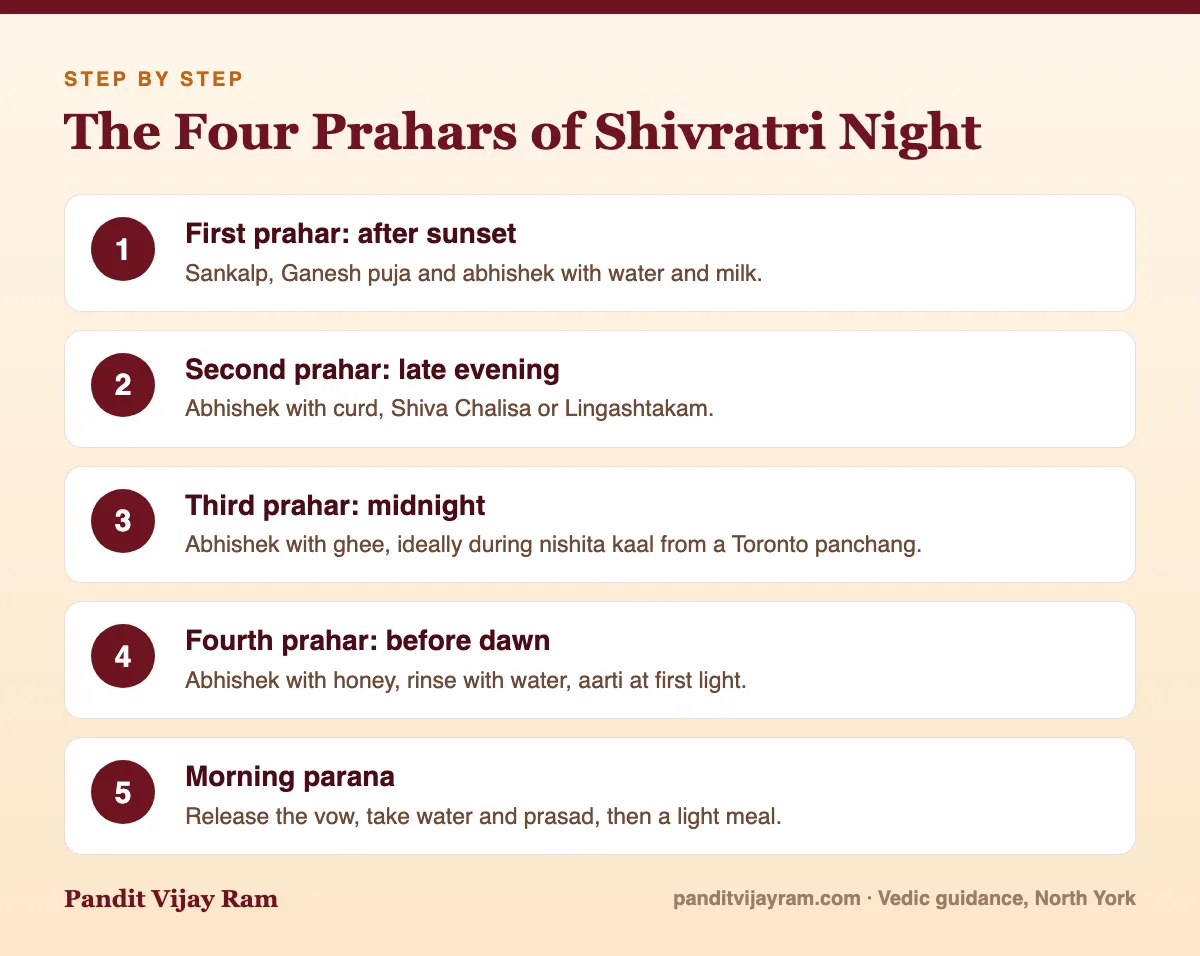
The night from sunset to sunrise is divided into four prahars, or watches, of roughly three hours each. Shiva is worshipped once in each watch with abhishek, bilva leaves and mantra. A common custom offers milk in the first prahar, curd in the second, ghee in the third and honey in the fourth.
Prahar timings change with the length of the night, so take them from a Toronto panchang rather than a list made for India. The panchang will also show nishita kaal, the window around local midnight that is considered the most sacred moment of the night.
- First prahar, after sunset. Sankalp, Ganesh puja, then abhishek with water and milk. Offer bilva, white flowers and a lamp. Chant Om Namah Shivaya.
- Second prahar, late evening. Abhishek with curd, then water. Read or listen to the Shiva Chalisa or the Lingashtakam.
- Third prahar, around midnight. Abhishek with ghee during nishita kaal if you can. This is the watch many families make the centre of the night.
- Fourth prahar, before dawn. Abhishek with honey, then a final rinse with water and aarti at first light.
Families who cannot manage four rounds often do the first prahar together and a single midnight abhishek. That is a perfectly sincere observance. For what each liquid means and how the Rudra hymn fits in, see our explainer on Rudrabhishek and Sri Rudram.
What can you eat during the Maha Shivratri fast?
Shivratri vrat rules vary from a waterless fast to a phalahar fast of fruit, milk, yoghurt, nuts and fasting flours such as kuttu and singhara, cooked with rock salt. Grains, lentils, onion, garlic and ordinary salt are usually avoided. Most households choose phalahar, and water is allowed in all but the strictest form.
Choose the level that suits your body and your next day.
- Nirjala: no food or water until the fast is broken. Traditional for some, but not suitable for most working adults in a heated Canadian home, and never for those with health conditions.
- Phalahar: fruit, milk, makhana, nuts, sabudana khichdi, kuttu or singhara rotis, potatoes and sweet potatoes, made with sendha namak.
- One meal: a single sattvic phalahar meal after the first prahar.
Please eat normally, or speak to your family doctor first, if you:
- have diabetes, especially on insulin or tablets that can cause low blood sugar;
- are pregnant, breastfeeding or trying to conceive with medical treatment;
- take regular medication with food, or have heart, kidney or blood-pressure conditions;
- have a history of disordered eating, or are a child, a teenager or a frail elder.
Sabudana and fried kuttu puris are heavy. Balance them with fruit and yoghurt, and drink water through the day. Fasting is one offering among many; charity, extra japa or giving up a habit are equally valid. Our guide to fasting as a spiritual discipline explains why intention outweighs severity.
How do you keep Shivratri jagran at home safely?
Jagran means keeping awake through the night in remembrance of Shiva. At home, families take turns chanting, singing bhajans, reading stories and doing the prahar pujas. Keep one lamp attended, never sleep with an open flame burning, avoid driving after the vigil, and let children and elders rest when they need to.
A full vigil is lovely and also tiring. A few plans keep it devotional rather than draining.
- Share the night. Divide it among family members so someone is always at the altar. Many households keep an unbroken chant of Om Namah Shivaya in shifts.
- Fill the hours. Bhajans, the Shiva Mahimna Stotram, the Shiva Tandava Stotram, Purana stories for children, or quiet meditation.
- Watch the flame. Use one ghee diya on a metal plate, away from curtains and books. Do not disable smoke alarms, and blow out the lamp if everyone needs to rest. Our lamp and condo fire-safety guide applies to this night too.
- Plan the morning. If you must drive or work, rest for a few hours before dawn. A vigil kept through midnight and the third prahar is still a jagran.
- Be gentle with children. Let them join the first prahar and the stories, then sleep.
Temples across the GTA hold all-night programmes, and some families split the night between home and temple. Check the temple's notices for parking and timing, and dress for the cold walk at three in the morning.
When and how should you break the Shivratri fast?
The fast is traditionally broken the next morning, after sunrise and after a final worship of Shiva, ideally before the chaturdashi tithi ends. The parana time is listed in a Toronto panchang. Begin with water, a little prasad and a light meal, rather than a heavy fried breakfast after a long fast.
Parana is the formal closing of a vrat, and it has its own small ritual.
- Bathe, offer water and a few bilva leaves to the lingam, and do a short aarti.
- Thank Shiva for the night and release the sankalp you took the evening before.
- Take a sip of water or panchamrit, then a little prasad.
- Eat a light meal, such as fruit, yoghurt and khichdi, before returning to normal food.
Many families also give food or a donation on the morning of parana. Feeding someone, or giving to a GTA food bank, carries the spirit of the night into the day.
Leftover bilva leaves and flowers can be composted or returned to a temple. If a fast felt hard on your body, note that for next year and adjust, rather than repeating the same strain.
Families who live far from a temple, or whose work makes the night impossible, sometimes ask a priest to perform the four prahar abhishek on their behalf. Vijay Ram ji does this through his puja and anushthan service, with the family joining by video for the prahar they can manage.
The bottom line
Maha Shivratri is a night of fasting, abhishek and wakefulness for Shiva, arranged in four prahars from sunset to sunrise. A phalahar fast suits most people, while anyone with diabetes, pregnancy or regular medication should eat normally or ask their doctor first. Keep the jagran shared and the lamp attended, and break the fast gently after sunrise at the time your Toronto panchang gives.
Key takeaways
- Maha Shivratri falls on the fourteenth night of the waning moon in late winter.
- Four prahar pujas divide the night, with nishita kaal at its centre.
- Phalahar is the common fast; health conditions call for eating normally.
- Jagran can be shared, and safety matters more than staying awake to dawn.
- The fast is broken after sunrise at the panchang's parana time.