
Mahamrityunjaya Jaap: When It Is Done and How Long It Takes

A request for Mahamrityunjaya jaap usually comes on a difficult day. A parent has been admitted to hospital, a scan has come back unclear, or a surgery date has been set. Families in North York, Don Mills and Brampton call me wanting to do something, anything, alongside what the doctors are doing. That instinct to pray is deeply human and deserves respect rather than judgement, and the Tryambakam mantra has carried it for thousands of years. In more than forty years of Vedic practice, I have organised many of these anushthans, and I have learned to explain plainly what they are and what they are not. This article sets out the mantra and its meaning, how an anushthan is structured from sankalp to concluding havan, what the common counts mean, how long each realistically takes, how family members can take part, and why the doctor's plan always stays at the centre.
What is the Mahamrityunjaya mantra and what does it mean?
The Mahamrityunjaya mantra is a verse from the seventh book of the Rigveda, traditionally linked with the sage Vasishtha and also found in the Yajurveda. It addresses Tryambaka, the three-eyed one, identified with Shiva. It asks to be released from the bondage of death as easily as a ripe cucumber falls from its vine.
The mantra reads: Om tryambakam yajamahe sugandhim pushtivardhanam, urvarukamiva bandhanan mrityor mukshiya mamritat.
- Tryambakam yajamahe: we worship the three-eyed one.
- Sugandhim pushtivardhanam: who is fragrant and who nourishes all beings.
- Urvarukamiva bandhanat: like a ripe cucumber from its stem.
- Mrityor mukshiya: may I be freed from death.
- Ma amritat: but not from immortality.
The image is gentle. A ripe fruit separates from the vine without force or tearing. Commentators read the prayer in two ways: as a plea for life and recovery, and as a prayer for release from fear of death, so that whenever the end comes, it comes peacefully and with awareness.
The name Mahamrityunjaya means great victory over death. Puranic stories connect it with Markandeya, the young devotee who clung to a lingam and was protected by Shiva when Yama came for him.
Many families already chant it at home, often 11 or 108 times a day. Our guide to protective mantras for the home covers how it sits beside the Gayatri and other daily prayers.

When is Mahamrityunjaya jaap done?
Families arrange Mahamrityunjaya jaap during serious illness, before and after surgery, for an elder in decline, during a chart period traditionally read as testing for health, after accidents or frightening events, and on birthdays as a prayer for long life. It is also done when someone is dying, to ask for a peaceful passing.
The situations I hear about most fall into a few groups:
- Hospital and surgery. A sankalp is taken in the patient's name, often starting before the operation and continuing through recovery.
- Long illness. Families with a relative in treatment sometimes keep a smaller daily jaap at home for months, with a larger anushthan at key moments.
- Chart periods. Astrologers sometimes suggest it during a dasha of a planet ruling a challenging house, or during Saturn's heavier transits. Our health and wellbeing service page explains how such readings are used for support, not diagnosis.
- Accidents and shocks. After a car accident or a near miss, as gratitude and steadying.
- Ayushya prayers. On birthdays, especially milestone ones for elders.
- At the end of life. For a gentle passing, free of fear, when recovery is no longer expected.
Mondays, Pradosh, the month of Shravan and Maha Shivratri are traditional times to begin, but for an urgent illness most priests start on the nearest suitable day rather than waiting. The Mahamrityunjaya mantra is also often chanted during a Rudrabhishek, and the two are sometimes combined.
How is a Mahamrityunjaya anushthan structured?
An anushthan begins with Ganesh puja, a sankalp naming the person and the count, and worship of Shiva and the kalash. Priests then chant the mantra daily on rudraksha malas until the count is complete. Traditionally a concluding havan offers one tenth of the count, followed by smaller tarpan, marjan and feeding.
The classical rule, often called dashansh, scales each concluding rite at one tenth of the one before it.
- Sankalp. The patient's name, gotra, location, the intention and the full count are stated on the first day.
- Daily jaap. Each chanter sits at a fixed time and place, facing east or north, with a rudraksha mala, and records the malas completed.
- Havan. When the jaap is complete, one tenth of the count is offered into fire with ghee and samagri.
- Tarpan. Water offerings equal to one tenth of the havan count.
- Marjan. Sprinkling of consecrated water, one tenth of the tarpan count.
- Brahmin bhojan and daan. Feeding and giving, symbolically one tenth again, often replaced today by food-bank donations or feeding those in need.
Some priests chant the plain mantra; others add a samput of seed syllables before and after each repetition. Both follow recognised lineages, so ask which form your priest uses.
The patient does not need to chant or even know about it, and in hospital they rarely can. A household member often sits in for the sankalp and the closing aarti. Vijay Ram ji organises such anushthans through his puja and anushthan service.
How long does a 1,25,000 Mahamrityunjaya jaap take?
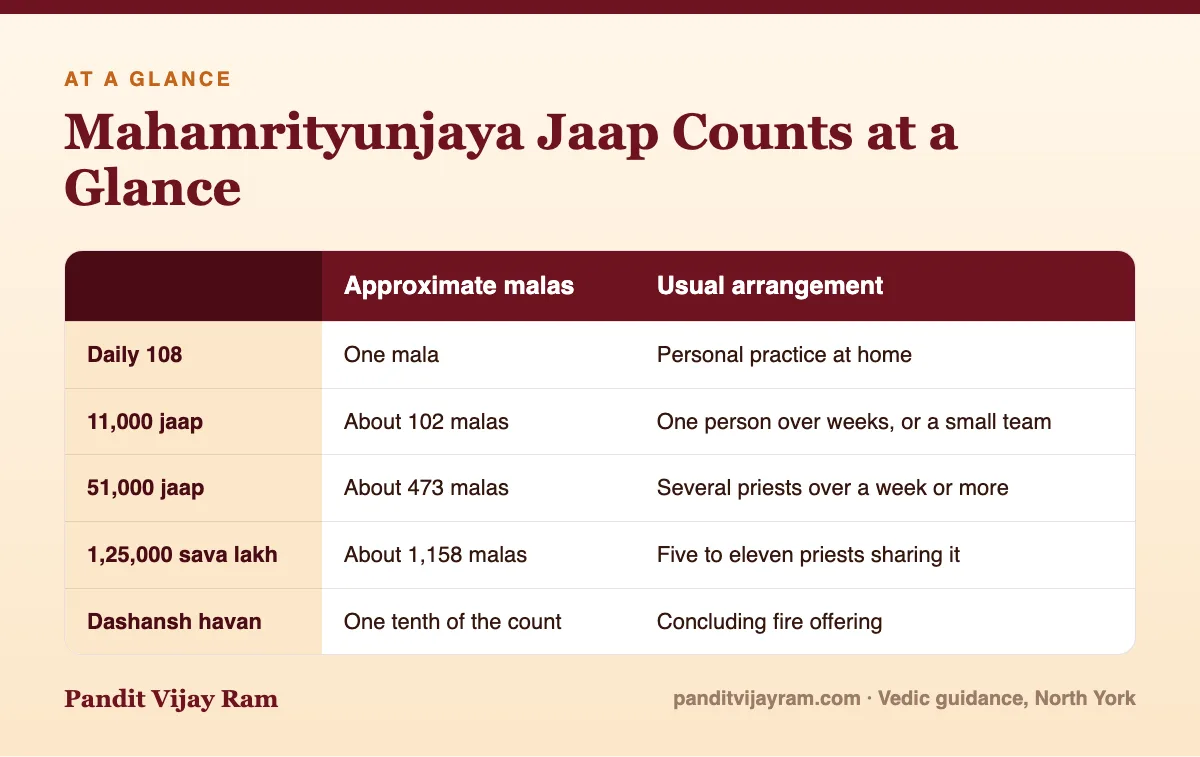
Sava lakh, or 1,25,000 repetitions, is about 1,158 malas of 108. One mala of this longer mantra takes several minutes, so the time depends on how many chanters share it. A single person might need several months; a team of five priests chanting about twenty malas each per day finishes in roughly twelve days.
The arithmetic is simple once you know the size of a mala, and it helps families judge whether a timeline is realistic.
- 11,000 jaap: about 102 malas. One devoted person can complete it in two to three weeks; a small team in a day or two.
- 21,000 jaap: about 195 malas.
- 51,000 jaap: about 473 malas, usually shared among several priests over a week or more.
- 1,25,000 jaap: about 1,158 malas, typically shared among five to eleven priests.
Clear pronunciation matters more than speed. A chanter racing through the mantra to finish early is not serving the sankalp. When someone offers a full sava lakh jaap done by one person in an evening, the numbers do not add up, and it is fair to ask how.
For families who want to join remotely, the sankalp and the final havan can be watched by video. Our guide to how online puja works explains what to ask. Family members can also add their own count. A daughter chanting one mala each evening in her own home contributes to the same prayer, and many find that the act of chanting steadies them through hospital visits.
Can Mahamrityunjaya jaap replace medical treatment?
No. Mahamrityunjaya jaap is a prayer for strength, recovery and peace, not a medical therapy, and no honest priest can promise that it will heal an illness. It belongs alongside the treatment the doctors recommend. Anyone suggesting you stop medication, skip surgery or delay care because of a jaap is giving dangerous advice.
I say this to every family before an anushthan begins. The doctors, nurses and the treatment plan come first. The jaap stands beside them, holding the family's hope and fear in a form they can offer.
What prayer can genuinely do, in my experience, is give a frightened household something steady to hold. It brings relatives together at a fixed time each day. It turns helpless waiting into an act of care. Some patients, when they learn that people are chanting for them, find comfort in that. None of this is a medical cure, and I never present it as one.
Practical points for families:
- Keep the medical team informed if you want to bring a mala, sacred thread or vibhuti into a hospital room, and follow infection-control rules.
- Never put herbal or ritual substances into a patient's mouth or feeding tube without the doctor's approval.
- Look after the caregivers. Sleep, food and support matter for the people keeping vigil.
- Seek help for distress. If a family member is struggling to cope, speak to your family doctor, the hospital's spiritual-care team or call or text 988.
For a wider discussion of illness and spiritual explanations, see our article can a curse make you sick, which sets out why medical care is always the first step.
The bottom line
Mahamrityunjaya jaap is the chanting of the Rigvedic Tryambakam mantra in a formal anushthan, with a sankalp, a set count and a concluding havan at one tenth of that count. Counts from 11,000 to sava lakh take days or weeks depending on how many chanters share them, and the timeline should add up. Above all, Mahamrityunjaya jaap is prayer offered alongside medical care, never a replacement for it.
Key takeaways
- The mantra comes from the Rigveda and asks for release like a ripe fruit from its vine.
- An anushthan has a sankalp, a fixed count and a dashansh havan at the end.
- Sava lakh is about 1,158 malas and is usually shared among several priests.
- A timeline that seems impossibly fast deserves a polite question.
- Prayer stands beside the doctor's treatment plan, never in its place.