
Retrograde Planets in a Birth Chart: What Vakri Grahas Mean

You open a kundli printout and see a small R or the word 'vakri' beside Saturn, perhaps Jupiter too. A search online returns a wall of warnings about karmic debt and past lives. It is easy to feel that something in your chart is running backwards. This article looks at retrograde planets in kundli charts calmly, for readers in North York and wherever else they live. It is about planets that were retrograde when you were born, not the retrograde seasons that news sites discuss; for one of those, see our post on Venus retrograde in love. You will learn what retrograde motion actually is, how often each planet is retrograde at birth, how the classical texts treat it, the main schools of interpretation, and what natal Saturn, Jupiter and Mercury retrogrades tend to look like. In more than forty years of practice I have noticed that people with several vakri planets are often deep thinkers who take longer to decide and then decide well. That is worth knowing before you worry.
What is a retrograde planet in a birth chart?
A retrograde planet only appears to move backwards. It happens when Earth and that planet pass each other in their orbits, so the planet seems to reverse against the background stars for a few weeks or months. In a birth chart, a planet marked R or vakri was in that backward-looking phase at your birth.
No planet actually reverses. The effect is like overtaking a slower car on the highway: for a moment it seems to drift backwards against the trees, though both cars move forward. Astronomers call this apparent retrograde motion.
Two facts about it matter for astrology:
- Outer planets (Mars, Jupiter, Saturn) turn retrograde around the time they stand opposite the Sun. They are then at their closest to Earth and at their brightest in the night sky.
- Inner planets (Mercury, Venus) turn retrograde around the time they pass between Earth and the Sun. They too are near their closest approach.
So a retrograde planet is, physically, close and prominent. That is one reason classical astrologers did not see it as weak. The Sun and Moon never turn retrograde. Rahu and Ketu, the lunar nodes, move backwards through the zodiac nearly all the time, so their 'retrograde' label is a normal state rather than a special one. Some software uses the true node, which wobbles direct for short spells, and others the mean node, which is always retrograde.
A retrograde planet still occupies one sign and house in your chart and still rules its houses. What the 'R' changes is how astrologers read its strength and style. For the planets' basic roles first, our tour of the twelve houses and the guide to the lagna are good foundations.

How common are retrograde planets at birth?
Quite common. Saturn is retrograde for roughly a third of each year and Jupiter for close to that, so about one person in three is born with each of them vakri. Mercury retrogrades about three times a year. Venus and Mars retrograde far less often, so natal retrogrades of those two are rarer.
Approximate figures, worked out from how long each planet spends retrograde in its cycle:
- Saturn: retrograde about four and a half months a year, so roughly 35 to 38 per cent of births.
- Jupiter: about four months a year, roughly 30 per cent of births.
- Mercury: about three weeks, three or four times a year, roughly one birth in five or six.
- Mars: about two to two and a half months in a cycle of just over two years, under one birth in ten.
- Venus: about six weeks in a cycle of roughly nineteen months, under one birth in ten.
Put together, most people have at least one retrograde planet besides the nodes, and many have two or three. A trait shared by a third of humanity cannot carry the dramatic meanings often attached to it online.
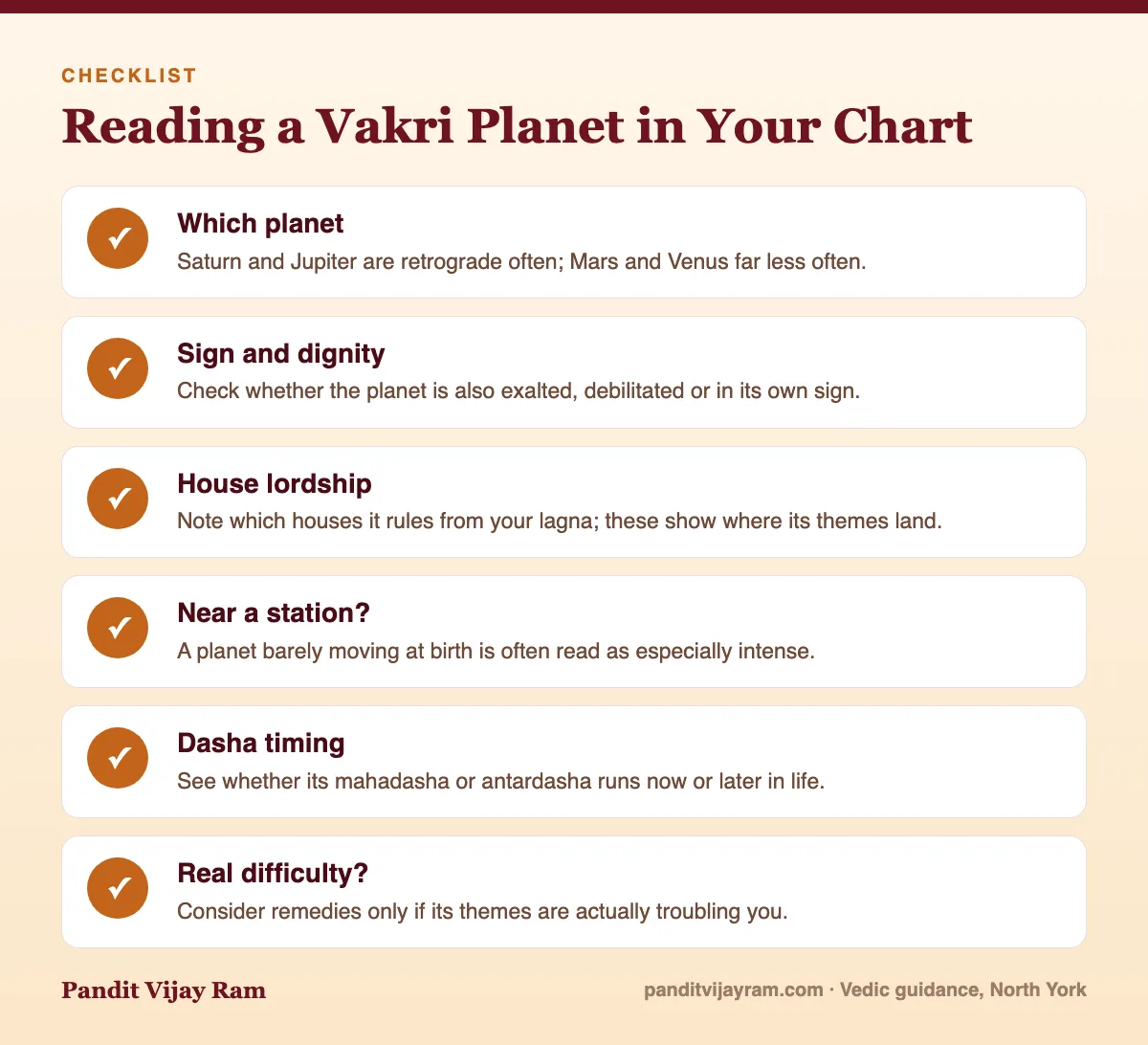
The figures also explain why a retrograde Saturn is the most discussed. It is simply the one people see most often on their printouts. If you would like to check your own chart, the free astrology calculators mark retrograde planets, and many show the speed too. A planet near its station, about to turn, moves very slowly and is often considered especially potent.
Are retrograde planets strong or weak in Vedic astrology?
In the Parashari tradition, retrograde planets are considered strong. Brihat Parashara Hora Shastra gives a retrograde planet the highest cheshta bala, or motional strength, within shadbala. Several later authors compare its strength to exaltation. Interpreters then debate how that strength expresses itself: intensely, inwardly, unpredictably or with delay.
The idea that 'retrograde means bad' comes mostly from popular Western writing about Mercury retrograde, where the focus is the transit. Classical Vedic texts approach the natal case differently.
Strength. Shadbala, the six-fold strength system, includes cheshta bala, strength from motion. A retrograde planet receives the maximum in this category. It is one score among six, so it does not override dignity or house placement, but it does mean the classical system saw retrogression as empowering.
Exaltation and debilitation. Some commentators say a retrograde planet behaves as if exalted, and a debilitated one gains strength when retrograde. Others say an exalted planet that is retrograde loses part of its exaltation. These rules contradict each other at the edges, so readings vary. Our guide to exalted and debilitated planets covers dignity itself.
Previous sign. One widely taught approach, especially in parts of South India, also reads a retrograde planet as influencing the sign before the one it occupies. Many other practitioners do not use this rule at all.
Results in time. Many astrologers describe vakri results as arriving after reflection, revision or a second attempt. In dasha terms, the planet's period may start with delays and then deliver strongly. Our explainer on the Vimshottari dasha covers timing in general.
What does retrograde Saturn or Jupiter mean in a birth chart?
Natal retrograde Saturn is often read as responsibility felt early and personally, with a strong inner sense of duty and slow, earned results. Natal retrograde Jupiter is often read as an independent, questioning relationship with teachers, faith and tradition. Mercury retrograde at birth tends to describe a reflective, revising thinker. House and sign shape every one of these.
These are common interpretive themes, not fixed outcomes.
- Saturn vakri: people often describe carrying responsibility young, being hard on themselves, or reworking rules they were given. The strength tends to show later in life, through patience and persistence. Some astrologers link it to unfinished duties from the past; treat that as a reflective idea rather than a diagnosis.
- Jupiter vakri: faith worked out personally rather than inherited, a tendency to question gurus, and wisdom gained by revisiting ideas. Teaching ability can be strong but unconventional.
- Mercury vakri: thinking before speaking, rewriting, a good memory for detail once learned, and sometimes slower early schooling that catches up.
- Mars vakri: energy that turns inward; sustained effort rather than quick bursts; anger that is slow to show and slow to fade.
- Venus vakri: a reflective, sometimes private approach to love and pleasure, covered more fully in our Venus retrograde article.
Notice the pattern: the planet's themes are processed internally before they are expressed. That is the most useful single idea for reading a vakri graha.
A planet's house lordship matters more than its direction. Retrograde Saturn ruling the 10th for a Taurus ascendant behaves very differently from retrograde Saturn ruling the 7th and 8th for a Cancer ascendant.
Do retrograde planets need remedies?
Usually not. A retrograde planet is not an affliction by itself, and many astrologers consider it strong. Remedies are worth discussing only when the planet is also weak by sign or house, afflicted, and its dasha is active. Prayer, charity and practising the planet's virtues are gentle options; fear-based rituals for 'reversed' planets are not needed.
A good decision rule before considering any remedy for a vakri planet:
- Is it also debilitated, combust or in the 6th, 8th or 12th?
- Does it rule houses that matter for your current concern?
- Is its mahadasha or antardasha running now or soon?
- Are you actually experiencing difficulty in its themes, beyond what ordinary life explains?
If most answers are no, the R on your printout is simply information. If several are yes, traditional supports include the planet's mantra on its weekday, charity linked to it, and steady habits that reflect its virtues. For Saturn, that might be service to elders and regular routines; for Mercury, careful study and honest speech.
Be cautious with anyone who says a retrograde planet means a curse, a past-life debt that must be paid in money, or danger. Retrogression is ordinary astronomy, shared by a third of humanity for Saturn alone. If a reading frightened you, a calm second opinion is reasonable.
For a personal look at how your vakri planets combine with dignity, house and timing, a kundli and horoscope reading goes through each one.
The bottom line
Retrograde planets in kundli charts are vakri grahas that appeared to move backwards at birth because Earth was passing them. Parashari astrology gives them strong motional strength, and many astrologers read their results as inward, revised or delayed rather than weak. Saturn and Jupiter are retrograde in about a third of charts each, so a vakri planet is common information, not a defect to fear.
Key takeaways
- Retrograde motion is apparent, caused by Earth overtaking or being overtaken by a planet.
- Saturn and Jupiter are each retrograde in roughly a third of birth charts.
- Classical shadbala gives retrograde planets maximum cheshta bala, or motional strength.
- Vakri planets are often read as processing their themes inwardly before expressing them.
- House lordship, dignity and dasha matter more than the R beside a planet.