
Combust Planets: When a Planet Sits Too Close to the Sun
Your chart report lists Venus as combust, and a quick search tells you this ruins marriage, or that combust Mercury means poor intelligence. Both claims are exaggerated, and both have frightened people I have met. This article explains what a combust planet is, how astrologers decide when combustion applies, and what it does and does not mean, for readers in North York and anywhere else. You will see the traditional combustion degrees for each planet, why Mercury and Venus are so often near the Sun, how different schools soften or tighten the rules, the effects classical writers describe, how combustion matters in choosing wedding dates, and which remedies are sensible. There are no dates here; for current combustion periods, check a current ephemeris or a Toronto panchang. In more than forty years of practice I have seen many people with a combust Mercury do brilliant intellectual work. Combustion describes a style of expression, and that difference matters.
What does combust mean in astrology?
In astrology, a planet is combust when it lies within a set distance of the Sun, measured along the zodiac. In the sky, such a planet is lost in the Sun's glare and cannot be seen. The Sanskrit term is asta, meaning 'set', and the state is also called moudhya. Classical texts treat it as reduced strength.
The idea comes from observation. Ancient sky-watchers saw each planet disappear for a while as it drew near the Sun, then reappear on the other side. Astronomers call the moment of reappearance a heliacal rising. The period of invisibility is what Jyotisha calls combustion.
The interpretation follows the image. The Sun stands for the self, authority and vitality. A planet swallowed by its light is said to lose some of its independent voice. Its significations may be absorbed into the person's ego or identity, or simply be harder to express openly.
Several points are worth keeping in mind:
- Distance, not sign. Combustion depends on degrees, so the Sun at 28° Aries and Mercury at 2° Taurus can be combust across a sign boundary.
- The Moon. When the Moon is near the Sun it is the new moon. Many astrologers treat this under the Moon's brightness, or paksha bala, rather than as combustion.
- The nodes. Rahu and Ketu are not physical bodies and are not treated as combust, though a Sun-Rahu conjunction is read in its own way.
Combustion is one of several factors used to judge a planet's condition, alongside dignity and retrogression. Our guides to exalted and debilitated planets and to retrograde planets cover the other two.

How many degrees from the Sun is a planet combust?
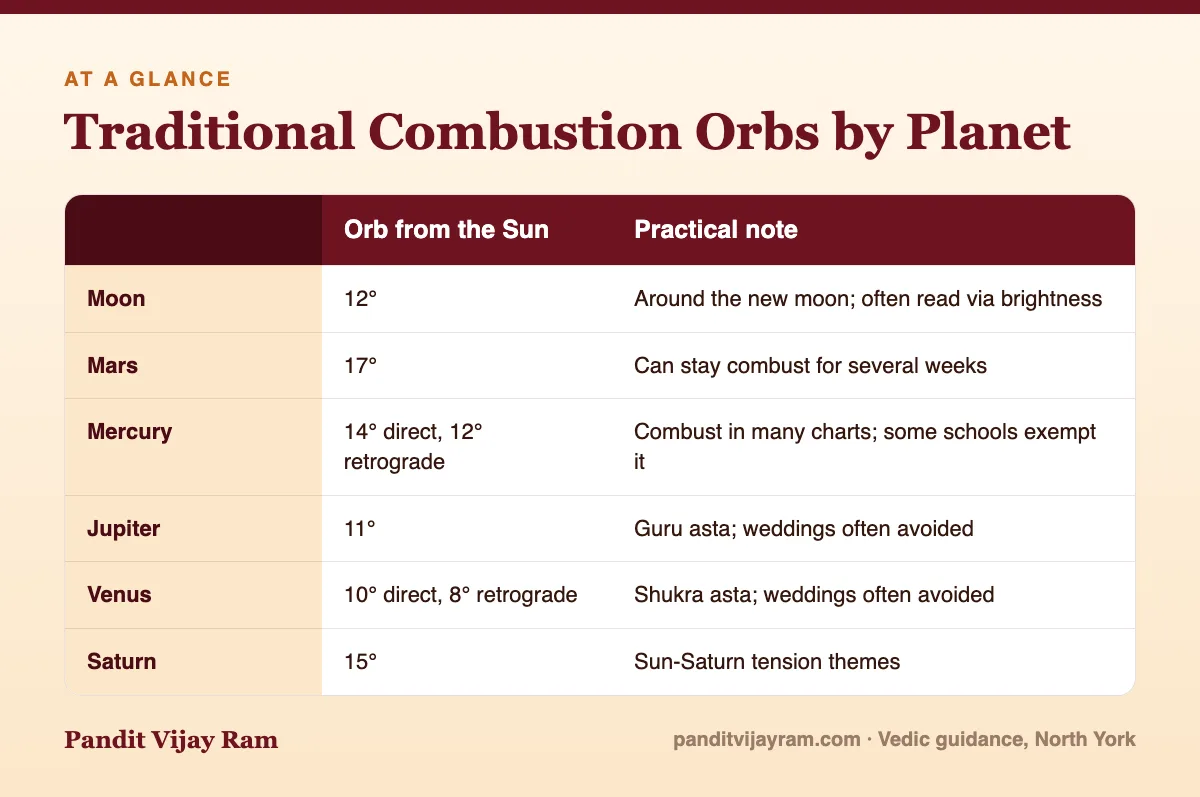
The orbs most often quoted are: Moon 12°, Mars 17°, Mercury 14° (12° when retrograde), Jupiter 11°, Venus 10° (8° when retrograde) and Saturn 15°. These figures trace back to classical astronomical texts. Many modern astrologers use tighter limits, and some treat combustion as a sliding scale that is strongest within a few degrees.
Here are the commonly cited combustion degrees, with what they mean in practice.
- Moon, 12°: roughly the day before and after the new moon.
- Mars, 17°: Mars spends long stretches near the Sun because it moves at a similar apparent speed, so its combustion can last for weeks.
- Mercury, 14° direct, 12° retrograde: Mercury never strays more than about 28° from the Sun, so it is within this orb in a large share of charts.
- Jupiter, 11°: Jupiter is combust for several weeks each year as the Sun passes it.
- Venus, 10° direct, 8° retrograde: Venus can stray up to about 47° from the Sun, so combustion is less frequent than for Mercury.
- Saturn, 15°: also a few weeks each year.
Where schools differ. These numbers are not universal. Some astrologers use a flat eight or ten degrees for every planet. Others say combustion only bites within about three to five degrees, with milder effects further out. A few traditions exempt Mercury almost entirely, because it is so often near the Sun and because the Sun-Mercury conjunction forms the well-known Budha-Aditya yoga. When two reports disagree on whether a planet is combust, the orb they use is usually the reason.
The free astrology checkers can show the exact distance between the Sun and each planet in your chart.
What are the effects of a combust planet?
A combust planet is traditionally said to give weaker or less visible results for its significations and the houses it rules. Its themes may be overshadowed by the person's pride or identity, or show through authority figures. Effects depend on the distance from the Sun, the planet's dignity, its houses and the running dasha, so readings vary widely.
Typical themes astrologers associate with each combust planet, offered as tendencies:
- Mercury: thinking closely tied to identity; strong opinions, or difficulty separating ideas from ego. Many writers, scientists and lawyers have a close Sun-Mercury, so this is rarely a sign of weak intellect.
- Venus: affection or pleasure expressed in a reserved or dutiful way; sometimes self-image bound up with appearance or relationships. Not a verdict on marriage.
- Mars: drive merged with ego; courage that needs a purpose; possible friction with authority.
- Jupiter: faith or advice shaped strongly by personal conviction; teachers and fathers may overlap.
- Saturn: discipline under pressure from authority; the classical Sun-Saturn tension, often seen as father-child or boss-employee strain.
A combust planet that is also strong by sign, such as Mars in Aries close to an exalted Sun, is read very differently from one that is debilitated and combust. Combustion also affects bigger combinations. A combust lord weakens a raj yoga, and a combust Jupiter softens Gajakesari yoga.
Combustion is also not a health diagnosis. If a reading links a combust planet to illness, any health concern belongs with your family doctor, not with a chart.
Why do weddings avoid combust Venus or Jupiter?
Many Hindu traditions avoid marriage muhurats while Venus or Jupiter is combust, periods called Shukra asta and Guru asta. Venus signifies marriage and Jupiter blessing and dharma, so their invisibility was considered unsuitable for beginning a marriage. Regional practice varies, and some communities follow the rule strictly while others weigh it with other factors.
This is one of the places where combustion has the most practical effect in community life. Each year, the Sun's passage near Venus and Jupiter creates windows that many priests and panchangs mark as unsuitable for weddings, griha pravesh and similar samskaras.
Points families often ask about:
- Length: Jupiter's combustion window lasts a few weeks a year. Venus can be combust for a few weeks or, around some conjunctions, considerably longer.
- Regional custom: North Indian, South Indian and Gujarati panchangs may differ slightly on start and end points, depending on calculation.
- Diaspora practice: families in Canada often balance the rule against venue bookings and travel. A priest can usually find a suitable muhurat outside the window.
Our article on choosing a wedding muhurat in Canada covers this in more detail, and the post on business opening muhurat explains how timing is chosen for other beginnings.
For dates, rely on a current ephemeris or a Toronto panchang rather than a list online, since those are often calculated for India and may not match local time.
What are the remedies for a combust planet?
Remedies for a combust planet usually aim to strengthen that planet gently rather than weaken the Sun. Common choices are the planet's mantra on its weekday, charity linked to it, and practising its virtues. Gemstones are sometimes suggested but need a careful chart check. Many combust planets need no remedy at all.
Ask first whether a remedy is warranted. A combust planet that is far from the Sun within the orb, strong by sign, and not running its dasha is often fine. A planet within two or three degrees, also weak by sign, ruling important houses and running its period, is where support makes sense.
Gentle traditional options:
- Mantra: the beej mantra of the combust planet, recited calmly on its weekday.
- Charity: giving that reflects the planet, such as green items or education support for Mercury, or white sweets and care for women in need for Venus.
- Balancing the Sun: some practitioners add Surya arghya, water offered to the rising Sun, to keep the relationship harmonious rather than to dim the Sun.
- Behaviour: for combust Mercury, separating ideas from pride; for combust Venus, expressing affection openly.
On gemstones. Opinions are divided. Some astrologers prescribe the stone of a combust planet to strengthen it; others feel it simply feeds the Sun's glare. Never wear a stone on the strength of a combust label alone. Our gemstone and numerology guidance explains trial wearing and how to avoid fraud.
For a full assessment of how combustion interacts with the rest of your chart, a kundli consultation is the right starting point.
The bottom line
A combust planet sits close enough to the Sun to be lost in its glare, and Vedic astrology reads this as reduced or overshadowed expression of its themes. Traditional orbs range from about 10 to 17 degrees, and schools disagree, especially about Mercury, which is combust in many charts. Combustion matters most in timing weddings and in judging bigger yogas, and gentle remedies are needed only when it is close, weak and active.
Key takeaways
- Combustion, or asta, means a planet is hidden by the Sun's glare within a set distance.
- Common orbs: Moon 12°, Mars 17°, Mercury 14°, Jupiter 11°, Venus 10°, Saturn 15°.
- Mercury is combust in a large share of charts, and some schools largely exempt it.
- Many families avoid wedding muhurats while Venus or Jupiter is combust.
- Remedies aim to support the combust planet, and many cases need none.