
Mangal Dosh Remedies Before Marriage: Kumbh Vivah and Alternatives

The word Manglik can land on a family like a stone. A relative reads the chart, mentions Mangal dosh, and suddenly someone suggests a kumbh vivah, a marriage to a clay pot, before any real wedding can take place. Parents worry. The young person feels singled out. I see this situation regularly with families in North York and across the GTA, often after an online report or a hurried reading has raised the alarm. This article explains what kumbh vivah is, how it differs from peepal, Vishnu and Arka vivah, and when a traditional priest would actually recommend one. It also names the fear-selling that surrounds Mangal dosh, and lists simpler remedies that many charts need instead. In more than forty years of reading horoscopes, I have found that most Manglik worries shrink once the whole chart is read properly. A symbolic marriage has its place, but it should be a calm, informed choice, never a reaction to fright.
What is kumbh vivah and why is it done?
Kumbh vivah is a ritual marriage to a kumbh, a clay or copper pot, performed with Vedic mantras before a person's actual wedding. Tradition holds that the harsh influence of Mars falls on this first symbolic spouse. The pot is then immersed or broken, and the person is considered free to marry without the dosha's weight.
The ceremony grows out of a specific belief. Mangal dosh, or Kuja dosh, is said to arise when Mars sits in certain houses of the birth chart, most often the 1st, 4th, 7th, 8th or 12th, and in some southern traditions the 2nd. Older texts warned that this placement could bring friction, separation or harm to a spouse.
The symbolic marriage answers that worry with a ritual transfer. Its usual shape:
- A pot is filled with water and sometimes holds a small image of Vishnu.
- It is dressed with a red thread, flowers and cloth, like a groom or bride.
- The priest recites marriage mantras, and the person circles or honours the pot as in a wedding.
- The pot is then immersed in water or broken, marking the end of that first 'marriage'.
It is a ritual act of faith. It carries no legal meaning, and nobody should be described afterwards as 'married before'.
Some families include it quietly a day or two before the real wedding; others prefer to avoid it altogether. Whether it is needed depends on the full chart, not on a single label. For how Manglik status interacts with a partner who is not Manglik, see our separate guide on Manglik and non-Manglik marriage.
What is the difference between kumbh, peepal, Vishnu and Arka vivah?
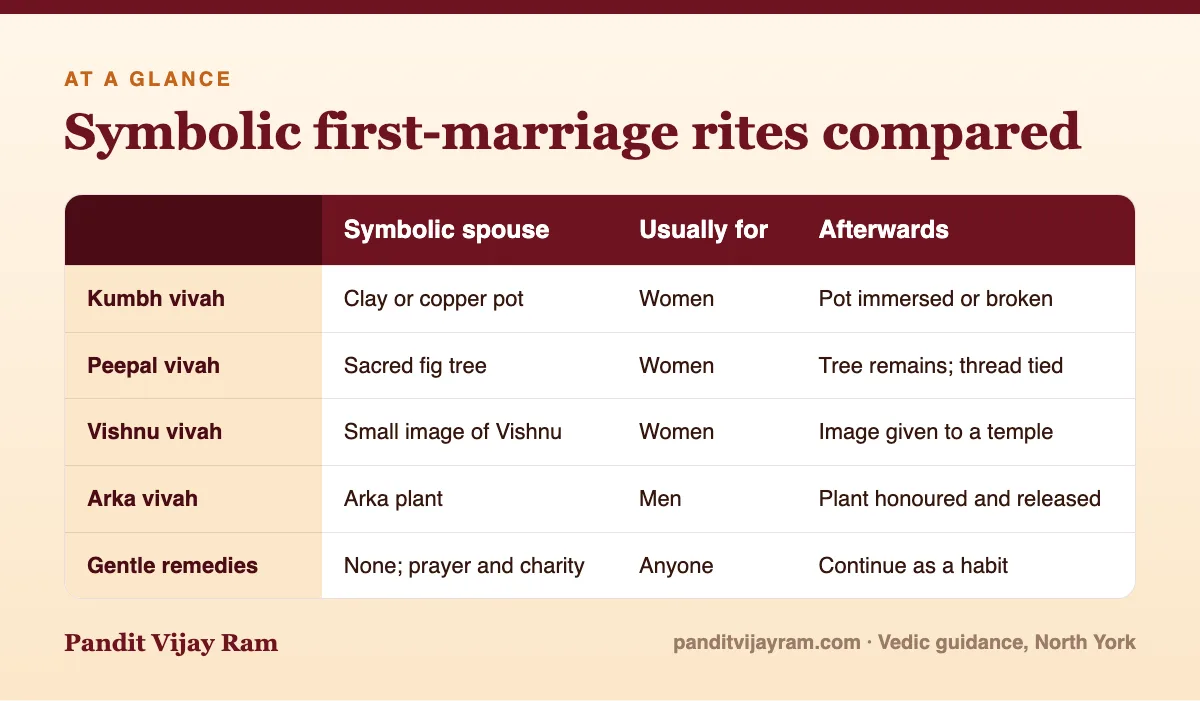
All four are symbolic first marriages meant to absorb Mangal dosh. Kumbh vivah uses a pot, peepal or Ashwattha vivah uses the sacred fig tree, and Vishnu vivah uses a small image of Vishnu. Arka vivah, to the Arka plant, is traditionally performed for men. Region and family custom usually decide which is chosen.
Here is a simple comparison families find helpful.
- Kumbh vivah — symbolic spouse: a clay or copper pot. Most often for women. Common in North and Central Indian families. The pot is immersed or broken afterwards.
- Peepal or Ashwattha vivah — symbolic spouse: the peepal tree, sacred to Vishnu. Mostly for women. The person ties thread around the trunk during the rite. The tree remains, which some families find gentler than breaking a pot.
- Vishnu vivah — symbolic spouse: a small image of Vishnu, sometimes in gold or silver, later given to a temple or a priest. Seen as the most devotional form.
- Arka vivah — symbolic spouse: the Arka plant, linked with the Sun. Traditionally for men with Mangal dosh or with a chart showing difficulty in marriage.
In Canada, finding a peepal tree outdoors is not practical, so priests usually choose a pot, an image or a potted plant. That is entirely acceptable; the intention and the mantras carry the rite.
Consent matters. These are rituals for adults who agree to them. A young person who feels uncomfortable should be heard, not pushed, and a gentler remedy chosen instead. Vijay Ram ji arranges any of these rites through the puja and anushthan service when a chart truly calls for one.
Does every Manglik person need a kumbh vivah?
No. Classical rules cancel or soften Mangal dosh in many charts, for example when Mars sits in its own or exalted sign, when both partners carry it, or when benefic planets aspect it. A careful reading often finds the dosha mild or cancelled. A symbolic marriage is usually kept for strong, uncancelled placements where families want extra reassurance.
Many people are told they are Manglik on the strength of one rule. A fuller reading checks much more:
- Is Mars counted from the ascendant only, or also from the Moon and Venus? Results differ.
- Is Mars in Aries, Scorpio or Capricorn, where many texts consider it settled?
- Does Jupiter aspect or join Mars?
- Does the partner's chart carry a similar placement, which traditionally balances it?
- How strong is the 7th house and its lord overall?
A practical decision rule:
- Dosha cancelled or mild: no symbolic marriage needed. Light devotional practice is enough.
- Moderate, partner also Manglik: usually matched as is, with prayer before the wedding.
- Strong, uncancelled, family concerned: a kumbh or Vishnu vivah may be offered as reassurance, alongside other remedies.
The detailed cancellation rules, and the common myth that the dosha simply ends at a certain age, are covered in our article on mixed Manglik marriages. A full kundli reading is the right place to settle the question for your own chart.
How do you spot fear-selling around Mangal dosh?
Be cautious if someone says a spouse will die, insists on an expensive rite immediately, refuses to explain the chart, or adds more remedies each visit. Honest astrologers show you the placement, mention cancellations, offer a range of options and never use threats. Mangal dosh is a tendency to discuss, not a sentence.
Mars has always been a frightening planet in popular belief, which makes it easy to sell against. Patterns to watch for:
- Death predictions. Statements that a husband or wife 'will not survive' the marriage. No responsible astrologer speaks this way.
- Urgency. 'This must be done within the week.' A ritual done in calm is better than one done in panic.
- No explanation. If you are not shown which house Mars occupies and why it matters, ask.
- Stacking. A kumbh vivah, then a gemstone, then a havan, then another, each with a new fee.
- Blame. Telling a young woman she is the cause of family misfortune. That is cruel and has no place in sincere guidance.
Simple arithmetic helps here. The traditional rule covers five or six of the twelve houses, so close to half of all charts qualify from the ascendant alone, and far more once the Moon and Venus are also used as reference points. If the placement were as dangerous as some claim, very few marriages would last.
If you feel pressured, pause and get a second reading. Our article on low guna milan scores shows the same calm, step-by-step approach to another number families tend to fear.
What are simpler Mangal dosh remedies before marriage?
Common gentle remedies include reciting the Hanuman Chalisa on Tuesdays, chanting the Mangal beej mantra, offering red lentils or jaggery in charity, and praying to Kartikeya or Mangal Chandika. They ask for Mars's energy to become courage rather than conflict. A red coral should only be worn after a full chart reading.
Mars is not an enemy. It stands for courage, energy and protection; the remedies aim to channel that strength well.
- Hanuman worship. Recite the Hanuman Chalisa on Tuesdays, or Sundarkand monthly. Hanuman is traditionally worshipped to steady Mars.
- Mangal beej mantra. Om Kram Kreem Kraum Sah Bhaumaya Namah, one mala on Tuesdays.
- Charity on Tuesdays. Red lentils, jaggery, a red cloth or a meal for someone in need.
- Mangal Chandika stotra. Recited by many women before marriage for a peaceful home.
- Kartikeya or Murugan prayer. Favoured in South Indian families as the deity of Mars.
- Practical Mars work. Regular exercise, anger management and fair handling of conflict are remedies too.
Red coral is often sold to Manglik clients by default. It strengthens Mars, which is not always wise. Wear it only if a reader has checked that a stronger Mars helps your chart.
Couples can keep some of these together in the weeks before the wedding, which turns a worry into a shared preparation. Families keeping a longer vow may also like our guide to the Solah Somvar vrat for marriage. Vijay Ram ji's love and marriage guidance brings the chart, remedies and family conversation together.
The bottom line
Kumbh vivah is a symbolic marriage to a pot, one of several first-marriage rites, alongside peepal, Vishnu and Arka vivah, meant to absorb a strong Mangal dosh. Many Manglik charts are cancelled or mild and need no such rite, so a full reading should come before any decision. Fear-selling, with its death predictions and stacked fees, has no place in honest guidance. Gentle remedies such as Hanuman prayer, Tuesday charity and the Mangal mantra suit most families well.
Key takeaways
- Kumbh vivah is a symbolic marriage to a pot before the real wedding.
- Peepal, Vishnu and Arka vivah are related rites; Arka is for men.
- Many Manglik placements are cancelled or mild on a full reading.
- Death predictions and urgent fees are signs of fear-selling.
- Hanuman prayer, Tuesday charity and the Mangal mantra are gentle remedies.