
Durga Saptashati Path for Spiritual Protection
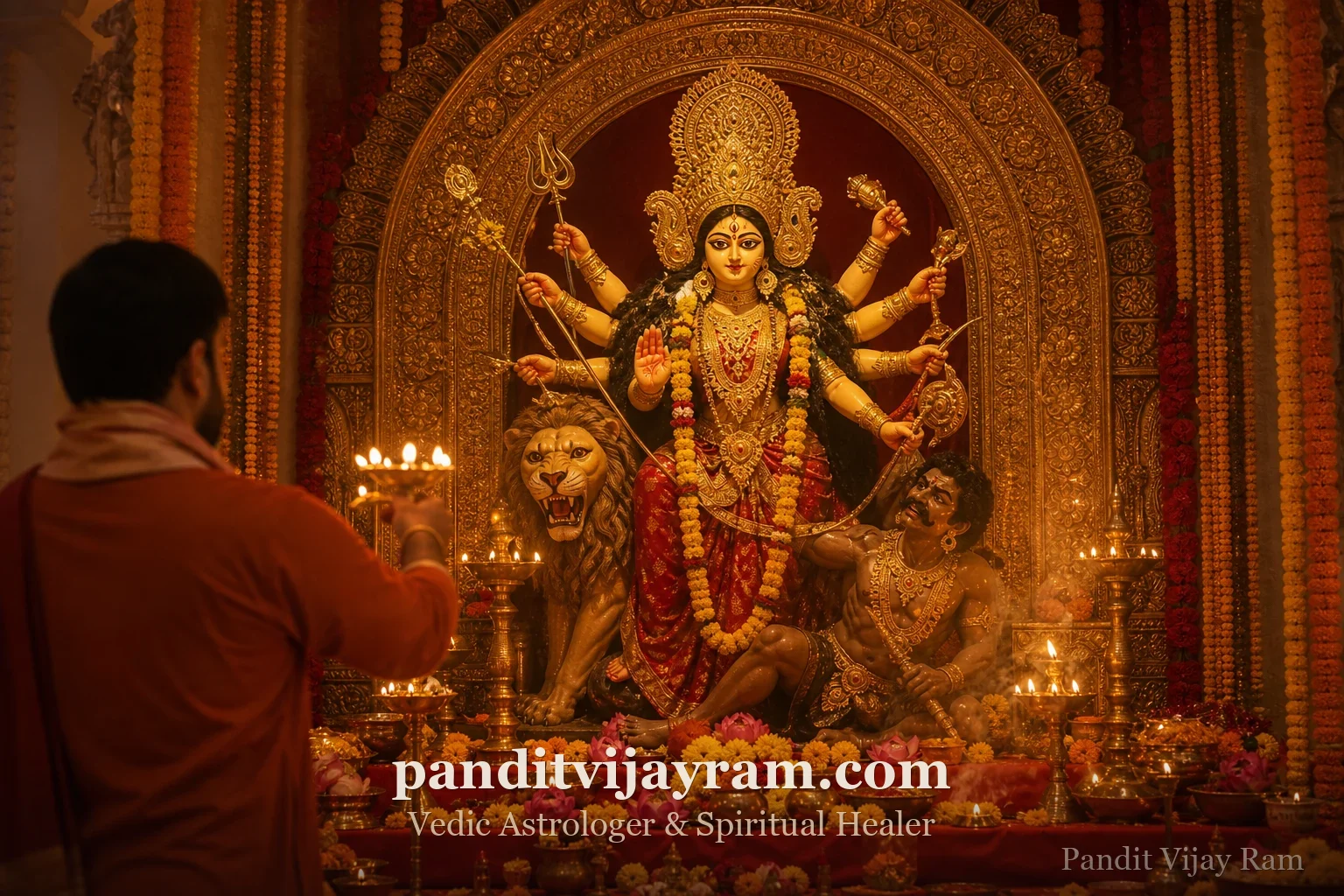
For many Hindu families, the sound of the Chandi path during Navratri is the sound of the Mother's protection. Some read the whole text in one sitting; others share the chapters among family members over several evenings. Yet many people in North York, Vaughan and Mississauga tell me they feel nervous about the Durga Saptashati path, worried that a mistake in pronunciation or order will do harm. That worry is understandable, and it can be eased with a clear picture of how the text is built and how families have always organised it. In this guide you will learn where the Saptashati comes from, how its thirteen chapters and three charitras fit together, which prayers are recited before and after, how to plan a reading at home, and how to approach the Sanskrit honestly if you are not fluent. I have led and guided this recitation for more than forty years, and my steady observation is that the Goddess responds to devotion and care, not to perfection. Medical, legal or family problems still need their own practical help alongside any path.
What is the Durga Saptashati and where does it come from?
The Durga Saptashati, also called the Devi Mahatmya or Chandi Path, is a Sanskrit text forming thirteen chapters of the Markandeya Purana. Saptashati means seven hundred, after its traditional count of about 700 verses. It tells how the Goddess, in different forms, defeats demons who threaten the gods and the order of the world.
The text is framed as a conversation. A king named Suratha, who has lost his kingdom, and a merchant named Samadhi, rejected by his family, meet in a forest and go to the sage Medhas. Both are troubled that they still feel attached to those who hurt them. The sage answers by telling them about the Devi, the great power behind all things, and the stories that follow make up the core of the text.
The thirteen chapters are grouped into three charitras, or episodes:
- Prathama charitra, chapter 1. The Goddess as Yoganidra awakens Vishnu to defeat the demons Madhu and Kaitabha. Mahakali presides.
- Madhyama charitra, chapters 2 to 4. The Goddess, formed from the combined radiance of the gods, defeats Mahishasura, the buffalo demon. Mahalakshmi presides.
- Uttama charitra, chapters 5 to 13. The Goddess defeats Shumbha and Nishumbha and their generals, including Chanda, Munda and Raktabija. Kali emerges from her brow in this section. Mahasaraswati presides.
At the end, the Goddess promises to return whenever the world is troubled, and grants the king and the merchant their wishes. That promise is why the text is read for protection. The guide to Kali puja explores the fierce form who appears in the seventh chapter.
Which prayers are recited before and after the Saptashati?
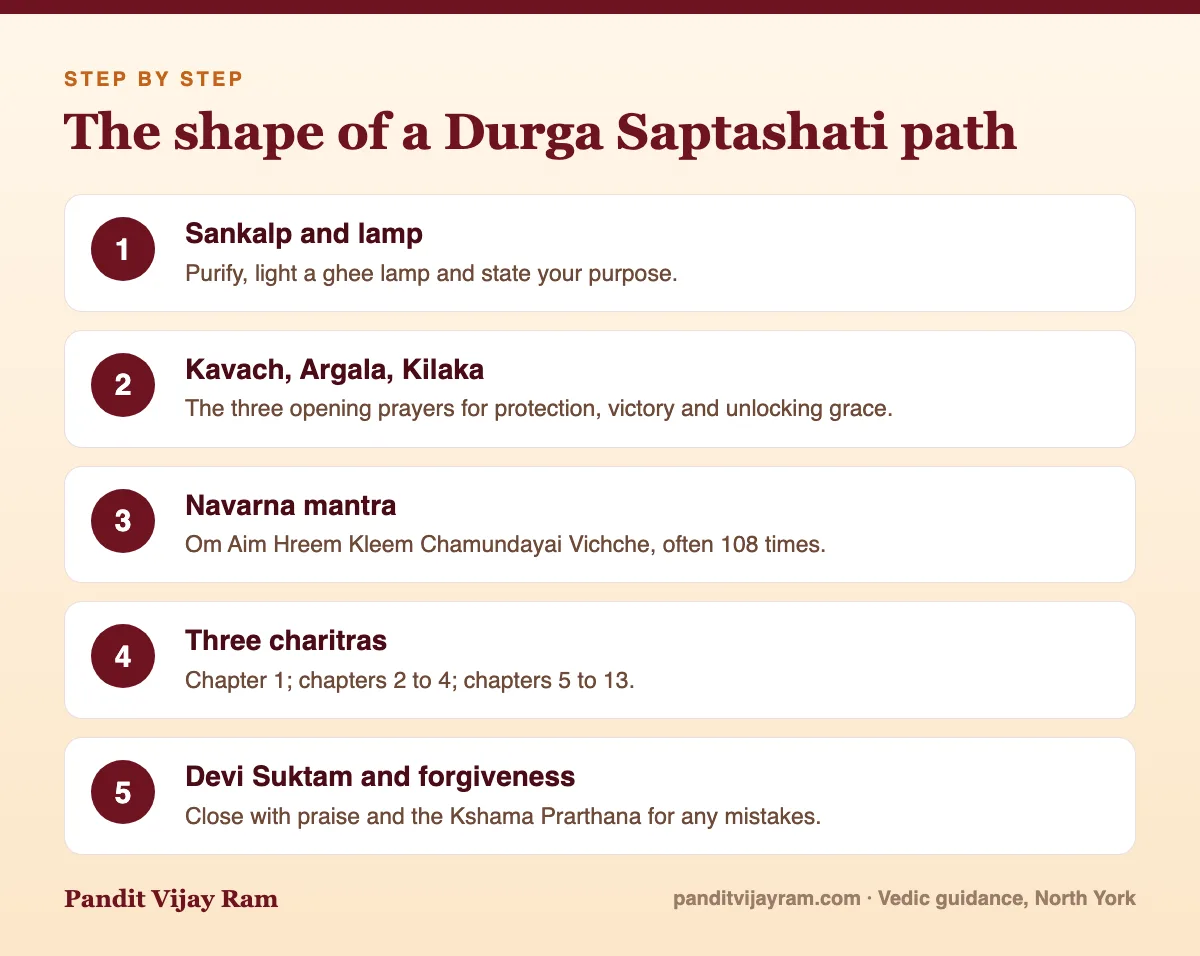
Many traditions recite three opening prayers called the angas: the Devi Kavacham for protection, the Argala Stotram asking for victory, and the Kilaka Stotram, said to unlock the text's benefit. The Navarna mantra is often chanted before and after. The reading usually ends with the Devi Suktam and a prayer asking forgiveness for errors.
A full recitation has a beginning, a middle and an end, rather like a puja. Printed editions vary slightly by region, but a widely followed order is:
- Purification and sankalp. Sipping water (achaman), lighting the lamp and stating the purpose and the reader's name and family line.
- Devi Kavacham. A hymn asking the Goddess's many forms to guard each part of the body. It is the most protective of the three angas.
- Argala Stotram. A hymn whose refrain asks the Goddess for form, victory and glory, and to destroy enemies. Many read these enemies as inner ones such as fear and anger.
- Kilaka Stotram. A short hymn about the key, or kilaka, that opens the text's grace.
- Navarna mantra. Om Aim Hreem Kleem Chamundayai Vichche, chanted 108 times in many traditions.
- The thirteen chapters.
- Closing. The Navarna mantra again, the Devi Suktam, and often the three rahasyas (secret chapters), followed by the Kshama Prarthana asking forgiveness for mistakes.
Some families also read the Ratri Suktam before the chapters. If you are unsure which order your family follows, ask your family priest or an elder. The Devi Kavach is also discussed in the guide to protective mantras and the Bajrang Baan.
How do families organise a Durga Saptashati path during Navratri?
Families either read all thirteen chapters each day, divide the chapters across the nights of Navratri, or invite a pandit to recite while the family listens. A common rule is to complete a whole chapter, or ideally a whole charitra, once begun. The reading is often completed with a havan on Ashtami or Navami.
There is no single correct schedule, and traditions differ. What matters is that the plan is realistic for your household, so the reading is calm rather than rushed.
Approaches I have seen work well:
- Complete path daily. An experienced reader recites everything each morning. This can take well over two hours at a careful pace.
- Divided over seven days. One division many families follow is: chapter 1; chapters 2 and 3; chapter 4; chapters 5 to 8; chapters 9 and 10; chapter 11; chapters 12 and 13. The angas are read at the start each day.
- Shared among family. Different members read different charitras on the same evening, sitting together.
- Guided by a priest. A pandit recites in Sanskrit while the family follows a translation and joins the Navarna mantra and arati.
Practical customs include placing the book on a stand or clean cloth rather than on the floor or lap, keeping a ghee lamp lit during the reading, and not stopping in the middle of a chapter for conversation. Dates for Navratri shift each year with the lunar calendar, so check a local panchang.
If your family wants the path completed with a fire offering, the guide to havan for spiritual cleansing explains the household havan, and the Durga puja and havan service describes a guided ceremony.
What if I cannot pronounce the Sanskrit correctly?
You are not alone, and it does not make the reading worthless. Learn slowly, ideally by listening to an experienced reader. Many teachers say that reading a faithful translation with devotion, or listening attentively while a priest recites, is better than avoiding the text out of fear. The closing forgiveness prayer exists precisely because mistakes happen.
I want to be honest here. The Saptashati is long, and its Sanskrit includes compound words and verse metres that take practice. Some traditions are strict about pronunciation for ritual recitation, especially in a formal anushthan. Others put more weight on devotion and understanding. Both views come from sincere teachers.
Here is a balanced path that respects both:
- Start with what you can manage. The Devi Kavacham, Argala and Kilaka are shorter. Learn them first, then add one chapter at a time.
- Listen before you read. Follow a careful recording by a temple priest or a teacher with the text in front of you.
- Use an edition with meaning. Editions with Hindi or English translation beside the Sanskrit help you understand what you are saying.
- Read the translation if needed. If Sanskrit is not possible yet, reading the meaning with full attention is a respected form of devotion in many homes.
- Ask a pandit for a formal anushthan. When a fixed number of complete readings is vowed for a specific purpose, a trained reader keeps it correct.
The puja and anushthan page explains how a longer, vowed recitation is planned. And always finish with the Kshama Prarthana; asking forgiveness is part of the practice, not a sign of failure.
Can the Durga Saptashati protect against negative energy?
In Hindu belief the Saptashati is among the most powerful texts for seeking the Goddess's protection, and its own closing chapter promises her help to those who recite it. It is a prayer of shelter, not a guaranteed cure. Practical causes of distress, from illness to conflict, still need practical care alongside the path.
The twelfth chapter is often called the phala-shruti, the statement of fruits. In it the Goddess describes the blessings that come to those who hear or recite her story with devotion, including freedom from fear, enemies and calamity. Devotees take great comfort in these verses.
I encourage people to hold that promise with faith and good sense together:
- It is devotion, not a technique. The text asks us to see the Mother in every power around us. The protection it offers grows from that relationship.
- It does not replace care. If someone is unwell, anxious, not sleeping or in a dangerous relationship, they need a doctor, a counsellor or the police as appropriate. In a mental-health crisis in Canada, call or text 9-8-8.
- It is not for harming anyone. Reading the Saptashati to punish another person goes against the text's spirit of compassion for the troubled king and merchant.
- Steadiness matters. A single careful reading each Navratri, or a few chapters weekly, often brings more peace than an anxious marathon.
When a household feels heavy for reasons it cannot explain after ordinary checks, the Saptashati can sit alongside other steps described in the magic and entities hub. Those drawn to Vishnu's protective form may also read the guide to the Narasimha mantra.
The bottom line
The Durga Saptashati path is the recitation of the Devi Mahatmya, thirteen chapters of the Markandeya Purana grouped into three charitras. Families organise it in many valid ways, from a complete daily reading to chapters shared across Navratri, framed by the Kavach, Argala, Kilaka and a closing prayer for forgiveness. Learn the Sanskrit patiently, lean on a priest when needed, and let the path sit alongside practical care for any real-world problem.
Key takeaways
- The Durga Saptashati is the Devi Mahatmya, about 700 verses in 13 chapters of the Markandeya Purana.
- Its three charitras are presided over by Mahakali, Mahalakshmi and Mahasaraswati.
- The Kavach, Argala and Kilaka are commonly recited before the chapters.
- Families may read it whole, divide it over Navratri, or listen to a pandit.
- Pronunciation can be learned gradually; the Kshama Prarthana asks forgiveness for errors.