
Love Bombing: Why Intense Early Romance Can Be a Red Flag

They text from the moment you wake up. Within weeks they call you their soulmate, plan your wedding and say they have never felt this way before. It feels like being chosen at last. Love bombing is the name for this rush when it becomes a way of gaining power over someone, and it can be hard to spot because it looks so much like the romance we were promised in films. Several people in North York have told me they were swept off their feet, then later felt they could not breathe. This guide explains how love bombing works, the signs to look for, why some people do it, how it differs from genuine early infatuation, and what a healthy pace looks like. It also covers love bombing in online dating and marriage introductions. In more than forty years of practice I have found that real love is patient enough to let you know someone. Intensity is not the same thing as depth.
What is love bombing in a relationship?
Love bombing is excessive attention, praise and affection at the start of a relationship that pushes for fast emotional closeness and commitment. It can create a strong sense of obligation and dependence. In manipulative relationships, it is often followed by criticism, control or withdrawal, so the other person works hard to regain the early warmth.
The term was first used to describe recruitment tactics in some high-control groups, where newcomers were showered with affection to bind them quickly. It is now widely used for a similar pattern in romantic relationships.
Psychologists often describe a cycle in manipulative relationships:
- Idealisation. You are treated as perfect. Constant messages, grand gestures, talk of destiny.
- Devaluation. Once you are attached, warmth is replaced by criticism, sulking or jealousy. You begin trying to earn back the early phase.
- Discard or reset. The person pulls away, or returns to love bombing after conflict to restart the cycle.
Not everyone who falls fast is manipulative. Some people are simply enthusiastic or lonely. The difference shows over time, especially in how they react when you slow things down.
This cycle overlaps with the patterns described in our guide to on-and-off relationships, where intense highs and painful lows keep people returning to partners who hurt them.

What are the signs of love bombing?
Signs include declarations of deep love within days or weeks, constant messaging and calls, lavish gifts, pressure to commit or move in quickly, talk of destiny or soulmates, wanting all your time, and discomfort or anger when you set limits. The speed and pressure matter more than any single gesture.
Watch for a combination of these, especially in the first weeks or months:
- Too much, too soon. I love you or you're the one within days; plans for marriage or children before you know each other's families.
- Flooding contact. Messages from morning to night, and hurt or anger if you are slow to reply.
- Over-the-top gifts and favours that leave you feeling you owe them.
- Mirroring. They seem to share every interest and opinion you have, almost too neatly.
- Isolating attention. They want every free evening, and subtly criticise friends who take your time.
- Pushing past boundaries. When you say slow down, they sulk, guilt you or increase the pressure.
- Quick shifts in mood. Adoring one day, cold or critical the next.
A useful test is to set one small boundary, such as I'd like to keep this weekend for my family. A healthy partner says of course. Someone love bombing may react with hurt, anger or more pressure. If control is already appearing, read our guide to controlling partner signs.
Why do people love bomb?
Some people love bomb deliberately to gain control or attention, which is sometimes linked with narcissistic traits. Others do it from insecurity, fear of abandonment or a habit of rushing intimacy. Whatever the reason, the effect is similar: the other person feels obligated and loses the time needed to judge the relationship clearly.
It is tempting to label anyone who love bombs a narcissist. Narcissistic personality disorder is a specific clinical diagnosis made by professionals, and most people who rush romance do not have it. Possible reasons include:
- Seeking control. Fast closeness makes it easier to influence someone's choices later.
- Insecurity. Some people fear that if they slow down, the other person will leave.
- Learned patterns. People raised around dramatic, unstable relationships may see intensity as normal love.
- Financial motives. Romance scammers often use love bombing to build trust before asking for money.
You do not need to know the motive to protect yourself. Focus on behaviour: does this person respect your pace and your limits?
From a Vedic point of view, some astrologers associate a strong Rahu influence on Venus or the seventh house with sudden, intense attractions. Such readings show a tendency to look at with care, never proof about another person's intentions. A relationship compatibility reading can add perspective, but the real test is how someone treats you over time.
How is love bombing different from falling in love quickly?
Genuine early infatuation is mutual, welcomes your boundaries and grows steadily into trust. Love bombing is one-sided pressure that resists your boundaries and often turns to control or coldness. Both can feel intense at first. The difference appears when you slow down, disagree or spend time with others.
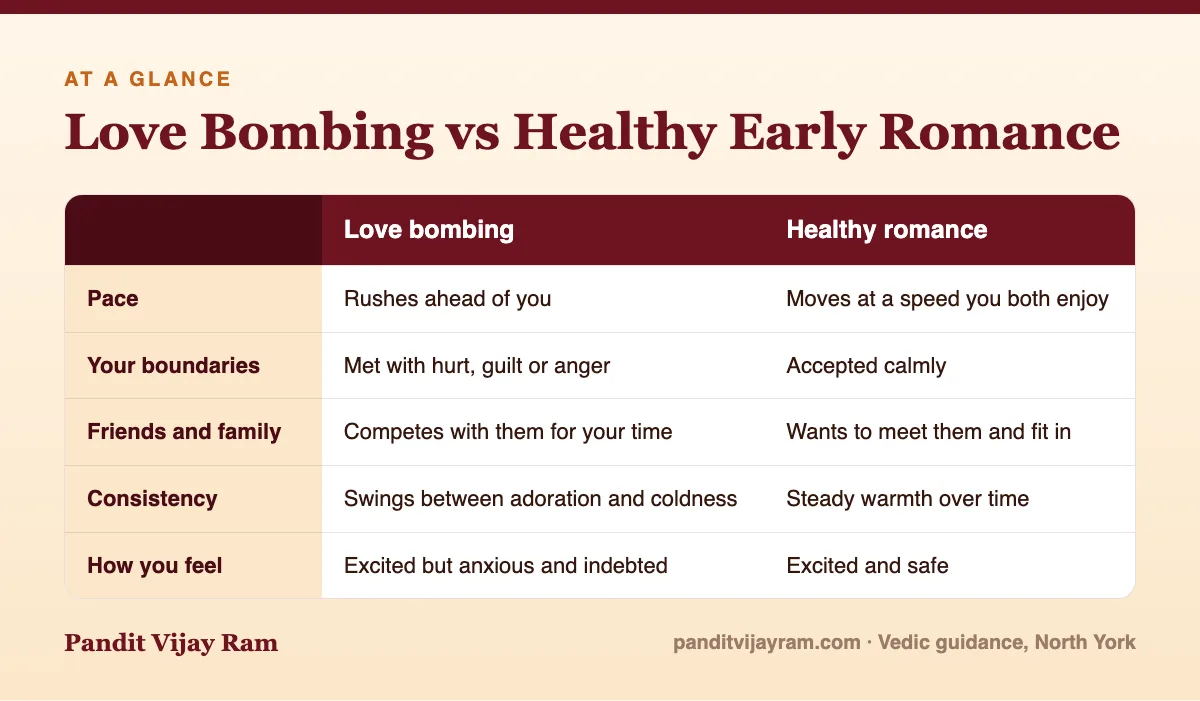
Here is a side-by-side view to help you compare:
- Pace: healthy romance moves at a speed both people enjoy; love bombing pushes ahead of you.
- Boundaries: a healthy partner hears no calmly; a love bomber treats it as rejection.
- Friends and family: healthy partners want to meet them and fit in; love bombers compete with them for your time.
- Consistency: healthy affection stays fairly steady; love bombing swings between adoration and criticism.
- Feelings in you: healthy romance feels exciting and safe; love bombing often brings anxiety, guilt and confusion alongside the excitement.
Cultural context matters too. In arranged or semi-arranged introductions, families sometimes move quickly toward engagement. Speed alone is not love bombing. Pay attention to whether the other person respects your questions, your need to meet properly and your right to say not yet. Our guide to the first meeting in an arranged marriage offers questions that help you know someone.
What should I do if I think I'm being love bombed?
Slow things down on purpose and watch the response. Keep your usual friendships, routines and finances separate. Talk to trusted people about what is happening. Never send money to someone you have only met online. If slowing down brings anger, guilt or threats, treat it as a serious red flag and step back.
Practical steps that protect your judgement:
- Set a pace you choose. For example, see each other once or twice a week for the first few months.
- Keep your life full. Maintain time with friends, family, prayer and hobbies.
- Delay big decisions. Moving in, engagement, joint accounts or loans can wait until you have seen the person in ordinary and stressful moments.
- Keep money separate. Requests for money, especially from someone met online, are a classic sign of a romance scam. Report suspected fraud to the Canadian Anti-Fraud Centre.
- Ask a trusted person what they notice. Outsiders often see warning signs we miss when infatuated.
- Notice your body. Feeling anxious more often than calm is worth listening to.
If you are new to dating in Canada, our guide to dating as a newcomer in the GTA covers safety and scams. In a love problem consultation I can help you reflect on a new relationship, but the decision to slow down is always yours, and a good partner will welcome it.
The bottom line
Love bombing is overwhelming early affection and pressure that can lead to control, and it often follows an idealise-devalue cycle. The clearest test is how someone responds when you slow down or set a limit. Keep your friendships, routines and finances your own, choose a pace that feels safe, and remember that steady affection outlasts intense pursuit.
Key takeaways
- Love bombing is intense early affection used to create obligation or control.
- The warning sign is how someone reacts when you set a boundary.
- Not every quick romance is manipulation; consistency and respect reveal the difference.
- Keep finances separate and never send money to someone met only online.
- A healthy pace leaves room to see a partner in ordinary and hard moments.