
Can a Love Binding Be Reversed? What Happens When You Undo One

Sometimes the person who writes to me is not the one who feels bound. It is the one who paid for the binding. They acted in heartbreak or jealousy, perhaps after a stranger online promised to bring a partner back, and now they feel uneasy, guilty or frightened. If you want to reverse a love binding you arranged, you have already taken the most important step, which is to see it clearly. Many of these messages come from North York and the rest of the GTA, and some from much further away. This article explains how reversal is approached in the Vedic view, what prayashchitta, or atonement, involves, how to deal with the practitioner who did the work, and whether to tell the other person. In more than forty years of practice, I have found that regret handled honestly becomes one of the most healing experiences a person can have. You will not find fear here. You will find practical steps and a way to make peace with what happened.
Can a love binding be reversed?
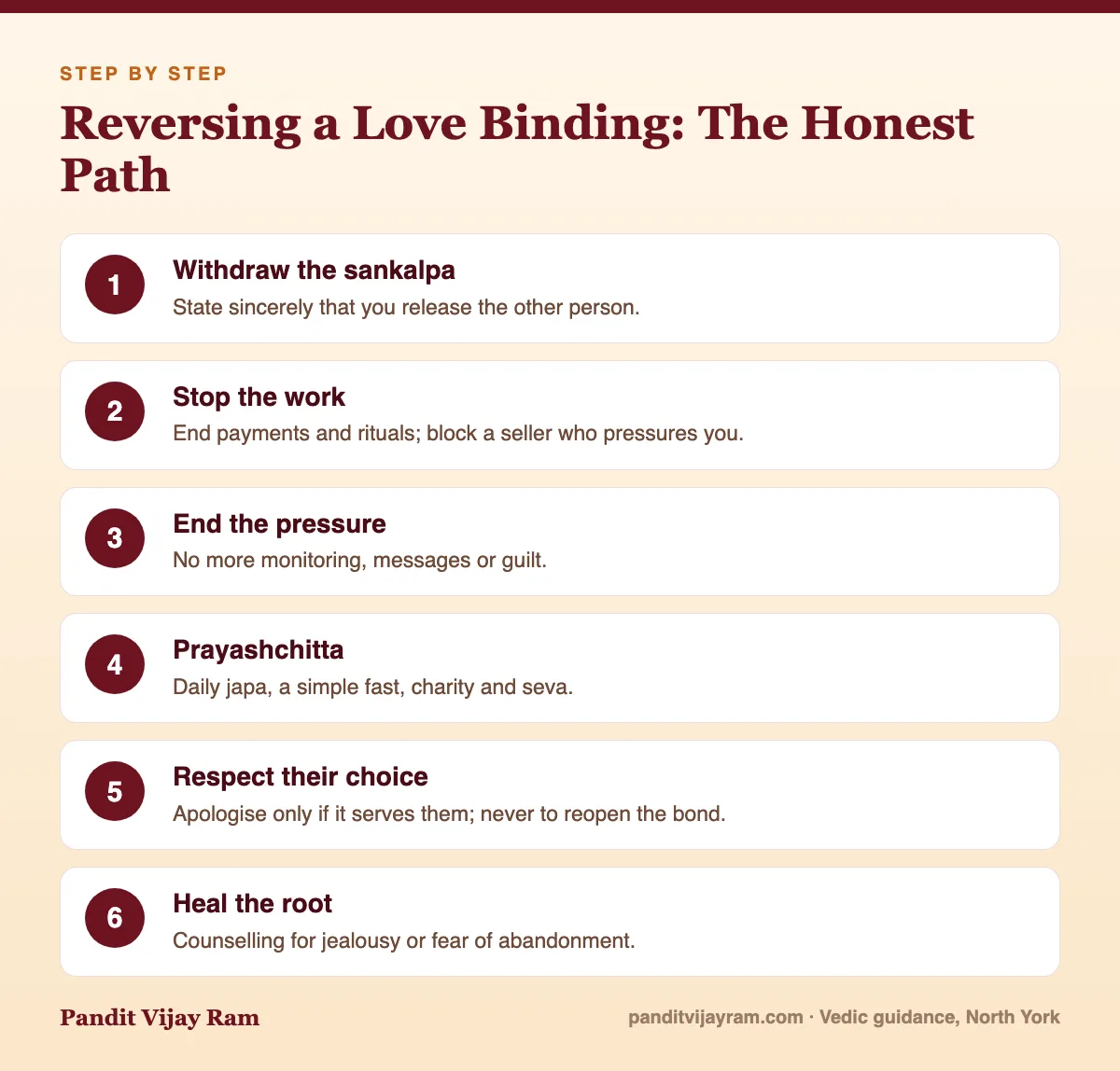
Yes, in the sense that matters most: you can withdraw your intention, end the arrangement and repair your own conduct. In Vedic thought the force of any ritual rests on sankalpa, the will behind it. When you sincerely retract that will and stop feeding it, the reversal has begun.
People who regret a binding often imagine they need an equally powerful counter-spell, usually from the same seller. That is rarely true. A binding, as sellers describe it, depends on the commissioning person's continued wish and on repeated work. Removing both is the core of reversal.
Think of it in three layers:
- Intention. Sit quietly before a lamp and say plainly, in your own words, that you withdraw any wish to control the other person and release them to their own path.
- Action. Stop payments, cancel any scheduled rituals and return or dispose of items connected to the work.
- Conduct. Stop any messaging, monitoring or pressure that went alongside the ritual.
Most of the harm people worry about comes from the third layer. A binding is often paired with constant contact, guilt-tripping or checking up on the person. Ending that behaviour is something you can do today, and it helps the other person immediately.
If you are unsure what a binding is meant to be, the pillar guide on love binding, meaning and free will explains the idea and why Vijay Ram ji declines such work. Our article on love spell side effects covers the emotional and financial costs many people report.

What is prayashchitta after a love spell?
Prayashchitta is the Vedic practice of atonement for a wrong action. After a love spell it usually means acknowledging the act honestly, chanting a chosen mantra daily for a set period, fasting or simplifying on certain days, giving in charity and, above all, changing the behaviour that led to it.
Atonement in the Vedic tradition is not self-punishment. It is a way of restoring balance and returning to dharma. A typical prayashchitta for regret over a love ritual might look like this:
- Acknowledgement: before the deity of your choice, often Shiva, Vishnu or Durga, name what you did and why, without excuses.
- Japa: a mantra such as Om Namah Shivaya or the Mahamrityunjaya mantra, one or more malas a day for a period you can keep, such as forty days.
- Simplicity: a light fast on Mondays or Ekadashi, or simply giving up a comfort for a time.
- Charity: giving to those who are vulnerable, especially to services that support people in difficult relationships.
- Seva: time given at a temple, shelter or community kitchen.
The most important element is a changed life. Ask yourself what led you to want control. Fear of abandonment, jealousy or a sense of being worthless are common. These deserve care, often from a counsellor as well as through prayer.
Vijay Ram ji can shape a prayashchitta around your chart and circumstances, and where suitable include a puja or anushthan performed with a sincere sankalpa of release rather than control.
What should I do about the practitioner who did the binding?
Stop paying them and stop all contact if they pressure you. You do not need their permission or their paid reversal to withdraw your intention. If they threaten harm, demand more money or hold personal information over you, keep records and report it to the Canadian Anti-Fraud Centre or police.
A common pattern is that the same seller who performed the binding then offers to undo it, for a larger fee. Some add frightening warnings: that stopping halfway will reverse the spell onto you, or that a curse will fall on your family. These are pressure tactics, not spiritual truths.
Practical steps:
- Send one brief message saying you are ending the arrangement and want no further work done. You owe no explanation.
- Do not send more money, gift cards or cryptocurrency, whatever is said.
- Screenshot all messages, receipts and profiles before blocking.
- If you shared photos or personal details of the other person, ask for their deletion in writing.
- Report threats or fraud to the Canadian Anti-Fraud Centre and, for threats of harm, to your local police.
Many people feel ashamed and stay silent. Please do not. Reporting protects others, and you are far from the only person to have been drawn in during a painful time. The article on fake love spell casters online describes these tactics in detail.
If fear lingers after you have stepped away, a protective practice such as the Hanuman Chalisa or a consultation through the curse and hex removal service can help you feel settled again.
Should I tell the person I tried to bind?
It depends on whether telling them would help them or only ease your guilt. If they have asked for no contact, respect that and keep your atonement private. If you are still in contact, an honest apology for pressure or controlling behaviour may help, kept brief and without asking anything back.
Use this decision rule before speaking to them:
- Do not contact them if they have blocked you, asked for space, or if contact would frighten them. Your atonement can be complete without their involvement.
- Consider a short apology if you are still in regular contact and your behaviour, not just the ritual, affected them. Focus on what you did: the messages, the pressure, the jealousy.
- Tell them more fully only if you believe they would want to know, and you are prepared for anger or an end to the relationship.
Whatever you decide, do not use the confession to reopen the relationship, seek reassurance or test their feelings. That would be another form of pressure.
If you shared their photos, address or other private details with a seller, consider whether they need to know for their own safety, for example to watch for unusual contact. In that case honesty serves them directly, and it is the right course.
Being honest with yourself matters as much as honesty with them. Write down what you hoped the binding would do and what it cost. Many people find that seeing it on paper loosens the shame. For the wider question of how to respect someone's freedom after a breakup, the piece on no contact and spiritual remedies may help.
What happens after you undo a love binding?
Usually, life becomes quieter and more honest. If the relationship continues, it does so on its own terms. If it ends, there is grief, but also relief from secrecy and fear. Many people find the anxiety that drove the binding eases once they stop trying to control the outcome.
People often expect something dramatic when they withdraw a binding. What they report is more ordinary and more lasting:
- Less anxiety about whether the other person's affection is real.
- An end to the cycle of paying, waiting and paying again.
- Room to grieve the relationship properly, if it was ending.
- A clearer sense of what they want in a partner next time.
Some feel a period of emptiness or sadness. That is grief catching up, not a spell rebounding. Keep up your daily prayer, eat and sleep regularly, and talk to someone you trust. If the sadness becomes overwhelming, please see your family doctor, and if you have any thoughts of harming yourself, call or text 9-8-8.
If the relationship does continue, protect it from the old patterns. Couples counselling can help two people rebuild trust openly. Prayer together, such as Monday worship of Shiva and Parvati, can become a shared practice rather than a secret one.
When you feel ready, Vijay Ram ji's love problem guidance can help you look at your chart for the next chapter, with remedies that work on your own life and leave others free.
The bottom line
To reverse a love binding you regret, withdraw your intention sincerely, stop all further work and payments, and end any pressure on the other person. Prayashchitta through japa, simplicity, charity and changed conduct restores balance without fear or a costly counter-ritual. Respect the other person's freedom, report any threats from the caster, and seek counselling or medical support if guilt or grief becomes heavy.
Key takeaways
- Withdrawing your sankalpa and stopping the work begins the reversal.
- Prayashchitta is atonement through acknowledgement, japa, charity and seva.
- You do not need the original seller's paid counter-ritual.
- Tell the other person only if it serves them, not just your guilt.
- Life after reversal is usually quieter, more honest and less anxious.