
Why Vedic Practice Uses Prayer, Not Binding, for Marriage
Families come to me when a marriage seems stuck. A partner will not commit, parents disagree, or a proposal keeps falling through, and someone suggests a binding spell for marriage as the answer. I understand the pressure, especially in communities where marriage carries so much meaning for the whole family. Many of these conversations happen in North York and across the GTA, often with a parent sitting beside the person concerned. This article explains why the Vedic tradition does not bind a partner into marriage, and what it offers instead. You will learn the meaning behind the wedding vows themselves, how Gauri-Shankar worship and the Katyayani mantra are traditionally used, what kundli matching can and cannot show, and what to do when a partner or family says no. In more than forty years of practice, I have seen that marriages built on willing hearts carry families through hard years, while those built on pressure tend to crack. Prayer, honesty and patience are slower, but they rest on firmer ground.
Is there a Vedic binding spell for marriage?
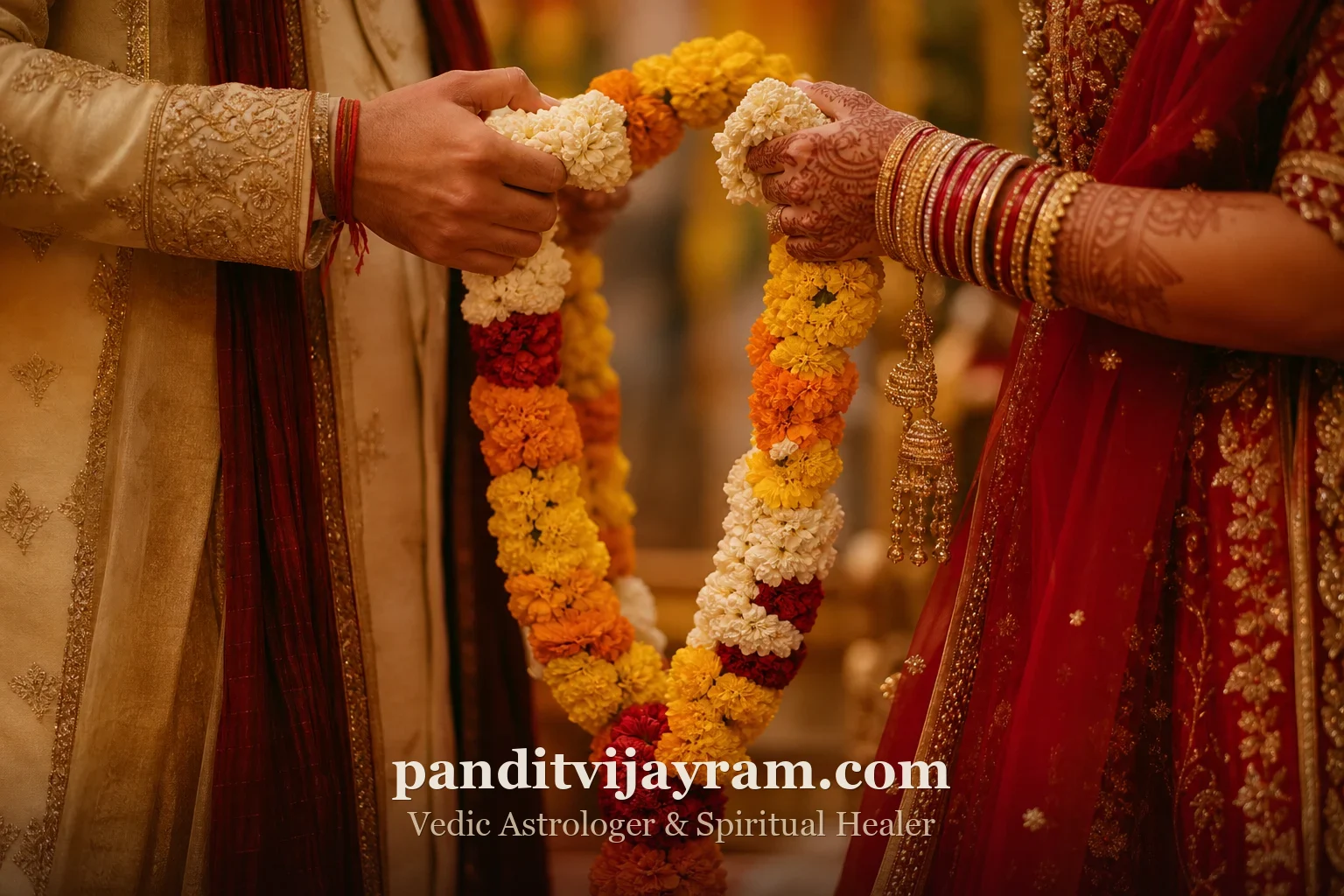
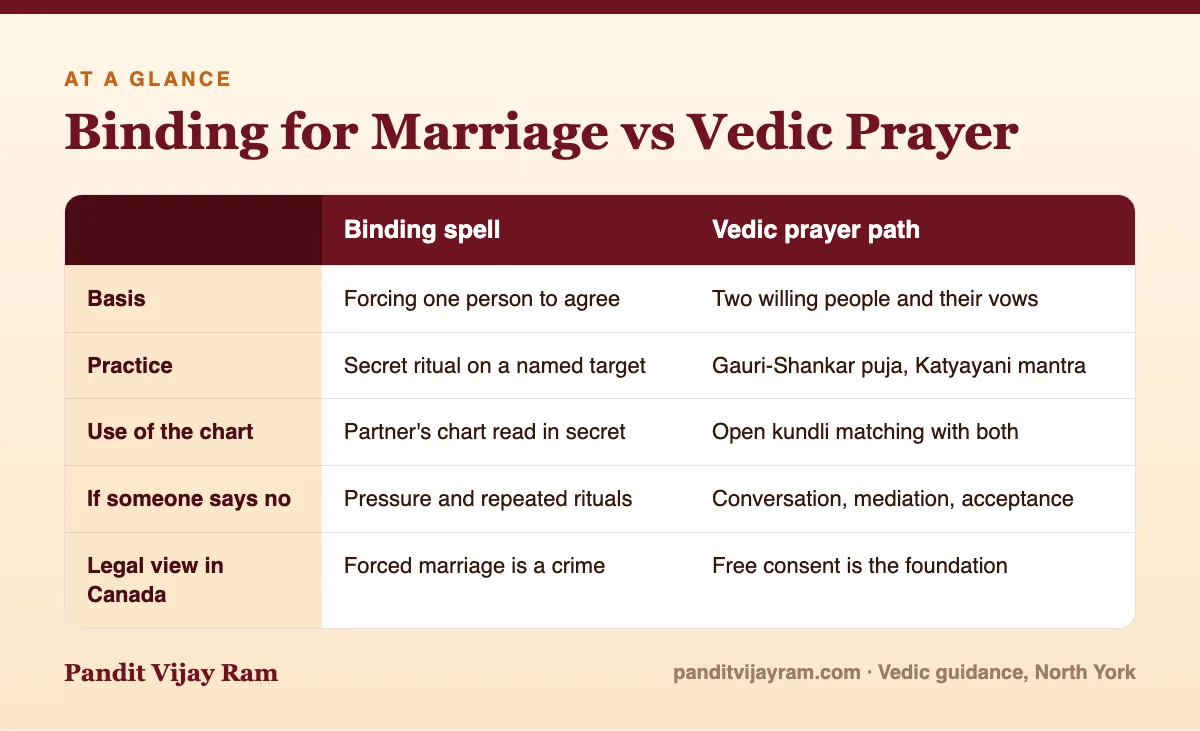
No genuine Vedic rite binds an unwilling person into marriage. Vivah is a samskara, a sacrament, in which both bride and groom take vows before the sacred fire. Its central act, the saptapadi or seven steps, is a mutual promise. A marriage obtained by force contradicts the very ceremony it would end in.
The Hindu wedding is built around consent and partnership. During the saptapadi, the couple take seven steps together around the fire, each step tied to a shared vow: nourishment, strength, prosperity, happiness, children, long life and friendship. The last step is often described as the moment the two become companions for life.
Classical texts describe several forms of marriage. The ones treated as most honourable are those arranged with the agreement of the bride, the groom and their families. Forms involving abduction or deception are named only to be condemned.
So when a seller offers a ritual to "make him marry you" or "tie her to you for seven lifetimes," they are using Vedic language for something the tradition itself rejects. Vijay Ram ji does not perform such rituals. What he offers instead is prayer for the client's own readiness and for harmony, alongside an honest look at the chart.
Our pillar on the ethics of love binding explains the free-will issue in more depth. For families worried that marriage is blocked by something unseen, the separate article on black magic and marriage delay covers that concern and its ordinary causes.

What is the Gauri-Shankar puja for marriage?
The Gauri-Shankar puja honours Shiva and Parvati as the ideal married couple. Parvati is said to have won Shiva through long devotion and tapas, not force. Unmarried people pray to them for a good partner, and married couples for harmony. It is often done on Mondays, during Shravan, or at Mahashivaratri.
The story behind this worship matters. Parvati, daughter of the mountain king, longed to marry Shiva, who was absorbed in meditation after the loss of his first wife, Sati. Rather than trick or compel him, she undertook severe austerity until Shiva himself recognised her devotion and chose her. The tradition holds up their union as proof that love sought through sincerity bears fruit.
A simple Gauri-Shankar practice at home might include:
- On a Monday, after bathing, offer water, milk or bel leaves to a Shivling, or before an image of Shiva and Parvati.
- Offer red flowers, kumkum and bangles to Parvati.
- Chant Om Gauri Shankaraya Namah or the Swayamvara Parvati mantra for a set number of rounds.
- Pray for a partner who will be a true companion, or for understanding in your existing marriage.
Women in many families keep the Mangala Gauri vrat on Tuesdays during Shravan, and the Hartalika Teej fast is also linked to Parvati's resolve. A Gauri Shankar rudraksha, two beads naturally joined, is sometimes worn for marital harmony, but only after proper guidance.
For a full ceremony, the puja and anushthan service can arrange a Gauri-Shankar puja with a sankalpa suited to your situation.
How is the Katyayani mantra used for marriage?
The Katyayani mantra is a prayer to Goddess Katyayani, a form of Durga, for a suitable spouse. In the Bhagavata Purana, young gopis kept a month-long vow to Katyayani hoping to marry Krishna. People today chant it for a good partner, often during Navratri or for a fixed number of days.
The mantra most often used is:
Katyayani Mahamaye Mahayoginyadhishwari, Nandagopasutam devi patim me kuru te namah.
Its literal wording asks the Goddess for Krishna, the son of Nandagopa, as a husband. In modern practice people understand it more broadly as a prayer for a partner of good character. Some substitute a neutral phrase so the prayer does not name anyone. That is a wise choice, because naming a particular person you know turns a prayer for blessing into a request for their capture.
A common way to practise:
- Begin on an auspicious day, such as the sixth day of Navratri, which is dedicated to Katyayani.
- Chant one or more malas each morning before a lamp, with yellow or red flowers.
- Keep the practice for a set period, often forty days, without skipping.
- Pair it with real-world steps: meeting proposals with an open mind, speaking honestly with family.
The Katyayani vow is a lovely example of how tradition handles longing. The gopis did not cast anything on Krishna. They fasted, bathed in the river at dawn and prayed. Devotion shaped them. Vijay Ram ji's love marriage guidance often includes this mantra for people hoping to marry.
How does kundli matching help instead of binding a partner?
Kundli matching compares two charts to show emotional, practical and timing compatibility. It uses the ashtakoot system of 36 gunas, checks Manglik status and studies the 7th house and dasha periods. It informs a couple and their families about strengths and frictions. It never forces either person to choose the other.
Kundli matching answers a different question from binding. Binding asks, "How can I make this person marry me?" Matching asks, "If we both choose this, what will help and what will test us?"
What a careful match looks at:
- Ashtakoot points: eight factors, from temperament to health, scored out of 36. Eighteen or more is traditionally considered workable.
- Manglik dosha: Mars placement that may bring heat to the marriage, often balanced when both partners share it.
- 7th house and Venus: how each person bonds and what they need from a spouse.
- Dasha timing: whether the coming years favour settling, moving, starting a family.
How to use the result, as a simple rule:
- A good match plus mutual willingness: proceed with blessings.
- A weaker match plus mutual willingness: proceed with awareness and specific remedies.
- A good match without one partner's willingness: the chart cannot change their mind, and should not be used to pressure them.
Charts are read with both people's knowledge. Vijay Ram ji does not analyse a partner's chart secretly to plan influence. The relationship compatibility service describes the process, and the free love and marriage tools give a quick first look.
What if my partner or family won't agree to marriage?
Then the honest path is conversation, patience and, sometimes, acceptance. Talk openly with your partner about their hesitation, involve respected elders or a family counsellor, and give the matter time. No prayer should be used to override a partner's refusal, and any pressure towards forced marriage is illegal in Canada.
Hesitation often has practical roots. A partner may worry about career, immigration status, money, religion or a parent's health. Families may object over caste, community or past hurts. These are real concerns that conversation can sometimes resolve and prayer alone cannot.
Steps that help:
- Ask your partner directly what is holding them back, and listen without arguing.
- Invite a trusted elder, temple priest or family counsellor to mediate with both families.
- Agree on a reasonable period to revisit the question, rather than pushing every week.
- Keep your own daily prayer for patience, such as the Gauri-Shankar or Katyayani practice above.
If your partner says a clear no, respect it. That is painful, and grief is appropriate. Our article on no contact and spiritual healing may help in that season.
If you are the one being pressured into a marriage you do not want, by a partner or relatives, please know that forcing someone to marry is a criminal offence in Canada. You can contact police, a local shelter or a settlement or community service for confidential help. Spiritual guidance should never be used to push anyone, including you, into vows they have not freely chosen.
The marriage problem consultation offers a calm space to think through these situations with chart insight and practical advice.
The bottom line
A binding spell for marriage contradicts the Vedic understanding of vivah as a sacrament of two willing people, sealed by mutual vows in the saptapadi. Instead, tradition offers Gauri-Shankar worship, the Katyayani mantra and kundli matching, all of which work on readiness, harmony and informed choice. When a partner or family refuses, conversation, mediation and acceptance are the honest path, and anyone facing a forced marriage should seek help from police or support services.
Key takeaways
- Vivah is a sacrament of consent, sealed by shared vows.
- Gauri-Shankar worship honours a union won through devotion, not force.
- The Katyayani mantra asks for a good spouse without naming a captive.
- Kundli matching informs willing couples; it cannot change a refusal.
- Forced marriage is a crime in Canada, and help is available.