
Love Binding With Photos, Hair or Personal Items: Myths and Safety

Perhaps an online caster has asked you for a clear photo of your ex, a few strands of their hair, or a shirt they wore. Or perhaps you have found your own picture tucked somewhere it should not be, and the worry will not leave you. Questions about love binding with photos reach me often, from families in North York and from people writing in from much further away. This guide explains where the idea comes from, which parts are folklore, and which parts carry a real risk you can actually manage. You will learn why a request for someone's personal items is a warning sign, how to protect your images online, and what to do if you believe your belongings have been used against you. In more than forty years of Vedic practice I have never needed a lock of anyone's hair to help them. What people truly need is clarity about their own heart, steady prayer for their own life, and firm boundaries with anyone who tries to collect pieces of them.
Why do love spell casters ask for a photo or hair?
Casters ask for photos, hair or clothing because many folk-magic systems teach that a part of a person, or an image of them, stays linked to that person. Anthropologists call this sympathetic or contagious magic. In practice the request also builds commitment, gathers private data, and makes a client feel invested before money is discussed.
The belief is old and widespread. European grimoires, some hoodoo rootwork and certain village practices in South Asia all treat hair, nail clippings, a footprint or a worn garment as a stand-in for the person. Modern online sellers call such an item a taglock. The logic is that whatever is done to the token is done to its owner.
The Vedic tradition I follow uses a person's name, birth date and birth place for a kundli reading, because those details describe a chart, not a handle on someone's mind. Nothing in sincere puja requires a strand of another adult's hair.
There are also quieter reasons a stranger wants your images:
- Leverage. Intimate or identifying photos can later be used for pressure or extortion.
- Credibility theatre. A detailed ritual request makes a cheap service feel serious.
- Data. Names, faces and addresses can be sold or used for further targeting.
If the person asking also promises a fixed date by which your ex will return, you are looking at a sales script rather than a spiritual practice. Our pillar article on the love binding spell explains why Vijay Ram ji declines that kind of work entirely.
Can someone really bind you with your picture or a strand of your hair?
No honest practitioner can show that a photo or hair sample lets anyone take over your feelings. Love that is forced is not love in the Vedic sense, and the tradition holds that each soul keeps its own will. What a found photo can do is frighten you, and fear itself changes sleep, mood and choices.
People who believe they have been bound describe obsessive thoughts, sudden longing, or an inability to leave a relationship. Each of these has well-understood ordinary explanations worth checking first: grief after a breakup, limerence, anxiety, depression, poor sleep, or a partner who has used guilt and isolation to keep control.
That last one matters most. Feeling unable to leave is sometimes the result of coercive control by a real person, not magic. If someone monitors your phone, cuts you off from friends, or threatens you, speak to a counsellor or a domestic-violence support line, and call police if you are in danger.
Within faith, the scriptures I study describe protection through one's own devotion. A sincere daily prayer, a lit lamp and the name of a deity you trust are traditionally said to shield the mind far more strongly than any token held by someone else. That is a matter of belief, not a promise of outcome, and it works best alongside practical help.
If you feel tied to someone and want to understand it, our guide to the signs of a love binding spell walks through each symptom alongside its everyday explanation.
What should I do if a love spell caster asks for my ex's photo or belongings?
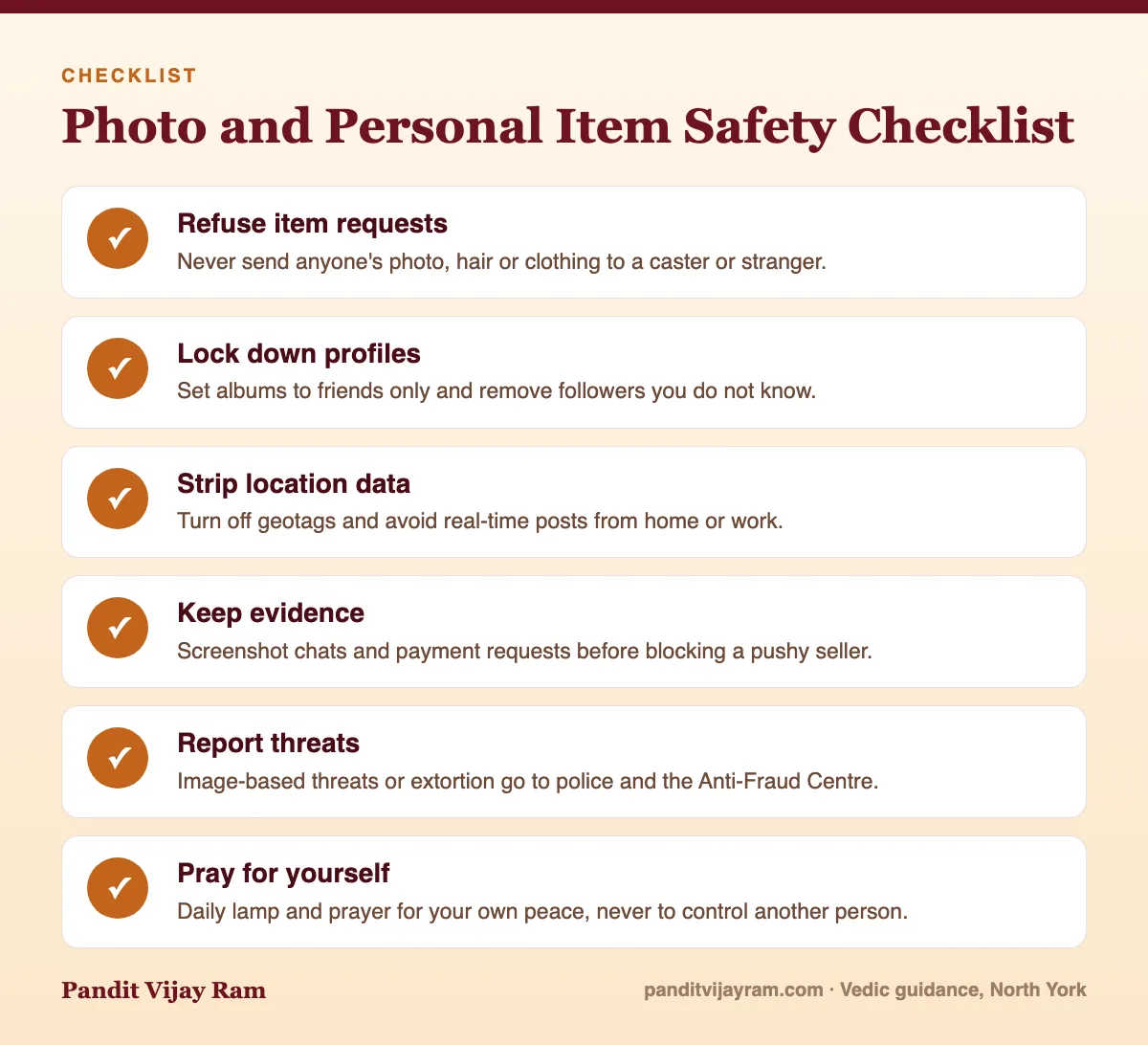
Decline, and do not send anything. Sending another person's photos, hair or clothing to a stranger breaches that person's privacy and may expose you to blackmail. Keep the conversation as a record, stop payment if any is pending, and report clear fraud to the Canadian Anti-Fraud Centre.
A simple decision rule helps here. If a request involves someone else's body, images or property, the answer is no, whatever the explanation.
- Pause. Do not reply in the heat of heartbreak. Nothing is lost by waiting a day.
- Screenshot the chat, the payment request and the seller's profile.
- Stop contact. Block the account if they become pushy or begin warning of disaster.
- Report money loss or threats to your bank and to the Canadian Anti-Fraud Centre.
- Talk to someone you trust, a friend, an elder or a counsellor, before deciding anything else.
If you already sent items, do not panic. Ask for nothing back, change any passwords you may have shared, and watch for messages asking for more money to "finish" or "undo" the work. That second demand is a classic pattern described in our article on fake love spell casters online.
Then turn the energy toward your own healing. Vijay Ram ji's love problem guidance begins with your chart and your situation, never with collecting pieces of the person you miss.
How do I protect my photos online from being used in spells or scams?
Treat photo privacy as ordinary digital safety. Limit who sees your pictures, remove location data, avoid sending images to strangers, and review old posts. These steps protect you from impersonation, stalking and sextortion, which are far more common harms than any ritual a stranger might perform with your face.
Whether or not you believe a photo can carry spiritual influence, the practical precautions are the same and they are worth doing this week.
- Audience settings. Set social profiles to friends only and remove followers you do not know.
- Location data. Turn off geotagging in your camera app and avoid posting your home or workplace in real time.
- Old albums. Archive or delete couple photos after a breakup if seeing them hurts or if an ex still follows you.
- Intimate images. Never send them to a new contact. If someone threatens to share yours, save the evidence and contact police; this is a crime in Canada.
- Search yourself. A reverse image search shows whether your pictures appear on accounts you did not create.
Spiritually, many households keep family photographs in a clean, respected place and do not leave them scattered or torn. That is a gentle custom of dignity rather than a defensive wall. If you would like a calm protective practice to go with these steps, a blessed kavach or taweez worn with daily prayer is the traditional route.
What if I find my photo or hair hidden in my home or car?
First consider safety and simple explanations. A hidden photo may mean a relative's well-meant prayer, an old keepsake, or someone entering your space without permission. Photograph the find, handle it with gloves, and tell police if it points to stalking or a break-in, before arranging any spiritual cleansing.
Finding a picture of yourself pinned, burned or tied with thread is upsetting. Take a breath. Many South-Asian, Caribbean and Latino families have elders who place a photo near a shrine as a blessing, and the gesture can look strange out of context. Ask gently before assuming harm.
If the object appeared somewhere only an intruder could reach, treat it as a security matter first. Change locks or codes, note dates, and report it. Our step-by-step guide to a suspicious object found at home covers gloves, disposal and documentation in more detail.
For the spiritual side, the traditional response is not to burn the photo in anger or send anything back. It is a sincere cleansing of the space and of yourself, followed by steady prayer. You can begin with the household practices explained in our guide to cleansing negative energy from your home. If the fear stays with you or the finds repeat, Vijay Ram ji can look at the chart and the situation together through his vashikaran guidance service, which focuses on protection and release, never on control of another person.
The bottom line
Love binding with photos rests on an old idea of linked tokens, but Vedic ethics never ask for another adult's hair or images to work on their heart. The risk you can actually measure is privacy, so guard your pictures and refuse any request for someone else's belongings. Where a hidden photo suggests intrusion or a relationship feels controlling, safety and police come before ritual.
Key takeaways
- A request for someone's photo, hair or clothing is a warning sign, not a credential.
- Vedic practice uses birth details for a chart and never needs another person's body or belongings.
- Photo privacy settings protect you from stalking, impersonation and sextortion.
- A hidden photo at home is first a security question, then a spiritual one.
- Prayer for your own life and boundaries with others are the honest alternatives to binding.