
Hanuman Jayanti: Meaning and How Families Observe It
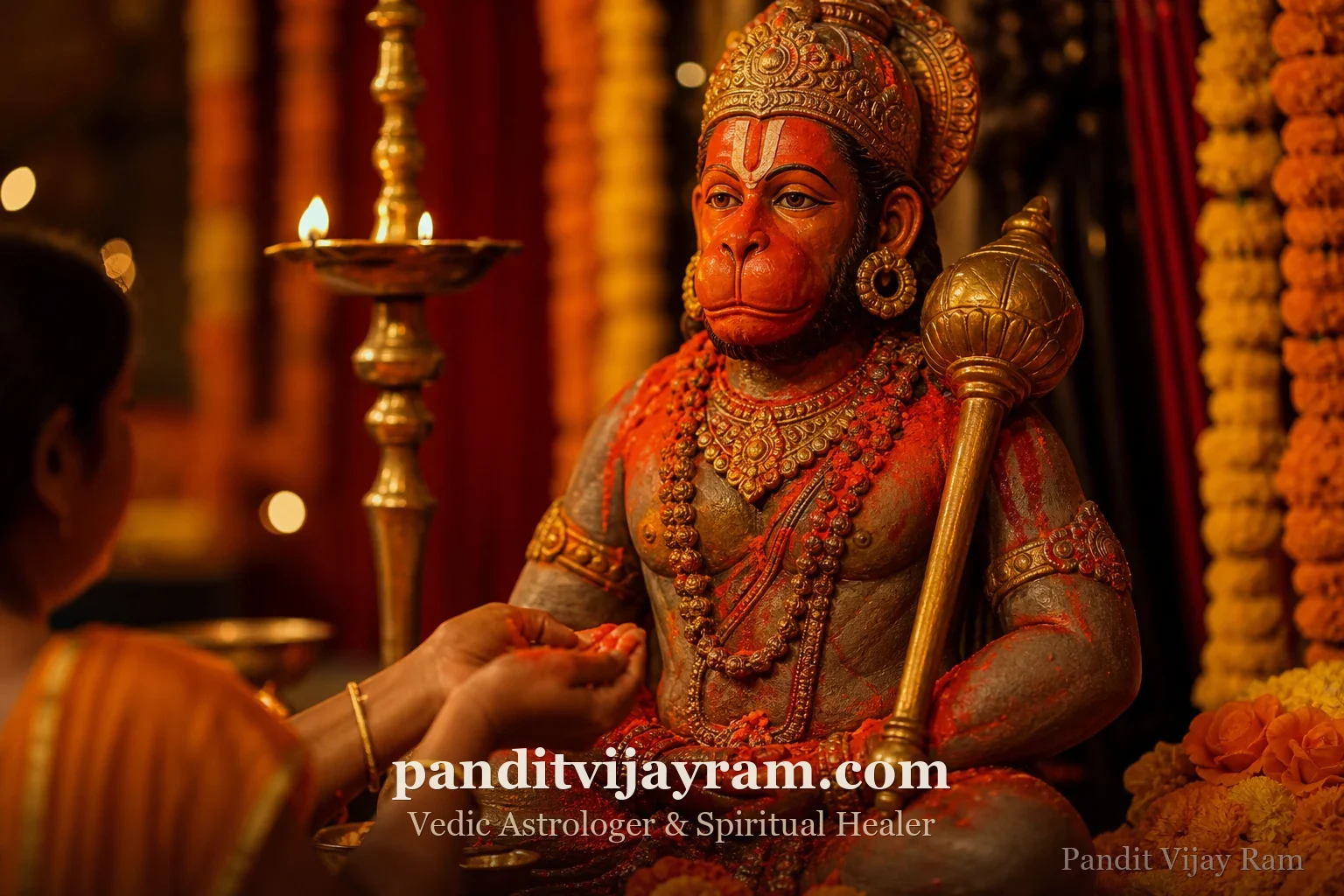
Ask three families in the GTA when Hanuman Jayanti falls and you may get three different answers. A Punjabi household will point to the spring full moon. A Tamil family may talk about the cold month of Margazhi. A Telugu devotee may describe a forty-one-day deeksha that ends weeks after the North Indian festival. None of them is wrong. In more than forty years of Vedic practice, serving families in North York and across Canada, I have learned to begin by asking which tradition a household follows before I suggest any timing. This article explains what the festival celebrates, why some devotees prefer the name Hanuman Janmotsav, how each region sets its observance, and what families typically do on the day, from sunrise prayers to temple seva. I will not give dates, because they move every year and differ by tradition. Instead you will learn how to find the right day for your family from a panchang set for Toronto or your own city.
What is Hanuman Jayanti and why is it celebrated?
Hanuman Jayanti marks the birth of Hanuman, son of Anjana and Kesari, blessed by Vayu, the wind god. Devotees celebrate his strength, humility, learning and complete devotion to Rama. The festival is a day to ask for courage and protection, and to remember that real strength serves others rather than the self.
Hanuman's birth story is told in several versions. In a widely known one, Anjana, a celestial being living on earth, prayed for a son. Vayu carried a portion of divine blessing to her, and Hanuman was born with extraordinary strength. Many traditions also link him to Shiva, describing him as an incarnation or portion of Shiva who came to serve Rama.
As a child he is said to have leapt toward the rising sun, thinking it was a ripe fruit. That story explains why so many temples begin Hanuman Jayanti celebrations at dawn: devotees believe he was born around sunrise.
Why the festival matters to families:
- Courage. Hanuman crossed the ocean to find Sita when others doubted they could.
- Humility. Despite his power, he described himself only as Rama's servant.
- Learning. He is called a master of grammar and scripture, which is why students pray to him.
- Protection. His name is invoked against fear, illness and danger.
- Chiranjeevi. He is counted among the immortals who remain on earth.
For a weekly way to keep this devotion alive between festivals, see our guide to Hanuman puja at home on Tuesday and Saturday.
Why do some people say Hanuman Janmotsav instead of Hanuman Jayanti?
Some devotees prefer Janmotsav, meaning birth festival, because they believe Hanuman is chiranjeevi, still living on earth. In their view, jayanti suits the birth anniversary of someone no longer physically present. Others point out that jayanti is used freely for living deities too. Both names are acceptable and widely understood.
The debate is a friendly one, and you will hear both words in GTA temples.
- Jayanti comes from a root linked with victory and is used for the appearance days of many deities and saints, such as Krishna Jayanti, the name many South Indian families use for Janmashtami.
- Janmotsav combines janma, birth, with utsav, festival. Supporters say it fits a deity believed to be ever-present.
- Regional terms add more variety: Hanumath Jayanthi in Tamil Nadu, Hanuman Vratam in Karnataka and Hanuman Jayanthi in the Telugu states.
Teachers I respect take a relaxed view. Devotion, not vocabulary, is what Hanuman values. If your grandparents said jayanti, keep saying it. If your temple prints janmotsav on its flyer, that is equally correct.
What matters more is understanding the qualities you are celebrating. Many families find it helpful to read a short passage from the Sundara Kanda of the Ramayana on this day, the section that tells of Hanuman's leap to Lanka. Our wave-one guide to organising a Sundarkand path at home explains how families share the reading.
Why is Hanuman Jayanti celebrated on different days in different regions?
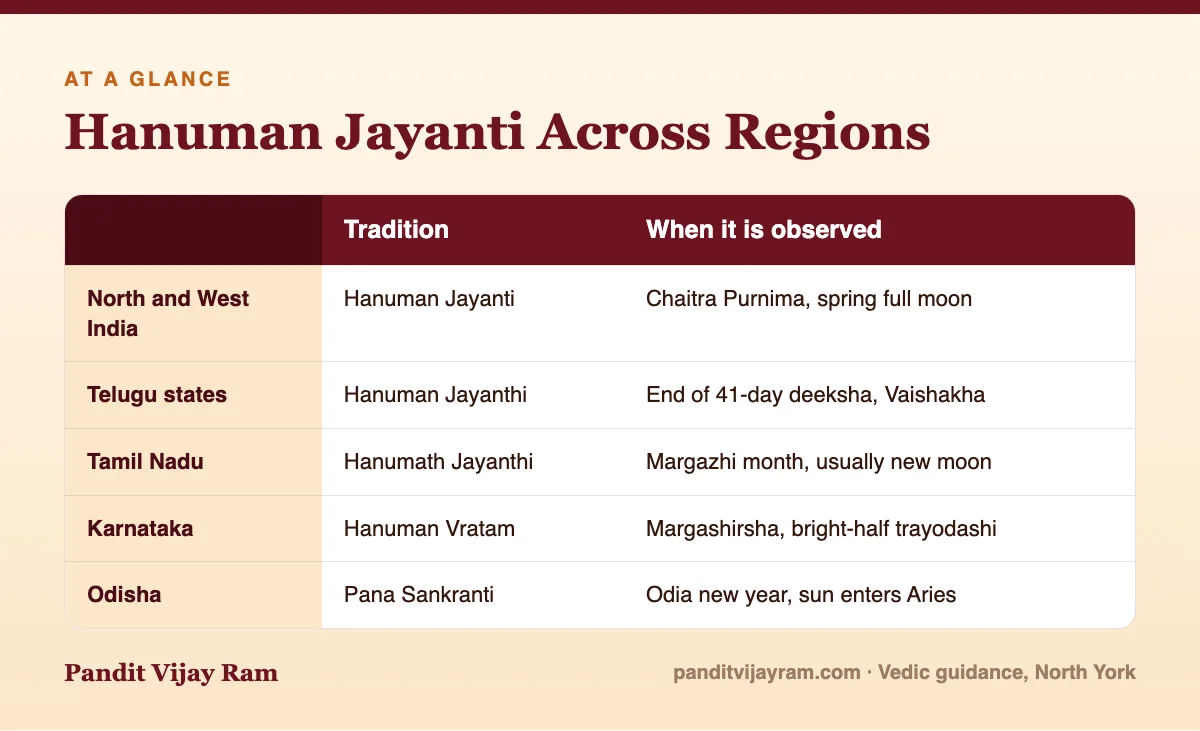
Regions follow different calendars and different textual traditions about Hanuman's birth. North and West India usually observe Chaitra Purnima. Telugu states end a forty-one-day deeksha on Vaishakha Krishna Dashami. Tamil families celebrate in Margazhi, Karnataka in Margashirsha, and Odisha on Pana Sankranti. Some North Indian communities also honour Kartika Krishna Chaturdashi before Diwali.
Here is a simple reference to the main regional traditions. Exact days shift every year with the lunar calendar.
- North and West India. The full moon of the month of Chaitra, in spring, a few days after Rama Navami and the end of Chaitra Navratri.
- Some North Indian traditions. The fourteenth day of the dark fortnight of Kartika, the day before Diwali, based on a different textual account.
- Andhra Pradesh and Telangana. A deeksha starts on Chaitra Purnima and runs for forty-one days, ending on the tenth day of the dark half of Vaishakha.
- Tamil Nadu and parts of Kerala. Hanumath Jayanthi in the month of Margazhi, in winter, often on the new moon day with Moola nakshatra.
- Karnataka. Hanuman Vratam on the thirteenth day of the bright half of Margashirsha.
- Odisha. Pana Sankranti, the Odia new year, when the sun enters Aries.
Month names also depend on whether your family follows the amanta calendar, where months end at the new moon, or the purnimanta calendar, where they end at the full moon. This is why the same day can carry different month names.
To find your day, use a panchang calculated for Toronto or your own city, and ask your temple which tradition it follows. Our panchang timing guide explains how to read one.
How do families observe Hanuman Jayanti at home and at the temple?
Typical observances include an early bath, a sunrise puja with sindoor and red flowers, recitation of the Hanuman Chalisa or Sundarkand, a light fast, offerings of laddoos or gud-chana, and a temple visit for aarti. Many families also serve food at a bhandara or donate to a food bank as seva.
The day often has a rhythm of three parts.
Morning. Families rise early, bathe and set up the altar before sunrise. A lamp, sindoor tilak, red flowers and tulsi are offered. Some recite the Hanuman Chalisa eleven or 108 times in a group, each person taking a share.
Daytime. Many keep a light fast of fruit and milk, breaking it after the evening aarti. Temples in the GTA often hold akhand path, continuous recitation, along with chola seva, where the murti receives a fresh sindoor coating, and havan. Check your temple's own calendar; programmes vary.
Evening. Families gather for aarti, sometimes with bhajans or a shobha yatra, a devotional procession, at larger mandirs. Prasad of boondi laddoo or halwa is shared.
Regional touches:
- Telugu devotees completing the deeksha may wear saffron through the forty-one days and visit a temple to close it.
- Tamil families may offer a vada mala or butter to Anjaneya.
- Indo-Caribbean homes often raise a new red jhandi flag for Hanuman after the puja.
Fasting is optional. Anyone with diabetes, low blood pressure, pregnancy or regular medication should eat normally or follow a doctor's advice; our article on fasting safely covers who should not fast.
Can you sponsor a Hanuman Jayanti puja if you cannot attend the temple?
Yes. Many devotees who work on the day, live far from a mandir or have health limits sponsor a puja, chola seva or havan with a sankalp in their family's name. You can join by phone or video, or simply light a lamp at home at the same time. Devotion does not depend on being physically present.
Work shifts, school runs and winter roads mean that many GTA families cannot reach a temple on a weekday festival. Tradition makes room for this.
- Ask your temple. Most mandirs accept names and gotras for group sankalps and seva in advance.
- Arrange a private puja. A pandit can perform a Hanuman puja, Sundarkand or havan with your family's sankalp, and send you prasad or blessed sindoor where possible.
- Join remotely. Watch or listen while the puja is performed, and keep a lamp lit at home during that time.
- Mark the day yourself. Even ten minutes of prayer after work, with a sweet offering and the Chalisa, honours the festival.
Be careful with online services that pressure you or promise specific results from a Jayanti puja. A genuine sankalp asks for blessing and protection; it does not guarantee a job or a court win. Our guide to how online puja works explains what to ask.
Vijay Ram ji performs Hanuman pujas, Sundarkand and havans for families who wish to sponsor one, through his Hanuman puja service. The sankalp is read in your name, and you are welcome to join on video.
The bottom line
Hanuman Jayanti celebrates the birth of a deity loved for strength, humility and devotion. Different regions mark it in different months, so the right day for your family depends on your tradition and a panchang for your own city. Families observe it with sunrise prayer, the Chalisa or Sundarkand, optional fasting and seva. However you mark Hanuman Jayanti, sincerity matters more than scale.
Key takeaways
- Hanuman Jayanti honours Hanuman's birth and his ideal of selfless strength.
- Janmotsav and jayanti are both acceptable names for the festival.
- Regions observe it in Chaitra, Vaishakha, Margazhi, Margashirsha or at Pana Sankranti.
- Sunrise prayer, the Chalisa, light fasting and seva are common observances.
- Check a panchang for your own city and your temple's tradition for the day.