
Conflict Between Adult Siblings: Repair and Boundaries

You grew up sharing a room, a school bag and every family secret. Now you sit at opposite ends of a wedding table and barely speak. Sibling conflict in adulthood is painful in a particular way, because the person who once knew you best has become someone you avoid. Families in North York and throughout the GTA bring me these stories often, especially when parents are ageing and decisions must be made together. This guide explains why adult siblings fall out, how to open a repair conversation that does not reopen old wounds, how to set boundaries when reconciliation is not yet safe or possible, and what Raksha Bandhan and Bhai Dooj actually ask of brothers and sisters. It also covers what the chart traditionally shows about siblings and when counselling is the wiser step. After forty years of listening to families, I am convinced that most estrangements are kept alive by silence rather than by the original quarrel.
Why do adult siblings stop talking to each other?
Adult siblings usually drift or break apart over a mix of old childhood roles, perceived favouritism, caring for parents, money and inheritance, and the influence of spouses. A single argument is often only the final trigger. Underneath it lies years of feeling unseen, compared or unfairly burdened by the family.
When a brother or sister describes a rift to me, I ask when they last felt close. The answer often goes back decades, which tells me the break was building slowly.
Patterns I see repeatedly:
- Fixed childhood roles. The responsible eldest, the favoured son, the "difficult" youngest. Adults resent being treated as their childhood label.
- Comparison. Parents who compared marks, careers or marriages leave siblings competing long after they leave home.
- Care of parents. One sibling does the hospital runs while others send advice from far away.
- Money. Loans never repaid, business ventures gone wrong, or quarrels over a house. Our post on family property disputes covers that side.
- Spouses and in-laws. Loyalty to a husband or wife can make a sibling feel replaced.
- Migration. Siblings who settled in different countries grow apart in lifestyle and values.
None of these is anyone's fault alone. Recognising the pattern lets each person stop defending the last argument and start talking about the real hurt.
If harsh words or a perceived curse were spoken during the fight, the guide to hurtful words after a family argument may help you let them go.

How do you reconcile with a sibling after a long fight?
Begin with a short, low-pressure message rather than a big confrontation. When you meet, speak about your own feelings, acknowledge your part, and listen without correcting. Do not try to settle every old grievance at once. Agree on one small next step, such as a phone call or a family meal, and build from there.
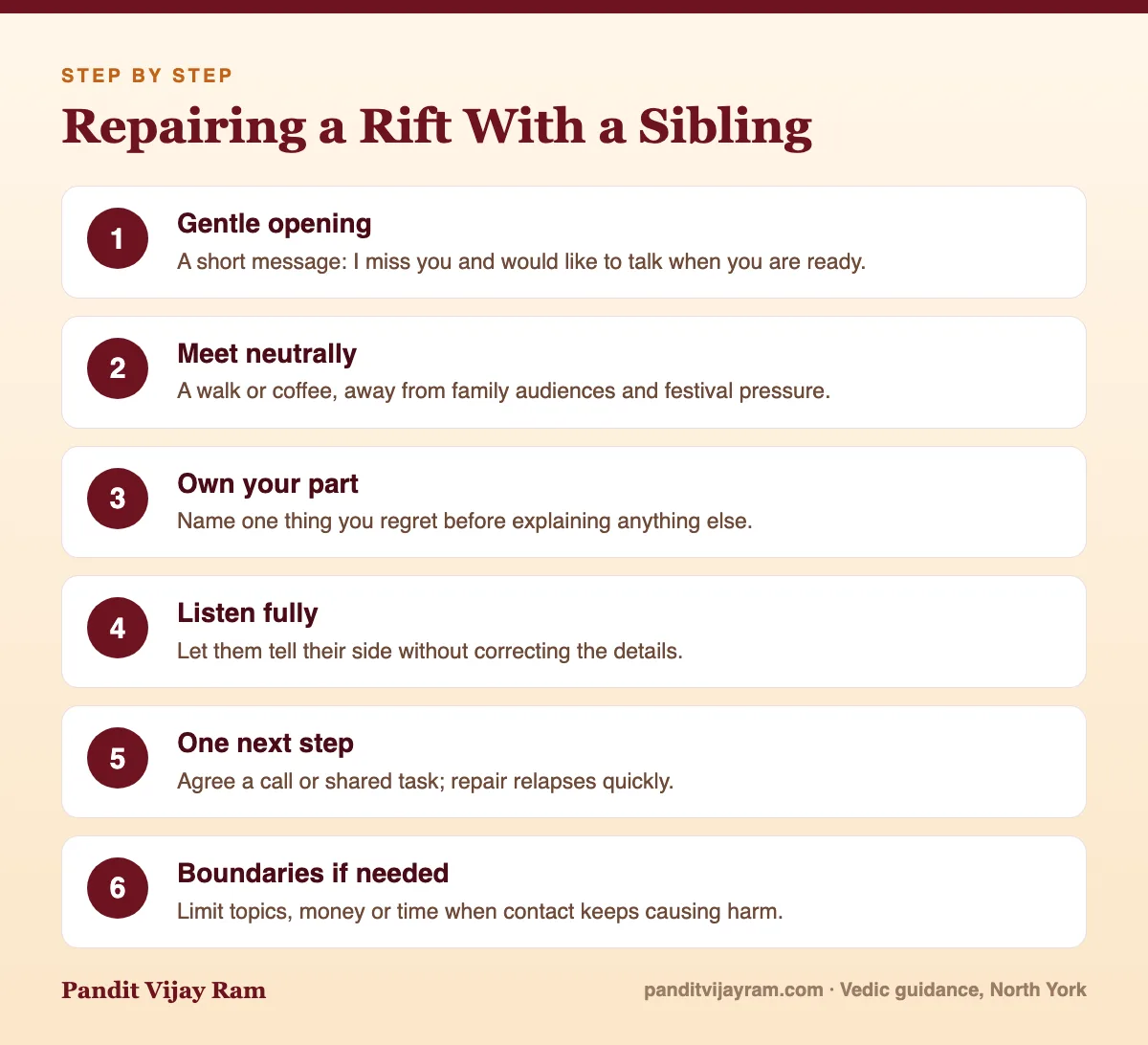
Reconciliation rarely happens in one dramatic talk. It happens through a series of small, safe contacts. A simple repair sequence I suggest:
- Send a gentle opening. "I miss you and I'd like to talk when you're ready." No blame, no conditions.
- Meet briefly and neutrally. A walk or a coffee works better than a family gathering with an audience.
- Name your part first. "I was harsh when Dad was ill" lowers defences faster than any explanation.
- Listen fully. Let your sibling describe their side without interruption, even if you remember it differently.
- Avoid the ledger. Don't list every past wrong. Choose one issue that matters most.
- Agree on a next step. A call next week, or helping each other with a parent's appointment.
- Be patient with relapse. Old tones will return. Repair them quickly rather than walking away again.
Some people find it easier to start in writing. A letter allows you to choose words carefully and gives your sibling time to respond rather than react.
If both of you want to try but conversations keep collapsing, a family therapist or counsellor can provide structure. Many community agencies in the GTA offer family counselling on a sliding scale, and your family doctor can suggest options. Our family problem guidance can sit alongside that work.
How do you set boundaries with a toxic sibling?
Decide clearly what you will and will not accept, such as shouting, borrowing money or criticism of your spouse. State it calmly once, then act on it consistently by ending calls or leaving visits when it is crossed. Boundaries protect the relationship from repeated harm; they are not punishment, and they can loosen as trust returns.
Not every sibling relationship can be repaired quickly, and some should not be forced. Where there is ongoing insult, manipulation or exploitation, distance is a form of self-respect.
Practical boundaries families use:
- Topic limits. "I'm happy to talk about Mum's care, but not about my marriage."
- Money limits. No further loans, stated kindly and without lectures.
- Time limits. Shorter visits, or meeting only at family events where others are present.
- Channel limits. Messages rather than calls, so you can respond calmly.
- Leaving. If the conversation turns to shouting, you end it and try another day.
Tell your parents what you are doing so they are not caught in the middle, but do not ask them to choose sides.
There is a clear line between a difficult sibling and an abusive one. Threats, violence, stalking, or control of a parent's money and documents are not family disagreements. Contact police in an emergency, and seek legal advice if a vulnerable parent is being exploited.
Spiritually, a boundary is not a curse on your sibling. You can keep distance and still pray for their wellbeing. The guide to jealousy and negative energy from others explains how protection can work without retaliation.
What do Raksha Bandhan and Bhai Dooj mean for brothers and sisters?
Raksha Bandhan, on the full moon of Shravan, is the festival where a sister ties a rakhi on her brother's wrist and he promises to protect her. Bhai Dooj, shortly after Diwali, is when a sister applies tilak and prays for her brother's long life. Both celebrate a lifelong bond of mutual care.
These festivals are often reduced to gifts and photographs, but their meaning is deeper. The rakhi is a raksha sutra, a protective thread. In one well-known story, Draupadi tears her sari to bind Krishna's wounded finger, and he later protects her honour. The bond is mutual: each looks after the other.
Bhai Dooj is also called Yama Dwitiya, after the story of Yama visiting his sister Yamuna, who welcomed him with a tilak and a meal. Regional names include Bhau Beej in Maharashtra and Bhai Phonta in Bengal, with Bhai Tika observed in Nepal.
For estranged siblings these days can hurt, but they can also open a door:
- Send the rakhi anyway. A thread in the post, with no demand for a reply, says the bond still matters to you.
- Make it mutual. Many families now have sisters tying rakhi to sisters, or brothers honouring sisters equally.
- Keep the prayer. Light a lamp and pray for your sibling's health even if you do not meet.
- Avoid using the day for confrontation. Let it be a gesture, not a negotiation.
The protective thread tradition is explained further in our post on the kalava and raksha sutra.
Which house in the kundli shows siblings?
In Vedic astrology the third house represents younger siblings, courage and communication, and the eleventh house represents elder siblings, friends and gains. Mars is the natural significator of brothers and sisters. A reading can show the tone of sibling bonds and difficult periods, but it never proves that one sibling is to blame.
When a client asks me to look at a sibling rift in the chart, I consider:
- The third house and its lord. Younger siblings, and also one's own initiative in making contact.
- The eleventh house and its lord. Elder siblings and the wider circle of support.
- Mars. Its strength and aspects describe the warmth or friction in sibling bonds.
- Current dasha and transits. Periods linked to these houses often bring sibling matters to the surface, for better or worse.
I use this to suggest timing and attitude. A strained Mars period may be a time for patience and fewer heated conversations. A supportive period may be a good time to send that first message.
I never tell a client that their brother's chart makes him a bad person, and I never prescribe rituals against a sibling. Remedies are for your own steadiness: Hanuman Chalisa on Tuesdays to temper anger, a lamp for family harmony, and small acts of service.
For a full chart review, see the kundli and horoscope reading. A daily household routine is set out in family peace prayers.
The bottom line
Sibling conflict in adulthood usually grows from old roles, comparison, care of parents and money rather than a single fight. Repair begins with a gentle opening, owning your part and agreeing small next steps, with counselling when patterns run deep. Clear boundaries protect you from repeated harm without cursing anyone. Raksha Bandhan, Bhai Dooj and steady prayer can keep the bond alive while trust returns.
Key takeaways
- Most sibling rifts build slowly from childhood roles and unfairness.
- A short, blame-free message is a better start than a big confrontation.
- Boundaries protect a relationship; they are not a punishment.
- Threats, violence or exploiting a parent are matters for police and lawyers.
- Rakhi and Bhai Dooj can be gentle gestures even during estrangement.