
Starting a Business: Choosing an Opening Muhurat and Name

Opening a business is a proud moment for any family, and many South Asian households want it to begin at the right time. A shop in Scarborough, a restaurant in Brampton, a consultancy launched from a home office in North York: each one is often blessed with a Ganesh puja and a carefully chosen hour. This article explains how a business opening muhurat is chosen, which panchang factors astrologers weigh, how the owner's chart enters the picture, and what to do when real-world constraints like a landlord's handover date get in the way. It also touches on choosing a business name, and sets out the practical registration and planning steps that no muhurat can replace. You will not find specific dates here, because a valid muhurat must be calculated for your city, your chart and your schedule. In more than forty years of practice, I have helped many families pick an opening time. The ones that thrived were nearly always the ones that had also done their homework on location, costs and customers.
What is a business opening muhurat?
A business opening muhurat is a window of time judged favourable in Vedic astrology for beginning commercial activity, such as the first sale, the inauguration puja or the signing of key papers. It is chosen from the panchang, the Hindu almanac, and refined using the rising sign at the moment and the owner's birth chart.
Muhurta is an old branch of Jyotish devoted to choosing times. Weddings, griha pravesh and naming ceremonies all have their own rules, and commercial beginnings, often called vyapar arambh, have theirs.
Families usually choose a muhurat for one of these moments:
- The inauguration puja, often a Ganesh and Lakshmi puja at the premises.
- The first sale, called bohni in many homes.
- Signing a lease, partnership agreement or major contract.
- Launching a website or online store.
You do not need a separate muhurat for every step. Many owners pick one auspicious moment for the puja and first sale, and simply avoid traditionally unfavourable periods, such as Rahu kaal, for the others.
A muhurat is best understood as a blessing on intention. It marks a beginning with care and gathers the family around it. It does not decide sales, profits or survival.
For a wedding-related example of how muhurat must be calculated locally, see our article on wedding muhurat in Canada. For the inauguration ritual itself, our guide to Ganesh puja at home describes a simple method.

Which panchang factors make a good muhurat for opening a shop?
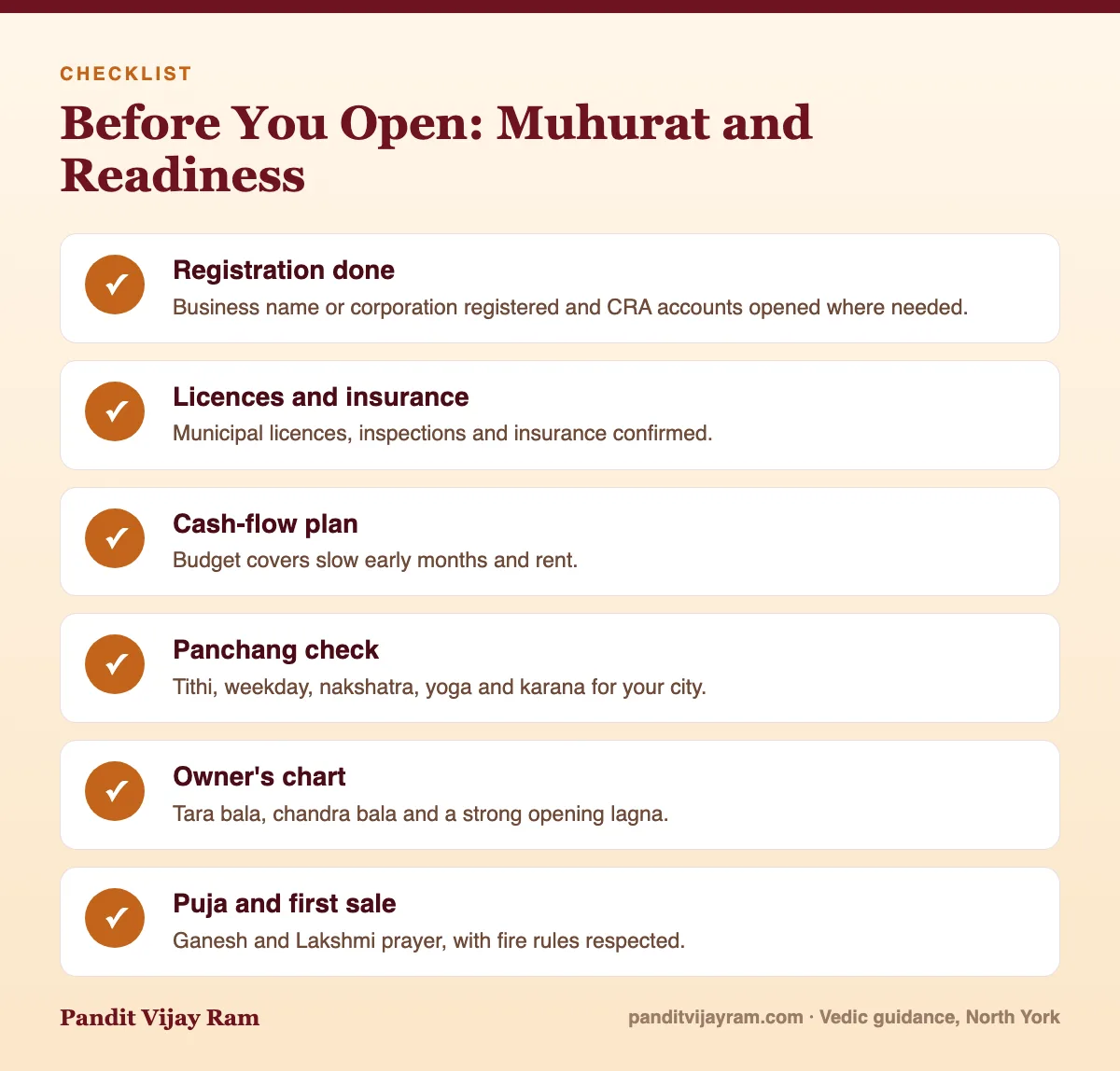
Astrologers look at the five limbs of the panchang: tithi, weekday, nakshatra, yoga and karana. Commercial beginnings traditionally favour waxing-Moon tithis other than the rikta tithis, weekdays such as Wednesday, Thursday and Friday, nakshatras like Pushya, Hasta, Rohini or Revati, and avoidance of Vishti karana and inauspicious yogas.
Here is a summary of the common rules. Regional texts and family traditions vary, so treat these as general guidance.
- Tithi. Shukla paksha, the waxing fortnight, is generally preferred. The rikta tithis, the 4th, 9th and 14th, and amavasya, the new Moon, are usually avoided for openings.
- Weekday. Wednesday, ruled by Mercury, is linked with trade. Thursday, ruled by Jupiter, and Friday, ruled by Venus, are also favoured. Tuesday and Saturday are often avoided for commercial starts, though some traditions accept Saturday for businesses linked with Saturn's themes.
- Nakshatra. Swift nakshatras such as Ashwini, Pushya and Hasta, and gentle ones such as Mrigashira, Chitra, Anuradha and Revati, are often recommended. Fixed nakshatras, including Rohini and the three Uttaras, suit ventures meant to last.
- Yoga. Vyatipata and Vaidhriti are commonly avoided.
- Karana. Vishti, also called Bhadra, is avoided for auspicious beginnings.
- Daily periods. Rahu kaal, yamaganda and gulika kaal are usually avoided within the chosen day.
All of these depend on local sunrise and the Moon's position for Toronto or wherever the business is. A panchang printed for India gives the wrong times for the GTA. Use a Toronto panchang or ask an astrologer to calculate for your location.
Nakshatras are explained in more depth in our guide to nakshatras and the birth star.
How does the owner's birth chart affect the opening time?
A careful astrologer checks the moment against the owner's chart as well as the panchang. Tara bala, based on the day's nakshatra counted from the owner's birth star, and chandra bala, the Moon's position counted from the owner's Moon sign, should be supportive. The rising sign at the opening and its condition are also weighed.
Two people opening businesses on the same day may be given different times, because the owner's chart changes the picture.
- Tara bala. The day's nakshatra is counted from the owner's janma nakshatra and grouped into nine taras. Some, such as sampat and sadhana, are considered supportive; others, such as vipat and naidhana, are avoided.
- Chandra bala. The transiting Moon should not be in the 6th, 8th or 12th sign from the owner's Moon sign, by most rules.
- Muhurat lagna. Fixed signs, Taurus, Leo, Scorpio and Aquarius, are often preferred for enterprises meant to endure. Benefics in kendras and trikonas, an empty 8th house and a strong lagna lord are sought.
- Running dasha. Some astrologers also consider whether the owner's current dasha is supportive of new ventures, though they rarely delay an opening on that alone.
For partnerships, astrologers may check the charts of the main partners, or choose the senior partner's chart.
Do not be alarmed if no perfect moment exists in the weeks you have. Every muhurat is a compromise among several factors. A competent astrologer chooses the best available window and explains the trade-offs plainly.
Vijay Ram ji's business and career guidance includes muhurat selection with the owner's chart.
What if the best muhurat does not fit your lease or schedule?
Practical constraints come first. If the lease starts on a certain day, inspections are pending or staff cannot start yet, choose the best available time within those limits. Many families hold a small puja at the ideal muhurat and open to customers when the business is genuinely ready, or the reverse.
I often see owners strain to hit a muhurat at the cost of something important. That is the wrong order.
A useful decision rule:
- If the business is not legally ready because registration, permits, insurance or inspections are incomplete, do not open to customers just to meet a muhurat. Hold the puja privately and open later.
- If the premises are ready but the ideal day falls weeks away, choose a good-enough day sooner rather than paying rent on an empty shop.
- If staff, stock or systems are not ready, a soft launch is fine. The muhurat can bless the formal opening.
- If the timing clashes with a family event or a religious observance, family harmony matters. Another window will come.
Remember that a commercial landlord may have rules on open flames, smoke or decorations. Ask before lighting a havan or many diyas, and keep fire safety in mind with smoke detectors, sprinklers and stock nearby. Our article on blessing an office or shop covers landlord-friendly methods.
Spiritual practice should make a beginning feel calm and sincere. If chasing the perfect muhurat is causing stress and expense, the chase has missed the point.
How should you choose a business name astrologically and practically?
Start with practical tests: is the name clear, easy to spell, available to register, free of trademark conflicts, and available as a website domain and social handle? Some owners then check a starting syllable or numerology value they find meaningful. Astrological naming should never override legal availability or a name customers can remember.
A name has to work in the market long before it works in a chart. A practical sequence looks like this.
- Brainstorm. List names that describe your offer or carry personal meaning.
- Test with real people. Can customers say it, spell it and remember it after hearing it once?
- Check availability. Search the business name registry where you will register, and check trademark databases for conflicts. Federal or Ontario incorporation may require a name search report.
- Check online. Domain names and social handles should be available or close.
- Add the traditional layer if you wish. Some families like a name beginning with a syllable linked to the owner's nakshatra, or one whose number they consider favourable.
That last step is optional. A business called after a family deity, a place or a founder can carry deep meaning without any calculation.
Numerology for business names is covered honestly in our article on business name numerology, including how the numbers are calculated and why branding matters more. If you want help with name syllables, the gemstone and numerology service can look at it as a matter of personal meaning, not fortune.
What practical steps matter more than the muhurat?
Registration, licences, a written business plan, realistic cash-flow projections, insurance, tax accounts and good bookkeeping matter far more to survival than an opening time. In Canada, that can mean registering a business name or incorporating, getting a CRA business number, checking municipal licensing and zoning, and speaking with an accountant early.
This list is general information, not legal or tax advice. Requirements depend on your structure, province and type of business.
- Choose a structure. Sole proprietorship, partnership or corporation, each with different liability and tax implications. An accountant or lawyer can explain the trade-offs.
- Register. In Ontario, sole proprietors and partnerships operating under a name other than the owner's legal name generally register it provincially. Corporations register provincially or federally through Corporations Canada.
- Get a business number. The Canada Revenue Agency issues business numbers and program accounts, such as GST/HST and payroll, when they apply.
- Check local rules. Many municipalities, including the City of Toronto, license certain types of business and enforce zoning. Food businesses face health inspections.
- Insure. Liability, property and, where needed, professional insurance protect the venture.
- Plan cash flow. Many small businesses struggle because they run out of cash before customers arrive. Plan for slow early months.
- Keep books from day one. Separate business and personal accounts.
The Government of Canada's starting-a-business pages link to these steps, and Ontario's small business resources and local enterprise centres offer free advice. If trade later slows, our article on a business not doing well starts with a numbers-first audit.
The bottom line
A business opening muhurat draws on the panchang's tithi, weekday, nakshatra, yoga and karana, refined by the rising sign and the owner's own chart. It must be calculated for your city and it should bend to practical limits such as lease dates and readiness. A good name passes practical tests before any numerology or syllable check. Most important of all, registration, planning, insurance and cash flow decide whether the business lasts, and the muhurat blesses that work rather than replacing it.
Key takeaways
- A business opening muhurat is chosen from the panchang and the owner's chart.
- Muhurat times must be calculated for your city, not taken from an Indian almanac.
- Practical readiness should come before an ideal muhurat.
- A business name must be clear, available and legally safe before any astrological check.
- Registration, licences, insurance and cash flow matter far more than the opening time.