
Business Name Numerology: Does It Matter?

When someone is about to register a company, a relative will often ask, "Have you checked the number?" Business name numerology is popular in many communities, and owners sometimes delay a launch or pay for a rebrand because a total came out wrong. People in North York ask me about this regularly, sometimes with a list of ten names and a calculator. This article explains plainly how numerologists calculate a business name, why the Chaldean and Pythagorean systems disagree, what the different numbers are said to mean, and what the evidence actually shows. It also gives a practical test for naming that puts customers and the law first, and explains when, if ever, a rename makes sense. In more than forty years of practice, I have seen meaningful names bring families pride and focus. I have also seen frightened owners spend money changing a good name over a single digit. Numbers can carry personal meaning, but they should never be the reason a sound business decision is abandoned or a working brand is thrown away.
How is business name numerology calculated?
Each letter of the name is given a number from a table, the numbers are added, and the total is reduced by adding its digits until one digit remains. Some numerologists also read the two-digit compound total before reduction. Practitioners disagree about whether to include words like Inc. or Ltd., and about spaces and initials.
Here is a worked example with an invented name, Maple Sweets, using the Chaldean table.
- Assign values. M=4, A=1, P=8, L=3, E=5 gives 21 for Maple. S=3, W=6, E=5, E=5, T=4, S=3 gives 26 for Sweets.
- Add the words. 21 + 26 = 47. This is the compound number.
- Reduce. 4 + 7 = 11, then 1 + 1 = 2. The single-digit number is 2.
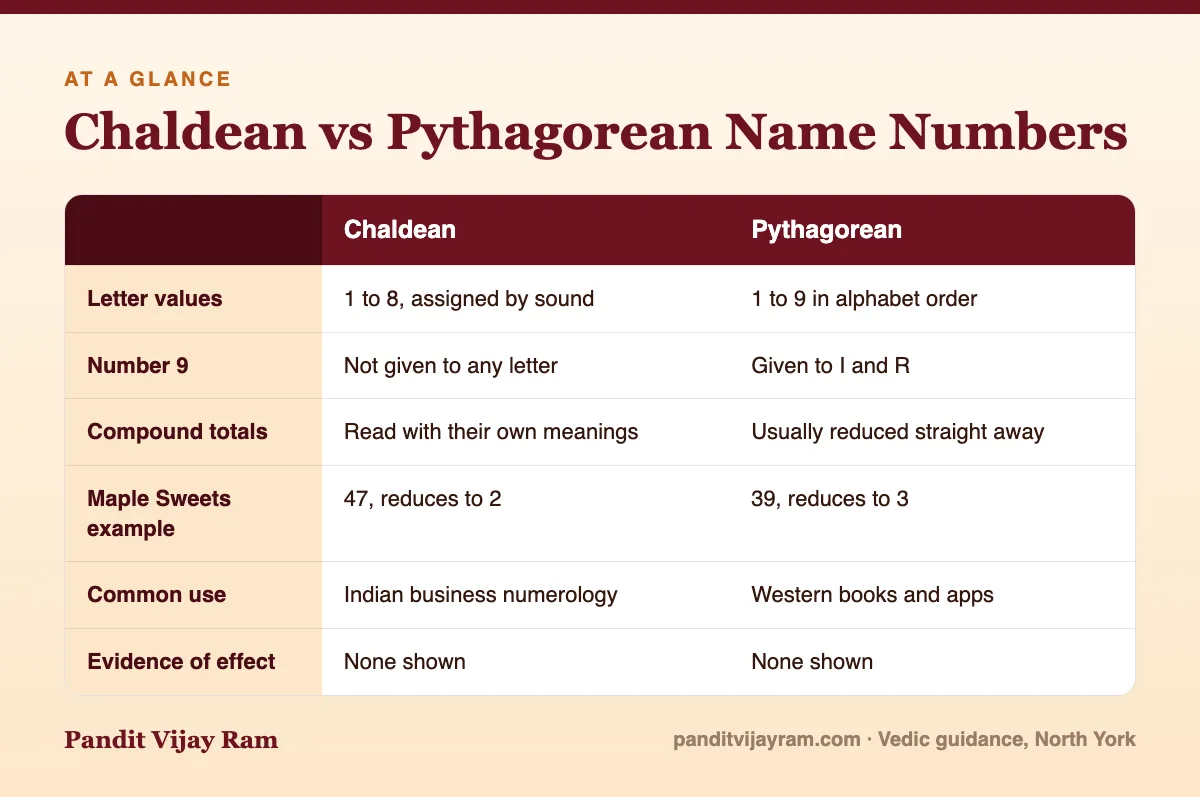
With the Pythagorean table the same name totals 39, which reduces to 3. So one method calls the brand a 2 and the other calls it a 3.
Now add the legal suffix "Inc." In Chaldean values it brings the total to 56, still reducing to 2. In Pythagorean values it also totals 56, which changes that result from 3 to 2. A single word on the incorporation papers can flip the number, depending on which rule you follow.
Practitioners also differ on whether to read the full legal name, the trading name on the sign, or the web domain. Some read all three and look for a pattern.
You can try your own names with the calculators on our numerology tools page. Treat the results as curiosity, not as a verdict.

What is the difference between Chaldean and Pythagorean numerology for a company name?
The Pythagorean system numbers letters in sequence from 1 to 9, so A is 1, I is 9 and J is 1 again. The Chaldean system uses values from 1 to 8 assigned by sound, never uses 9 for a letter, and gives weight to compound numbers. Indian business numerology most often follows the Chaldean table.
A quick comparison:
- Pythagorean: letters run A to I as 1 to 9, J to R as 1 to 9, S to Z as 1 to 8. Simple and common in Western books and apps.
- Chaldean: values 1 to 8 are assigned by the letter's sound and tradition. The number 9 is considered sacred and is not given to any letter, though a total may reduce to 9.
- Compound numbers: Chaldean writers, popularised in English by the palmist Cheiro, give meanings to totals from 10 upward, not only to single digits.
- Vedic overlay: Indian numerologists usually link numbers to planets: 1 Sun, 2 Moon, 3 Jupiter, 4 Rahu, 5 Mercury, 6 Venus, 7 Ketu, 8 Saturn, 9 Mars.
The "Chaldean" label is itself doubtful. Historians find little evidence that ancient Chaldean astronomers used this letter system; it appears to be a much later creation given an old-sounding name.
None of this means the practice has no cultural value. It does mean two numerologists can give opposite advice about the same name, and both will be following a published method. Our article on the life path number explains the same split for personal numbers.
Does a lucky business name number really affect success?
There is no reliable evidence that a name's numerological value affects sales, growth or survival. Business outcomes depend on product, pricing, location, service, cash flow, marketing and economic conditions. Numerology can add personal meaning or confidence for an owner who values it, but it should be treated as a cultural preference, not a business strategy.
Consider how the claim would have to work. If certain numbers brought success, large groups of companies with those numbers should outperform others. No such pattern has been shown, and the disagreement between tables makes it hard even to define which number a company has.
Success stories are easy to find, because people remember the thriving shop with a favourable number. The many favourable-number businesses that closed are rarely discussed. That is selective memory, the same habit that makes many other predictions feel accurate.
What does affect a name's performance is well studied in marketing:
- Clarity. Does the name suggest what you do?
- Pronounceability. Can a customer say it to a friend?
- Spelling. Will people find you when they type it?
- Distinctiveness. Does it stand apart from competitors and avoid trademark conflicts?
- Fit. Does it suit your customers and the feeling you want them to have?
Where numerology can help is softer. An owner who feels good about a name may present it with more conviction. That is a personal benefit, and an honest practitioner should describe it that way. For the wider evidence question, see our article is astrology accurate.
How should you test a business name before registering it?
Test it in this order: say it aloud to people who do not know your plans, check spelling and search results, search the business registry and trademark records for conflicts, check domain and social handles, and only then apply any numerology or syllable preference you hold. If a name fails the practical tests, no number can rescue it.
Here is a decision rule I give owners who want both practical and traditional input.
- Shortlist three to five names. Each should describe your offer or carry a story you can tell.
- The phone test. Say the name to five people. Can they spell it back without help?
- The search test. Type it into a search engine and maps. Is another business already using something similar nearby?
- The registry and trademark test. Check the provincial business registry and the Canadian trademarks database for conflicts. An incorporation may need a formal name search.
- The online test. Are a sensible domain and social handles available?
- The meaning test. Only now, if you wish, look at numerology or a starting syllable linked to your nakshatra.
If two names pass every practical test and you cannot choose, a number you find meaningful is a perfectly reasonable tie-breaker. That is a healthy place for numerology: a final, personal preference among good options.
Registration, licences and an opening time are covered in our guide to choosing a business opening muhurat and name. If you would like a calm conversation about name syllables, the gemstone and numerology service treats it as personal meaning rather than fortune.
Should you change your business name because of numerology?
Rarely, and never out of fear. Renaming an established business can cost signage, printing, legal filings, a new domain, lost search ranking and customer confusion. If trade is slow, examine pricing, marketing, location and cash flow first. A rename makes sense for practical reasons, such as a trademark conflict or a changed offer, not because a total is unlucky.
Owners usually consider a numerology rename when business is struggling and someone tells them the name is to blame. That is the moment to slow down.
Before any change, run a short audit:
- Are customers finding you? Check search listings, reviews and foot traffic.
- Is your pricing right for your area and competitors?
- Is cash flow the real problem, rather than demand?
- Has the market changed around you?
Our article on a business that is not doing well sets out a numbers-first audit in more detail.
Small spelling tweaks are a common middle path, such as adding a letter to change the total. They are cheaper than a full rebrand, but they can still confuse customers and search engines, and they create mismatches between legal documents and signage. The same caution applies to personal names, as our article on changing a name's spelling for numerology explains.
If someone tells you that your name will ruin your business unless you pay for a correction, treat it as a warning sign. Genuine guidance does not need fear to persuade you.
The bottom line
Business name numerology adds up letter values from a Chaldean or Pythagorean table, and the two systems often give different answers for the same name. There is no evidence that a name's number affects success, while clarity, spelling, distinctiveness and legal availability clearly do. Test names practically first, use numbers at most as a personal tie-breaker, and never rename a working business out of fear. Seen that way, business name numerology can be a small, meaningful custom rather than a costly worry.
Key takeaways
- Business name numerology adds letter values and reduces the total to a key number.
- Chaldean and Pythagorean tables often give different numbers for the same name.
- No evidence links a name's number to sales or survival.
- Clarity, spelling, trademark safety and online availability should decide the name.
- Do not rename an established business because of a frightening number.