
Space Clearing for an Office or Shop: Vedic Steps for Business Premises
Office space clearing is something many business owners ask about quietly. A shop in Scarborough has slow weeks after a dispute with a supplier. A small accounting office in North York feels tense since two staff left on bad terms. A new restaurant owner in Vaughan wants to open with blessings, but the lease says no open flame. This guide walks through business premises the way a Vedic practitioner does: entrance first, then the cash counter, the owner's desk, staff and storage areas, and finally the opening or reopening puja to Ganesha and Lakshmi. It explains which practices are traditional, which are simply good management, and how to adapt rituals so they respect the landlord, the fire code and staff of different faiths. In more than forty years of practice I have visited many shops and offices, and I have found that a cluttered back room or a broken sign often weighs on a business more than anything unseen. Spiritual practice works best on top of sound operations, not instead of them. Neither replaces a good accountant, a fair lease or honest service to customers.
How do you clear negative energy from a shop or office?
Start with a practical walk-through: fix broken fixtures, clear clutter and improve lighting. Then cleanse zone by zone, beginning at the entrance and moving to the cash counter, the owner's desk, staff areas and storage. Use salt-water mopping, a bell, a brief lamp and a mantra, finishing with a short Ganesh and Lakshmi prayer.
A business premises carries the mood of everyone who passes through it: customers, staff, delivery drivers, inspectors. Some heaviness is just wear and tear. The first round of clearing is therefore physical.
Walk the space with a notebook and look for:
- Burnt-out bulbs, flickering tubes and dark corners.
- Broken chairs, cracked glass, dead plants and stopped clocks.
- Boxes stacked in walkways, old stock, expired flyers.
- A back room or washroom nobody wants to enter.
- Signage that is faded, crooked or partly unlit.
Fix or remove what you can within a week. Vastu tradition treats broken and stagnant objects as drains on prosperity; ordinary business sense treats them as signals to customers that nobody is paying attention.
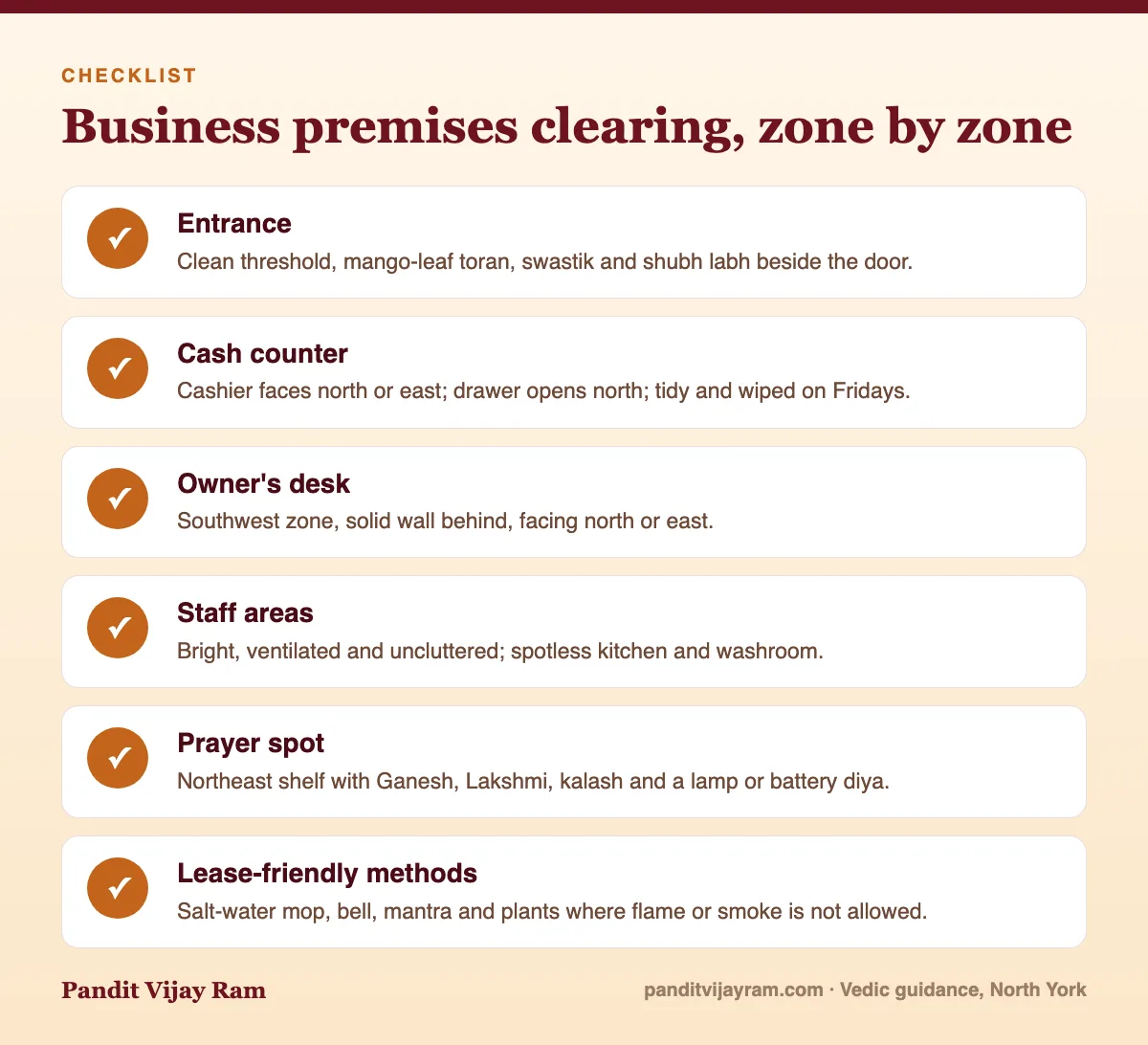
Then do the cleansing itself, after hours, in this order: entrance, customer area, cash counter, owner's desk, staff areas, storage and washrooms. Moving from the front inwards means the welcoming spaces are refreshed first. Mop the floors with a handful of rock salt in the water where the floor type allows; the dedicated guide to salt-water mopping lists floor cautions. Ring a bell in each zone, light a lamp briefly at the chosen prayer spot, and recite the Ganesh mantra Om Gam Ganapataye Namah eleven times. The cleansing and protection hub has more home methods that adapt well to a workplace.

Where should the cash counter face according to vastu?
Vastu tradition places the cash counter or safe so that the person handling money faces north or east, with the cash box opening towards the north, the direction associated with Kubera, the guardian of wealth. The counter should be clean, uncluttered and well lit, with no broken drawers or leaking pipes nearby.
The cash counter is the zone owners care about most, and the one where small fixes are easiest. Traditional guidance, adapted for typical GTA retail units:
- Direction. The cashier ideally faces north or east. The safe or cash drawer sits in the south or southwest part of the counter and opens towards the north. If the layout cannot change, a clean, steady counter matters more than exact direction.
- Order. Keep receipts, coins and paperwork sorted. A drawer jammed with old slips is the opposite of flow.
- Symbols. Many owners place a small Shree Yantra or Kuber Yantra inside the drawer, a swastik drawn in turmeric or sindoor on the box, or a coin from the first sale kept separately.
- Weekly care. On Friday, the day of Lakshmi, wipe the counter with clean water and a little rock salt and light a lamp briefly nearby.
- Avoid. Mirrors reflecting the cash box out of the door, a dustbin beside the till, and water leaks near the counter.
In a shared office, the equivalent is the desk or cabinet where invoices and the company chequebook live. Keep it tidy and clean, and give it the same weekly wipe.
For a full premises layout, a vastu consultation looks at the floor plan, entrance and owner's seat together. Vastu suggestions should always work within your lease and building rules.
How should the owner's desk and staff areas be arranged for a calm workplace?
The owner or manager traditionally sits in the southwest of the premises, back to a solid wall, facing north or east. Staff areas should be bright, ventilated and free of clutter, with a clean kitchen and washroom. Fair treatment of staff matters as much as any ritual for the atmosphere of a workplace.
Vastu describes the southwest as the zone of stability and authority, which is why the owner's cabin or desk is often placed there. A solid wall behind the chair is said to give support; a window or door behind it is considered unsettling. Facing north or east is linked with clear thinking and opportunity.
For staff:
- Light and air. Natural light where possible, good ventilation, and lamps that do not flicker.
- Seating. Staff ideally face north or east too, and nobody should sit directly under a heavy beam if it can be avoided.
- Kitchen and washroom. Kept spotless. Vastu places the pantry in the southeast, the fire zone. A grimy staff kitchen sours a workplace faster than most things.
- Storage. Heavy stock and archives in the south or west rather than the northeast.
- The northeast corner. Kept light and open, often for a small prayer shelf or simply a plant and water feature.
Staff of many faiths work in GTA businesses. Keep any shrine modest and placed where people can pass it without feeling obliged to take part, and never pressure anyone to join prayers. A workplace where people are paid on time, spoken to with respect and given clear roles already has the most important protection.
When tension in a business follows a dispute or the departure of a partner, the business and career guidance page explains how chart timing and practical review are combined.
Which puja is done when opening a new shop or office?
Most Hindu businesses open with a Ganesh puja to remove obstacles and a Lakshmi puja for prosperity, often together as a Lakshmi-Ganesh puja on a muhurat chosen from the panchang. Larger premises may add a vastu shanti and a small havan. Many owners also perform chopda or ledger puja at Diwali each year.
An opening puja, sometimes called udghatan, sets the intention for the business. A typical sequence for a shop or office:
- Choosing the time. A priest selects a muhurat from the panchang, avoiding Rahu kaal and inauspicious tithis.
- Entrance. A toran of mango leaves above the door, a swastik and the words shubh labh, auspicious profit, drawn in sindoor or turmeric at either side.
- Kalash sthapana. A copper or brass pot of water with mango leaves and a coconut placed at the prayer spot, usually in the northeast.
- Ganesh puja. Offerings of durva grass, modak or laddoo, and the mantra Om Gam Ganapataye Namah.
- Lakshmi puja. Lotus or red flowers, a lamp, kumkum and the Shri Suktam or Om Shreem Mahalakshmyai Namah.
- Blessing the tools. The till, ledger, laptop or first stock item is marked with kumkum and placed before the deities.
- Vastu shanti or havan. For larger or troubled premises, if flame is allowed.
- First sale and sweets. The first sale is accepted with gratitude, and sweets are shared with staff, neighbours and early customers.
Each Diwali, many owners repeat a smaller version with chopda pujan, blessing the new account books. Reopening after a renovation, a slow season or a dispute can follow the same outline. If a business owner believes the trouble runs deeper, the guide to spell removal for business and career explains how that concern is checked carefully before any removal work.
How can you cleanse a rented office or mall unit without breaking lease or fire rules?
Use smoke-free and damage-free methods: salt-water mopping after hours, a bell or conch, a battery diya, recorded or spoken mantra, live plants and removable symbols such as stick-on swastiks or a framed yantra. Ask property management in writing before any open flame or havan, and never cover smoke detectors or sprinklers.
Most commercial leases in Toronto and the wider GTA restrict open flame, smoke and permanent alterations. Mall units and office towers often have sensitive detectors that can trigger a building-wide alarm and a fire department response. A landlord-friendly approach keeps the spirit of the practice and avoids trouble.
Methods that usually fit any lease:
- Water and salt. Mopping with a little rock salt, or wiping counters and desks with salted water, after closing.
- Sound. A puja bell, a conch blown once at opening time, or a recording of the Ganesh or Lakshmi mantra at low volume.
- Light. A battery-operated diya at the prayer shelf, switched on each morning.
- Symbols. A framed Shree Yantra, a removable swastik sticker, a toran on a tension rod rather than nails.
- Plants. A tulsi or money plant near the entrance or in the northeast, cared for well.
- Fresh flowers. Changed before they wilt.
If you want a full havan for opening, ask property management in writing, explain the size of the fire, and offer to schedule it with detectors isolated by the building's own staff. Alternatively, hold the havan at the temple or at home and bring the blessed kalash water to sprinkle at the shop.
The threshold practices in the guide to main door cleansing also adapt neatly to a shop entrance.
The bottom line
Office space clearing works best as a sequence: practical repairs and order first, then a zone-by-zone cleansing from the entrance to the cash counter, the owner's desk and staff areas. A Lakshmi-Ganesh puja at opening, and a yearly chopda pujan, keep the intention fresh. Choose smoke-free methods that respect your lease and fire rules, and keep any shrine welcoming to staff of every faith. Sound management and fair treatment of people remain the foundation.
Key takeaways
- Fix lighting, clutter and broken fixtures before any ritual.
- Cleanse from the entrance inwards, zone by zone, after hours.
- Vastu places the cash box opening north and the owner in the southwest.
- Open with a Lakshmi-Ganesh puja on a muhurat from the panchang.
- Use salt water, sound and battery lamps where leases forbid flame.