
Kali Puja and Protection: What the Fierce Mother Represents
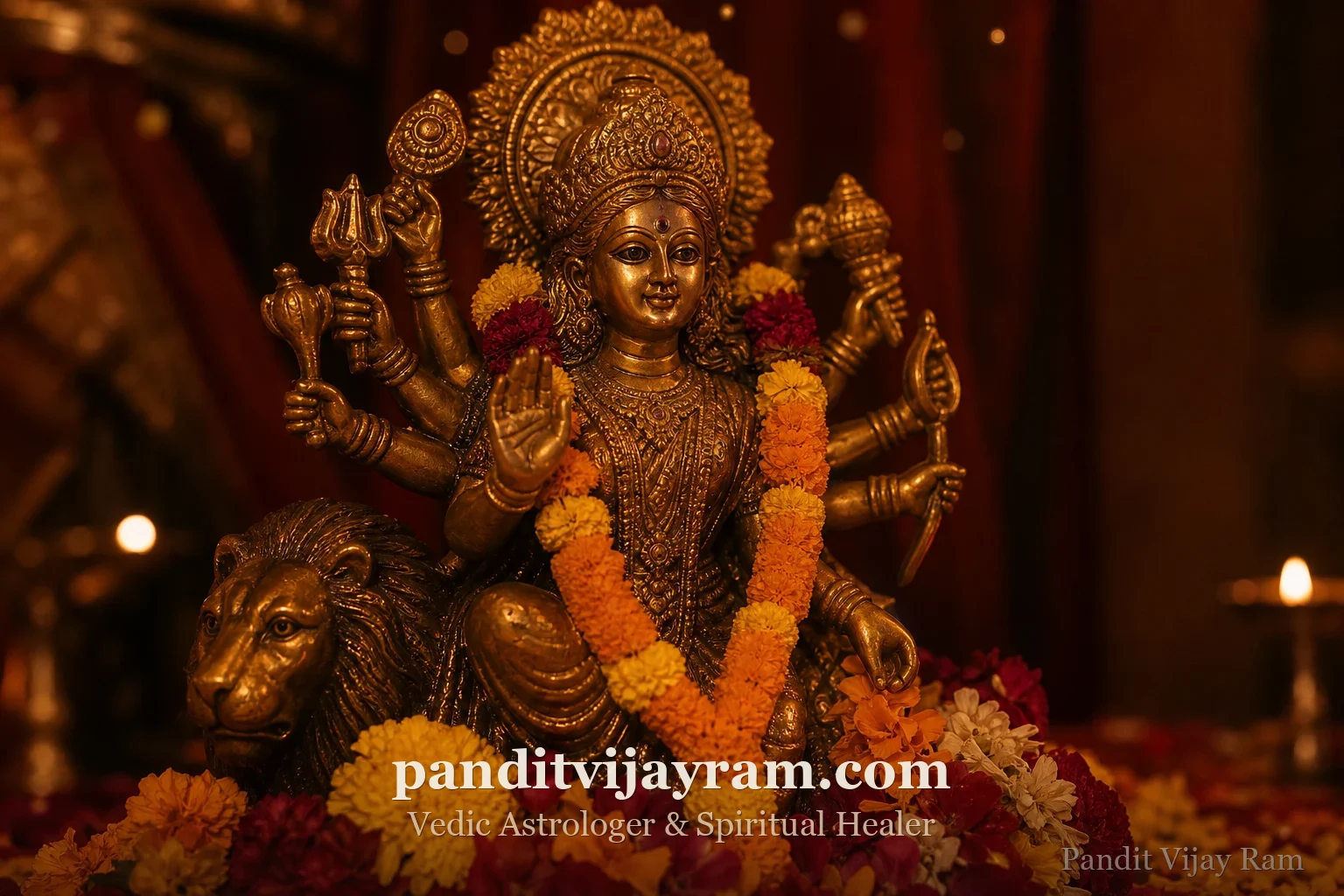
Many people first meet Maa Kali as a frightening picture: dark skin, a red tongue, a garland of heads, a sword raised high. It is no wonder that some assume she is connected with curses or black magic. Devotees see something very different: a mother so protective that nothing harmful can stand in front of her. Families in North York, Scarborough and Brampton, especially those with Bengali, Assamese, Odia and Caribbean Hindu roots, often ask me about Kali puja protection, and just as often ask whether her worship is safe at home. In this guide you will learn what each part of Kali's form represents, why the black magic idea is a misunderstanding, when and how Kali Puja is celebrated, which prayers families use, and when guidance from a priest matters. Over more than forty years I have watched people's fear of Kali soften the moment they understand her symbolism. She is called Ma, mother, and the tradition has always treated her that way. Everyday troubles still need their practical answers too.
What does Maa Kali represent?
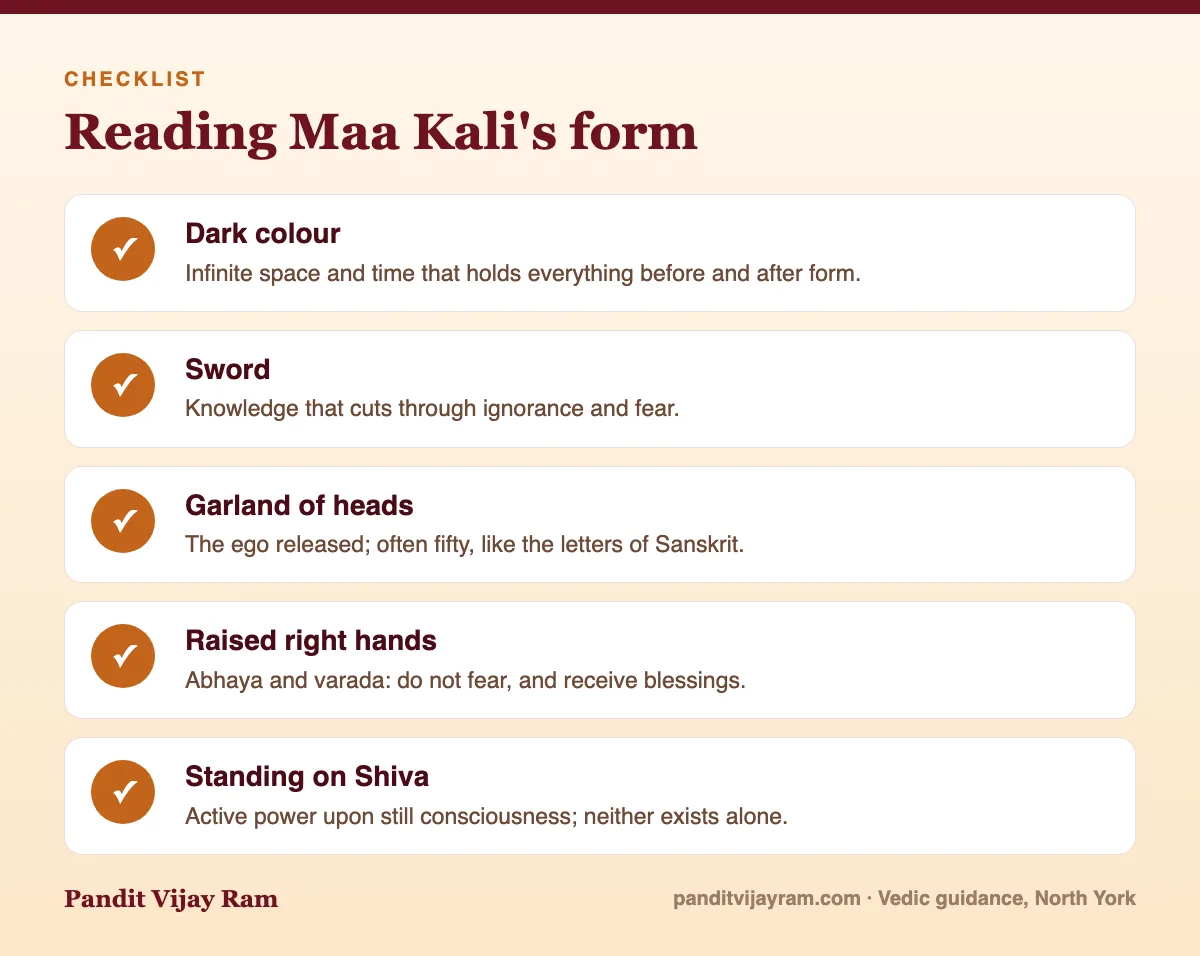
Kali represents the power of time and transformation that ends ignorance, ego and evil. Her name is linked to kala, meaning both time and black. Each fierce element of her image carries a meaning: the sword cuts ignorance, the garland of heads stands for the ego and its many forms, and her raised hands offer fearlessness and blessings.
Kali's iconography is detailed, and each part has traditional readings. Interpretations vary, but these are widely taught.
- Dark colour. The dark of infinite space and of time that contains everything, before form and after it. Some describe her as blue-black, like the night sky.
- Sword and severed head. The sword of knowledge cutting away ignorance; the head is the ego that has been released.
- Garland of heads. Often said to be fifty, matching the letters of the Sanskrit alphabet, the sounds from which all words and ideas arise.
- Skirt of arms. Human actions, or karma, which the Mother accepts and transforms.
- Raised right hands. In the common Dakshina Kali image, one hand shows abhaya, do not fear, and the other varada, granting boons.
- Standing on Shiva. Shiva as pure consciousness lying still, Kali as the active power. Neither exists without the other.
In the Devi Mahatmya she emerges from the Goddess's brow to destroy the demons Chanda and Munda, and later the demon Raktabija, whose every drop of blood spawned a copy of himself. Her protruding tongue is often linked to that story. The guide to the Durga Saptashati path explains where these chapters sit in the text.
Is Kali a goddess of black magic?
No. Kali is worshipped in mainstream Hindu temples and homes as the Divine Mother, and great saints such as Ramakrishna Paramahamsa devoted their lives to her. The black magic association comes from her fierce appearance, her link with cremation grounds and some tantric practices, and from films and rumour. Her worship asks for protection and liberation, not harm.
This misconception does real harm, so it is worth correcting gently.
Where the idea comes from. Kali is associated with the cremation ground, a place many people fear. Some tantric traditions worship her at night with specialised practices. Popular films sometimes show villains invoking her. Together these images can make people assume her worship is dark or dangerous.
What the tradition actually teaches.
- The cremation ground symbolises the end of ego and attachment, the place where all false identities fall away. It is a teaching about freedom, not about curses.
- Ramakrishna served as priest of the Kali temple at Dakshineswar near Kolkata and spoke of her as his loving mother. The poet Ramprasad Sen wrote devotional songs to her that are still sung.
- She is the first of the ten Mahavidyas, the great wisdom goddesses, a role tied to knowledge rather than sorcery.
- Hindu ethics, including in tantra, condemn using spiritual power to injure others.
When someone claims to perform harmful rituals in Kali's name, that is a misuse of her name. The older guide what is black magic explains how the tradition views such practices, and the article on negative energy scam warning signs describes how fear is sometimes sold.
When is Kali Puja celebrated and how is it done?
Kali Puja, also called Shyama Puja, is held on the new-moon night of the month of Kartik, the same night as Lakshmi Puja at Diwali in much of India. It is especially important in West Bengal, Assam, Odisha and among Bengali communities abroad. Worship takes place at night with lamps, red hibiscus, sweets and recitation.
While many North Indian homes worship Lakshmi on Diwali night, Bengali and Assamese families often worship Kali, praying for protection from darkness in every sense. In the Caribbean Hindu community, Kali is also widely honoured, with her own temples and festivals in places such as Guyana and Trinidad.
A typical Kali Puja includes:
- Preparing the shrine. An image or clay murti of Kali, often Dakshina Kali, on a red or black cloth, with many lamps.
- Invocation. The priest calls the Goddess into the image with mantra and a sankalp for the household.
- Offerings. Red hibiscus, known in Bengali as jaba, is her favoured flower. Sweets, fruit, lentils, rice and cooked dishes are offered.
- Recitation. Hymns, the 108 names of Kali, and in many homes devotional songs called Shyama Sangeet.
- Homa and arati. A fire offering in larger pujas, followed by arati and the sharing of prasad.
Historically some temples included animal offerings; today most households and many temples use fruits such as pumpkin or sugarcane instead, or simply flowers and sweets. Because the date follows the lunar calendar, check a local panchang. For guided worship, the Durga puja and havan service covers the Mother's fierce and gentle forms.
How can I worship Maa Kali at home for protection?
Keep it simple and devotional. Light a ghee or mustard-oil lamp before an image of Kali, offer a red flower, and recite a short prayer such as the verse Jayanti Mangala Kali. Tuesdays, Saturdays and new-moon nights are traditionally favoured. Pray for courage and shelter for your family, never for harm to anyone else.
Many families feel hesitant about keeping Kali at home. In mainstream practice, a gentle image of Dakshina Kali in the home shrine is entirely acceptable, and many Bengali homes have done so for generations.
A simple weekly routine:
- Clean the shrine and place a fresh red hibiscus or any red flower before the image.
- Light a lamp with ghee or mustard oil and a stick of incense.
- Recite the Argala verse: Jayanti Mangala Kali Bhadrakali Kapalini, Durga Kshama Shiva Dhatri Svaha Svadha Namostute. It praises the Mother through her many names, including Kali and Bhadrakali, the auspicious Kali.
- Sit quietly for a few minutes, picturing her raised hand that says do not fear.
- Offer something sweet and share it as prasad.
Many people also honour Kali as Kalaratri on the seventh night of Navratri. For choosing a suitable day, see the guide to the best day for spiritual cleansing. The magic and entities hub has further guides on protective practice.
Which Kali mantra is used for protection?
The most familiar is Om Kreem Kalikayai Namah, a short salutation using Kali's seed syllable kreem. Many households prefer verse prayers such as Jayanti Mangala Kali or the 108 names of Kali, which need no initiation. Longer tantric Kali mantras are traditionally taught by a guru in a lineage and should not be learned from videos.
I sort Kali prayers into three groups, so families can choose with confidence.
- Verse prayers and names. The Argala verse above, the Kali Ashtottara Shatanamavali (108 names), and devotional songs. Suitable for anyone, including children.
- Short salutation with seed syllable. Om Kreem Kalikayai Namah is widely chanted. Many teachers are comfortable with householders using it with devotion and a calm count of 11 or 108. Others prefer that seed-syllable mantras be received from a teacher. If your family has a guru, ask them.
- Tantric sadhana. Night practices, cremation-ground worship and longer mantras with multiple seed syllables belong to initiated lineages. They are not shortcuts to protection, and attempting them without guidance is discouraged across the tradition.
Pronunciation matters but should not frighten you. Say kreem with a long ee and a soft closing m, and Kalikayai as ka-li-KAA-yai. Listen to a priest if you can. If fear or disturbed sleep is behind your interest, consider also seeing your family doctor; prayer works well alongside care. For structured help with protection, the black magic removal service explains what a guided, non-harmful approach looks like.
The bottom line
Kali puja protection means seeking the shelter of the fierce Mother whose sword cuts away ignorance and whose raised hand says do not fear. She is a revered goddess of mainstream Hindu devotion, honoured by saints and poets, not a deity of black magic. Simple home worship with a lamp, a red flower and a verse prayer is open to all, while tantric forms belong with a qualified teacher.
Key takeaways
- Kali represents time, transformation and the ending of ego and ignorance.
- Her fierce image is symbolic; her raised hands grant fearlessness and blessings.
- Kali is a mainstream mother goddess, not a deity of black magic.
- Kali Puja falls on the new-moon night of Kartik, the night of Diwali.
- Verse prayers suit everyone; tantric Kali practice needs a qualified teacher.