
Tantra Is Not Black Magic: Clearing a Common Misunderstanding
Search for a pandit online and you will soon meet adverts for a "tantrik baba" promising to control a lover, destroy an enemy or remove black magic within days. No wonder so many people now think the word tantra means sorcery. The real tantra meaning is far wider and far older. When families in North York ask me whether tantra is dangerous, I explain that the puja they perform at home, the temple worship they attend, and the mantras they recite all carry tantric influence. This article sets out what the word means, which traditions are tantric, what tantric texts teach, why a small set of rites gave the whole field a bad name, and how Western neo-tantra differs again. You will also learn how to tell real teaching from online fear-selling. In more than forty years of Vedic practice I have used mantra, yantra and puja daily, and I have never needed to harm anyone to help someone. That is the heart of the matter.
What does the word tantra mean?
The Sanskrit word tantra comes from the root tan, to stretch or weave, and literally means a loom or the warp of a fabric. By extension it came to mean a system, a framework or a treatise. In religion it refers to a large body of texts and the practices they teach.
The word was used in early Sanskrit for many kinds of technical treatise; even a work on statecraft or medicine could be called a tantra. Over time it came to name a specific group of religious texts, often framed as dialogues between Shiva and the Goddess, that teach initiation and worship. Related texts are called agamas ("that which has come down") or, in Vaishnava tradition, samhitas.
Core features of tantric practice include:
- Diksha: initiation by a qualified guru.
- Mantra: sacred sound, often seed syllables called bija mantras.
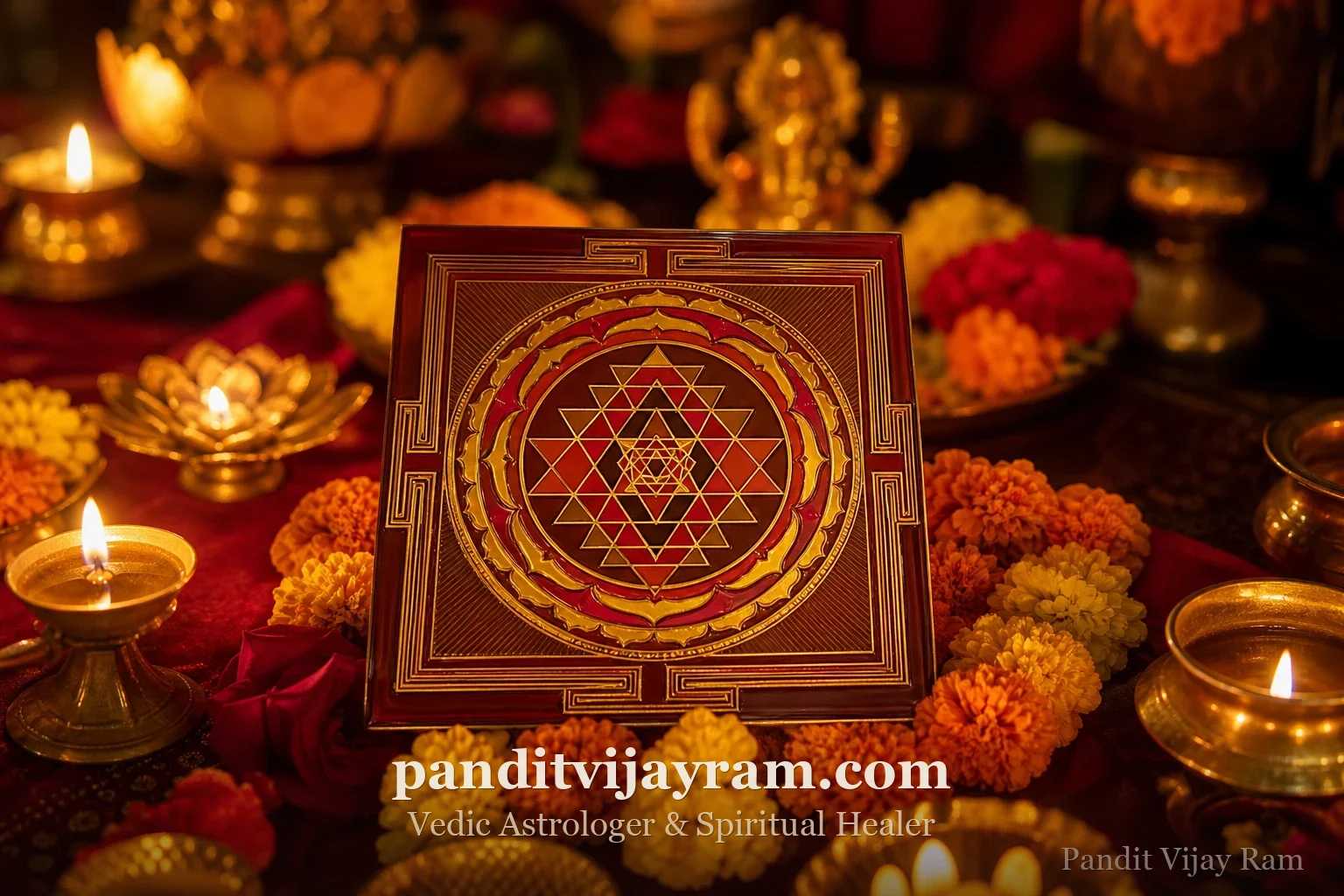
- Yantra and mandala: geometric diagrams that serve as seats of a deity.
- Nyasa and mudra: placing mantras on the body and using hand gestures.
- Puja: ritual worship with offerings, lamps and visualisation.
- Kundalini and the subtle body: meditation on energy centres.
If you have ever placed flowers on a Sri Yantra, recited a bija mantra to Durga, or watched a priest perform nyasa before a puja, you have seen tantric elements in ordinary Hindu worship. The guide on Kali puja for protection shows a tantric-influenced practice that is entirely devotional.
Which traditions are tantric?
Tantra spans several religions. Within Hinduism there are Shaiva tantras (including Kashmir Shaivism and Shaiva Siddhanta), Shakta tantras (such as Sri Vidya and the Kaula schools), and the Vaishnava Pancharatra. Buddhist Vajrayana in Tibet and the Himalaya is tantric, and Jain tradition also has tantric ritual.
A short map helps place the word correctly:
- Shaiva Siddhanta: a dualist Shaiva school whose agamas still govern worship in many South Indian Shiva temples.
- Kashmir Shaivism: a non-dual philosophy; the scholar Abhinavagupta wrote the Tantraloka, a major tantric encyclopedia.
- Shakta traditions: worship of the Goddess as supreme, including Sri Vidya, centred on the Sri Yantra and Lalita Tripurasundari, and the Kaula lineages.
- Pancharatra: Vaishnava texts that shape worship in many Vishnu temples.
- Vajrayana Buddhism: Tibetan and Himalayan practice with deity yoga, mandalas and initiations.
Scholars often distinguish dakshinachara, the "right-hand" path, which keeps to conventional purity, from vamachara, the "left-hand" path, which in some lineages used substances and acts normally forbidden, in order to break attachment to purity and impurity. Many right-hand teachers interpret those elements symbolically.
The Mahavidyas, ten forms of the Goddess, come from Shakta tantra. The guide to Baglamukhi puja explains one of them and why her worship is about stillness, not harming opponents.
Why do people confuse tantra with black magic?
Some tantric texts do describe rites for worldly ends, including a group called the six acts, which range from pacifying harm to attracting, immobilising or even harming others. Colonial writers, sensational media and modern online advertisers seized on these, so a small part of a vast tradition came to stand for the whole.
Honesty matters here. The shatkarma, or six acts, appear in a number of tantric manuals. They are usually listed as:
- shanti, pacifying illness or misfortune;
- vashikarana, bringing under influence;
- stambhana, immobilising or stopping;
- vidveshana, creating enmity;
- uccatana, driving away;
- marana, causing death.
Classical teachers often warned that the harmful acts carried grave karmic consequences, and many lineages forbade them. Their existence in some texts does not make tantra a system of sorcery, any more than a medical textbook's list of poisons makes medicine a system of poisoning.
Colonial-era scholars and missionaries also wrote of tantra as degenerate, focusing on the left-hand rites. Later translators and Indian scholars presented a fuller picture of its philosophy and devotion. Today, online advertisers use "tantrik" mainly as a sales word for love control and enemy destruction. That commercial use is the real source of confusion. For the Vedic view of harmful magic itself, see what black magic means in Vedic thought.
Is tantra about sex?
Mostly not. In Hindu and Buddhist tradition, tantra is primarily about initiation, mantra, ritual, meditation and liberation. Sexual symbolism and, in a few left-hand lineages, ritual sexual union appear, but they are a small, restricted part. The modern Western idea of tantra as sex technique, often called neo-tantra, is a recent reinterpretation.
The confusion is understandable. Tantric art can depict divine couples, and the left-hand lists of "five Ms" (panchamakara) include maithuna, ritual union, alongside wine, meat, fish and parched grain or gesture. In most traditional settings these were initiatory, rare and symbolic, or replaced entirely with substitutes.
A clear comparison helps:
- Traditional tantra: guru, initiation, mantra, deity worship, philosophy, aimed at liberation (moksha) and worldly wellbeing.
- Neo-tantra: workshops on intimacy, breathing and relationships, developed mainly in Western countries, with loose links to Indian texts.
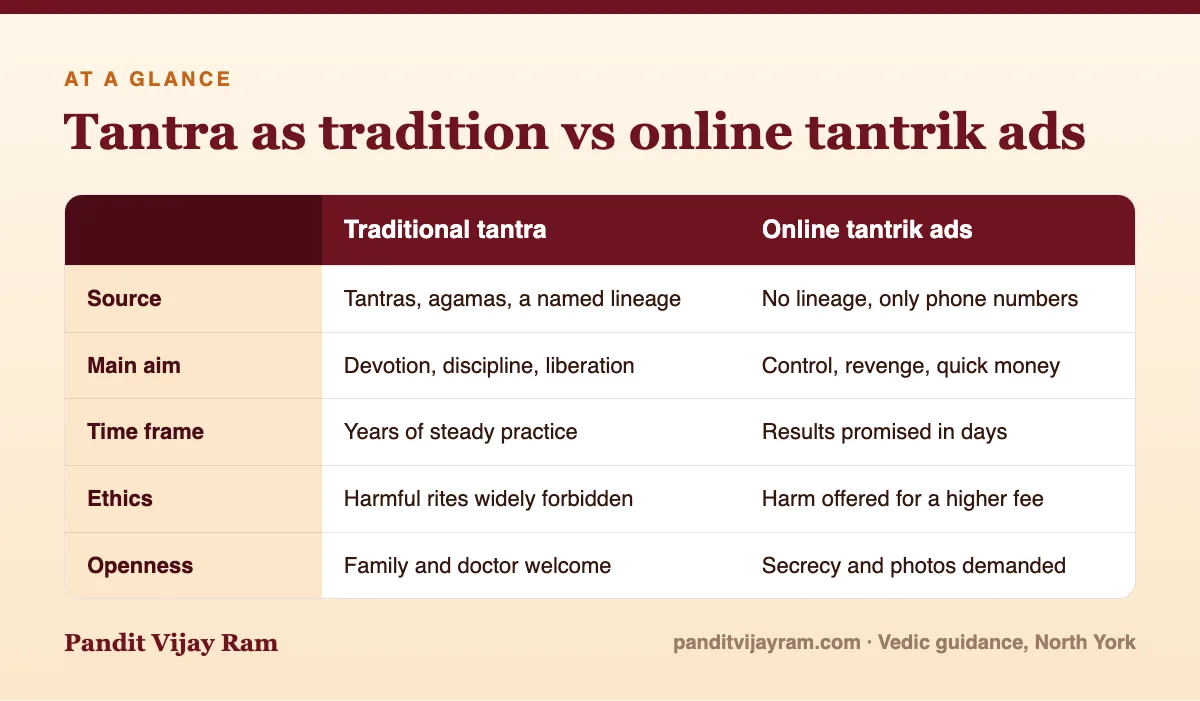
- Online "tantrik" services: sales of spells for love control, revenge or quick money, with no connection to either.
None of these require judging anyone's private life. But it is fair to say that a couples' workshop and a temple agama are very different things. If you are seeking help with a relationship, honest counselling and prayer serve better than any of the three; the love marriage consultation describes a respectful approach that never overrides another person's will.
How can you tell genuine tantric teaching from online scams?
Genuine tantric teaching comes through a lineage, a known teacher, long study and ethical rules, and focuses on devotion and inner discipline. Scams promise control over another person, enemy destruction, or sure-fire love or money, and ask for rising payments, photos or secrecy. Real teachers do not sell harm.
Use a simple test before trusting anyone who calls themselves a tantrik:
- Lineage: can they name their guru and tradition, and does that tradition exist?
- Aim: do they speak of devotion, discipline and peace, or of controlling and punishing people?
- Time: do they expect long, steady practice, or promise results in days?
- Ethics: do they refuse harmful work, or offer it for a higher fee?
- Openness: do they welcome your family and doctor, or demand secrecy?
- Payment: are fees clear and fixed, or do they grow with each new "obstacle"?
In my own practice, mantra, yantra and puja are tools of prayer for the person in front of me and their household. I do not perform rites to bind, harm or destroy anyone. The puja and anushthan page explains how such worship is arranged, and more articles are in the magic and entities hub. If you have lost money to a fake tantrik, report it to the Canadian Anti-Fraud Centre.
The bottom line
The true tantra meaning is a woven framework of texts and practices, from Shaiva and Shakta worship to Pancharatra and Vajrayana. A few rites for worldly or harmful ends exist in some manuals, but they do not define a tradition centred on initiation, mantra and devotion. Online tantrik adverts that promise control or revenge are scams, not tantra.
Key takeaways
- Tantra comes from a Sanskrit root meaning to weave or stretch.
- Shaiva, Shakta, Vaishnava, Buddhist and Jain traditions all have tantric forms.
- Much ordinary Hindu temple worship follows agamic and tantric rules.
- The six acts appear in some texts but were often condemned by teachers.
- Online tantriks promising control or revenge are selling fear, not tradition.