
Words Said in Anger: Can a Family Argument Become a Curse?

Families say things in anger that they would never say calmly. A mother-in-law shouts that the marriage will never be happy. A father tells a son he will never succeed. A sister, in tears, wishes the same pain on a sibling. Long after the shouting stops, those sentences keep playing in the mind, and a quiet fear grows. Late at night, people type curse from family argument into a search bar, hoping someone will say it is not real. People in North York share these moments with me with real shame, because the words came from someone they love. This guide looks at what Hindu, Muslim and Sikh traditions say about angry words, including the idea of bad-dua, an ill-wish spoken against someone. It explains why intention and innocence matter, and it gives practical steps to repair the relationship where that is safe. It also offers protective prayer you can do yourself, and it is firm about one thing: answering hurt with a counter-curse only deepens it. In more than forty years of practice, I have seen many family curses dissolve once both sides could finally talk.
Do angry words from family members turn into a curse?
Tradition generally says no, not by themselves. Words gain spiritual force from truth, restraint and a real wrong done to the speaker. Words thrown out in a heated moment, especially at someone who has done nothing seriously wrong, are widely believed to fall back without effect. The hurt they cause is real, though, and deserves attention.
In Hindu teaching, the weight of a curse is linked to the speaker's tapas and to justice. That is why the curses that come true in the epics are spoken by sages and deeply wronged people, not by relatives in a bad mood. The guide to shraap from elders and saints looks at those stories in detail.
Other faiths say something similar:
- Islam. A well-known hadith warns parents not to pray against themselves, their children or their wealth. Scholars commonly read this as guidance to guard the tongue in anger and to turn any bad-dua into dua for good.
- Sikhi. Gurbani repeatedly warns against harsh speech and urges sweet, humble words. Anger, krodh, is counted among the five thieves that rob a person's peace.
- Christianity. Many Caribbean and Latino families quote scripture on blessing and not cursing, and they pray for those who spoke harshly.
So the spiritual consensus is reassuring. What lingers after a family argument is usually not a curse but a wound: guilt, resentment, fear and distance. Those can affect sleep, health and confidence, which is why they feel so heavy. They also respond well to care.

What is bad-dua and does it work against your own children?
Bad-dua is an Urdu and Hindi term for an ill-wish, the opposite of dua, a prayer for good. Many families fear a parent's bad-dua more than any other. Most teachers say a parent's heart rarely truly wishes harm on a child, and that God weighs the deeper intention, not words torn out by anger.
The fear of a parent's bad-dua runs deep in South-Asian families because the parent's blessing is so valued. If maa-baap ki dua opens doors, people reason, their curse must close them.
Several points help put this in proportion:
- Intention matters. A mother who screams in frustration usually prays for the same child that night. Most elders, asked later, deny meaning it.
- Innocence matters. Tradition treats a curse against someone who has not done real wrong as weak, and often as rebounding on the speaker's own peace.
- Repair matters most. If the parent was genuinely wronged, the response is apology and care, which almost always brings the blessing back.
In-law conflicts follow the same logic. A mother-in-law's harsh words about a marriage often come from fear of losing her son or from her own unresolved hurt. Seeing that does not excuse cruelty, but it changes the response from fear to boundaries and patience.
When the conflict is constant rather than a single outburst, the post on constant fights at home looks at communication and household stress first.
How do you repair a relationship after hurtful words?
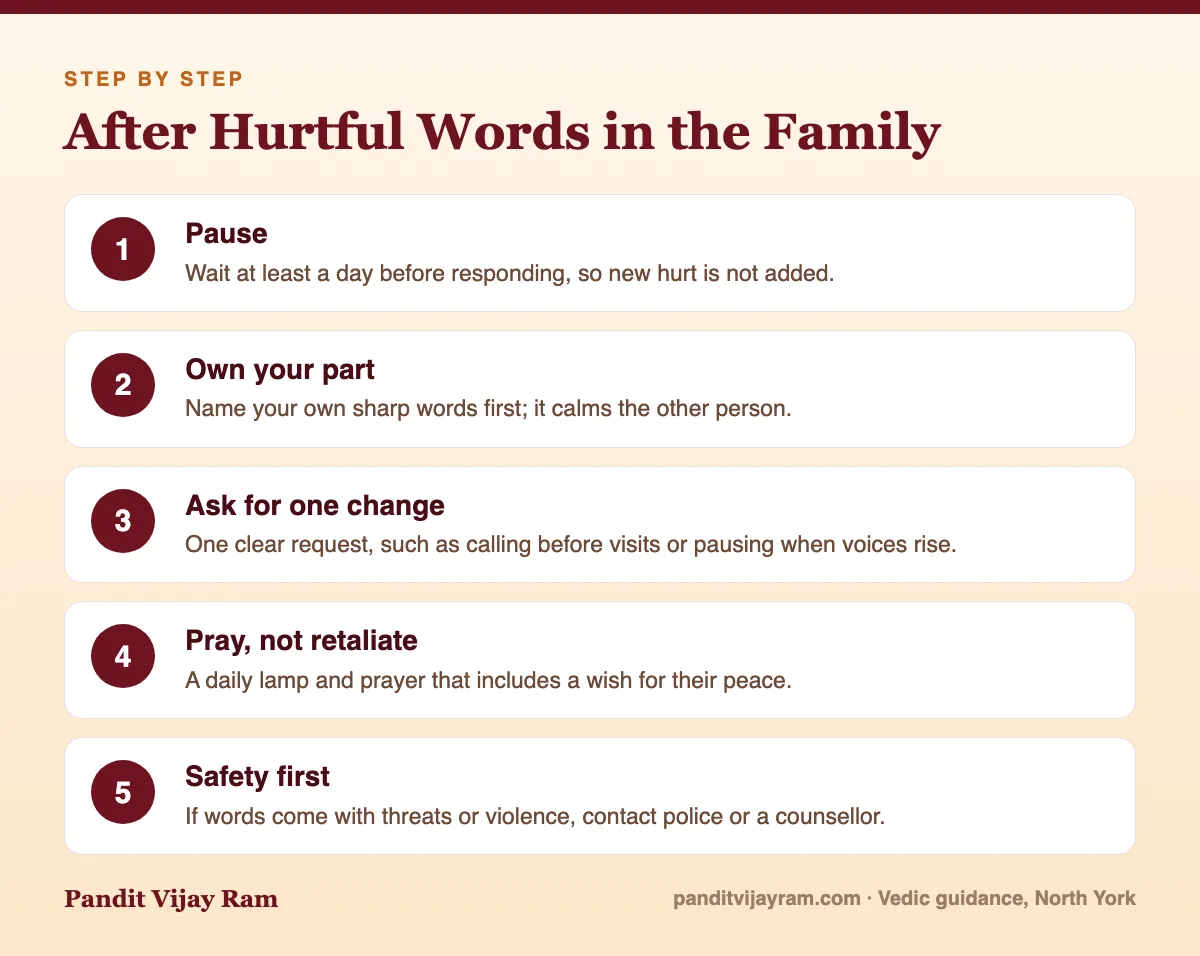
Let tempers cool, then speak privately and briefly. Acknowledge your part, say how the words affected you, and ask for a calmer way forward. Bring an elder or neutral relative if conversations keep exploding. Small, consistent acts of respect usually rebuild trust faster than one long conversation.
A practical sequence for repair:
- Wait at least a day. Responding in the same heat usually adds new hurt.
- Own your part honestly. Even if the other person said worse, naming your own sharp words disarms them.
- Say what hurt, once. For example: when you said my marriage would fail, it frightened me. Avoid listing every past grievance.
- Ask for something specific. Fewer comments about the children, calls before visiting, or a pause when voices rise.
- Use a mediator if needed. A respected aunt, a temple or gurdwara elder, an imam or a family counsellor can keep the conversation safe.
- Mark the peace. Share a meal, visit on a festival day, or touch an elder's feet and ask for ashirvad.
Forgiveness in this sense does not mean pretending nothing happened. It means choosing not to let the words keep ruling your mind.
Sometimes repair is not safe. If harsh words are part of ongoing control, threats or violence, your safety comes first. Call 911 in danger, and speak to a counsellor or a shelter service. Young people can contact Kids Help Phone. Our family problem guidance supports repair only where it is safe to attempt.
Which protective prayers can you say after a family curse?
Choose one short prayer from your own faith and say it daily with a calm mind. Hindu families often use the Hanuman Chalisa, Om Namah Shivaya or the Gayatri mantra. Muslims recite Ayat al-Kursi and the last two surahs of the Qur'an. Sikhs recite the Mool Mantar or Japji Sahib.
The purpose of protective prayer after a family argument is to steady you, not to strike back. A simple evening practice works well:
- Light a lamp. A ghee or oil diya in your home shrine, or simply a quiet corner.
- Sit for a few minutes. Breathe slowly until the replaying of the argument settles.
- Recite your chosen prayer. Eleven repetitions of a mantra, one Hanuman Chalisa, or the recitation your tradition prefers.
- Add a line for the other person. A short wish for their peace. This is the hardest part and the most freeing.
- Close with a request for your own home. Ask for calm speech, patience and protection.
Including the other person may feel wrong at first. Yet every tradition that warns against cursing also teaches blessing those who hurt us, and it changes how you carry the memory.
The guide to mantras for evil eye protection offers more choices, and the evil eye and curses hub lists every guide in this series.
Should you curse them back or reverse it?
No. Answering a curse with a curse, or paying someone to send it back, turns one hurtful moment into lasting enmity and carries its own karmic weight. It also damages the family further, often for children who were not part of the argument. Protection, boundaries and repair are the traditional response.
Some practitioners advertise reversal or return-to-sender work against relatives. Vijay Ram ji does not do this, for clear reasons:
- Karma. Wishing harm on a parent, sibling or in-law creates a new wrong, regardless of what they said first.
- Escalation. If the relative learns of it, the conflict hardens and may split the family for years.
- Misjudgment. Anger distorts memory. The person you blame may have said less, or meant less, than you recall.
- Exploitation. Reversal services often come with escalating fees and frightening stories.
The fuller reasoning is set out in the post on why return-to-sender spells are refused.
What you can do is protect your own mind and home, keep healthy boundaries, and leave space for the other person to soften. Families often reconcile at a wedding, a birth or an illness, and it helps if nobody has burned the bridge.
If the hurtful words came alongside actual ritual objects, threats or harassment, that is a different situation. Document it, contact the police if you feel unsafe, and seek negative energy guidance for spiritual support.
The bottom line
A curse from a family argument is mostly a wound, not a spell, because tradition gives little force to words torn out by anger against someone innocent. Repair begins with a calm conversation, an honest apology for your own part and, where needed, a mediator. Daily protective prayer that includes a wish for the other person steadies the mind, while retaliation only deepens the harm.
Key takeaways
- Words thrown out in anger carry little spiritual force in most traditions.
- A parent's bad-dua is widely believed to fail against an innocent child.
- Repair works best after a pause, with a specific request and a mediator if needed.
- Protective prayer is for your steadiness, not for striking back.
- Where harsh words come with threats or violence, safety comes first.