
Witchcraft Accusations: Why Blaming Someone Causes Real Harm

Few words do more damage inside a family than "she did black magic on us". I have heard versions of that sentence from people in North York, Brampton and across Canada, usually after an illness, a business loss or a broken engagement. The pain behind it is real. But a witchcraft accusation against a sister-in-law, a neighbour or an elderly aunt rarely ends the pain; it usually multiplies it. This article explains why. You will read how accusations have harmed people from early modern Europe to rural India and parts of Africa, why women and elders are targeted, what an accusation does to children who hear it, and how to seek protection without blaming anyone. I am a Vedic practitioner, and in more than forty years I have refused to name a "culprit" for any client, because the tradition I follow asks for protection and peace, not suspicion. If someone is threatening you, or you fear for an elder or child, the police come before any spiritual step.
Why are witchcraft accusations so dangerous?
Witchcraft accusations are dangerous because they turn misfortune into a target. Once a person is labelled a witch, family and neighbours may shun, beat, rob or expel them, and the accused has almost no way to prove innocence. In many documented cases accusations have led to torture and killing.
An illness or a run of bad luck has no face. An accusation gives it one. That is what makes the idea so tempting and so destructive. Historians of the European witch trials have shown how accusations often began with a quarrel over money, land or a refused favour. The same pattern appears in modern reports from India, Nepal, Ghana, Papua New Guinea and elsewhere.
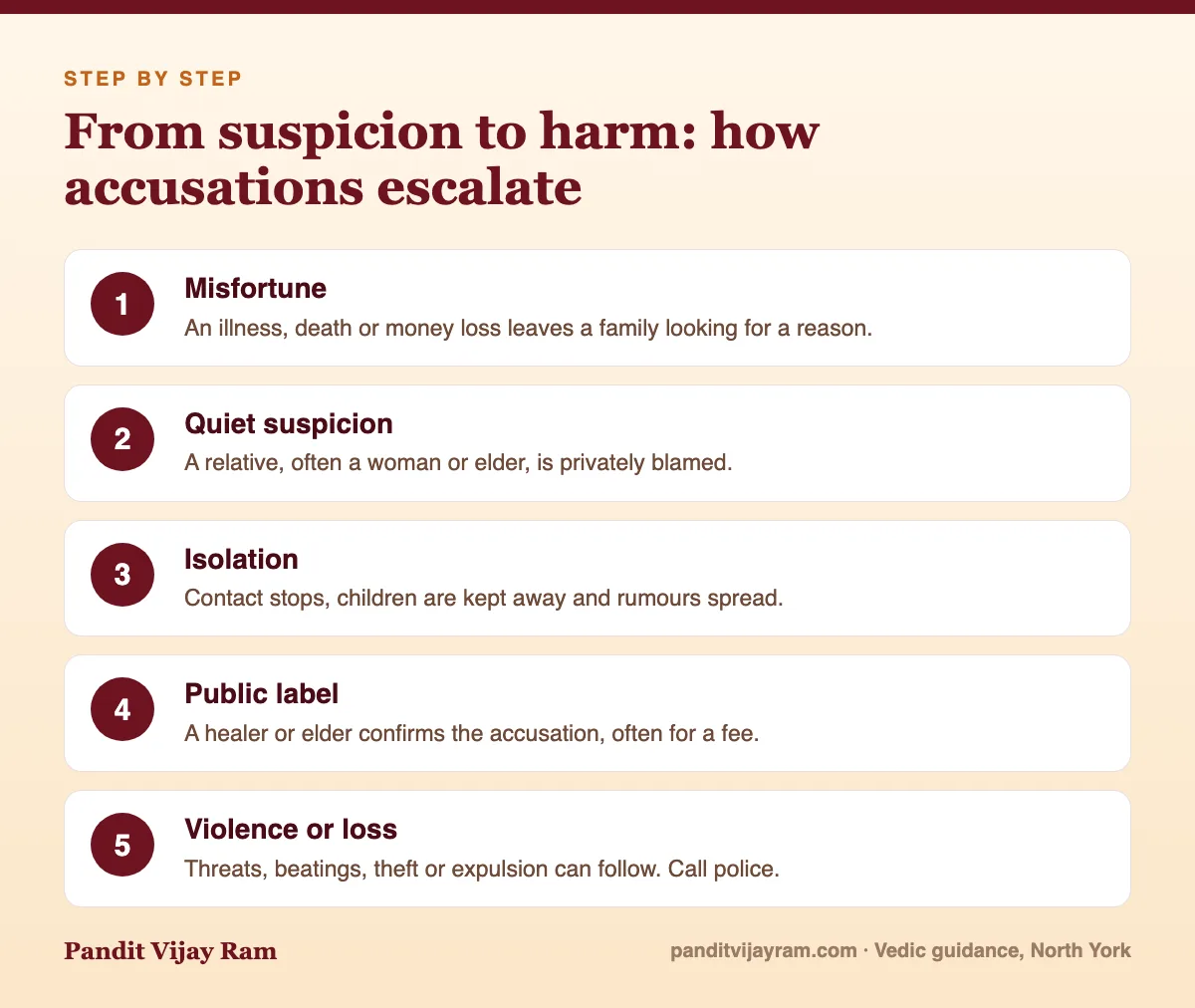
The harm follows a recognisable path:
- Suspicion: someone is quietly blamed for a death, illness or failure.
- Isolation: relatives stop speaking to them; children are kept away.
- Public naming: a healer, elder or crowd confirms the label.
- Violence or expulsion: beatings, forced "cleansing", theft of land or banishment.
Several Indian states have passed laws against witch-hunting because of these attacks, and Ghana has long-running camps where accused women have taken refuge. The United Nations Human Rights Council has also passed a resolution against harmful practices linked to witchcraft accusations.
In Canada an accusation can still lead to harassment, assault and elder abuse inside a home. Words spoken in grief can travel through a family group chat in minutes, and they are very hard to take back.

Why are women, widows and elders most often accused?
Accusations usually fall on people with the least power: widows, older women, unmarried or childless women, daughters-in-law, disabled people and the poor. They are easier to blame, less able to defend themselves, and their land, inheritance or place in the household may be wanted by someone else.
Across very different cultures, the accused share a profile. In India, the word daayan or dakan is hurled most often at widows or older women in rural areas, sometimes when relatives want their land. In early modern Europe, older, poorer women made up a large share of those tried. Researchers in Africa have documented similar patterns, and also accusations against children.
Inside diaspora homes the same pressure can appear in quieter forms:
- a new daughter-in-law blamed for a husband's job loss or a mother-in-law's illness;
- a widowed aunt blamed when a niece's marriage falls through;
- an elderly parent kept from grandchildren because "her eye is bad";
- a separated wife accused of "doing jadu" on her former husband's family.
Each of these hides an ordinary conflict: money, care duties, loneliness or grief. Our guide to suspected black magic by relatives explains how to protect yourself without confrontation.
Treating an older relative as a threat can also become elder abuse: withholding food, money, medicine or contact. If you see that happening, it is a safety matter. Speak with a doctor, a social worker, or police.
What does a witchcraft accusation do to children?
Children who hear that a grandmother or aunt is a witch learn fear and suspicion of people they love. In some communities children themselves are accused, then beaten, starved or abandoned. Any child at risk needs protection from police or a children's aid society, not a ritual.
Children absorb what adults say in the kitchen. A child told that a grandparent "did magic" may become afraid to visit, refuse food at that home, or blame themselves for a family illness. That fear can last into adult life.
More serious still is the accusation of children. Human rights groups and journalists have reported children in parts of Central and West Africa, and in some migrant communities in Europe, labelled as witches by relatives or self-styled pastors and then subjected to beatings, starvation or so-called deliverance that amounts to torture. Police in the United Kingdom have investigated such cases.
If you work with children, live with them, or know a family where a child is being treated as possessed or cursed, act on these signs:
- a child kept home from school for "spiritual" reasons;
- unexplained bruises, burns or weight loss;
- a child forced to fast, stand for hours, or be isolated;
- adults speaking of the child as evil or dangerous.
Contact your local children's aid society, or police if the child is in immediate danger. Kids Help Phone is there for young people who need to talk. For what genuine protective practice involves, and what it must never involve, see exorcism in Hinduism and practices to refuse.
How can you seek spiritual protection without blaming anyone?
You can ask for protection for yourself and your home without naming a source. Daily prayer, a lamp at dusk, the Hanuman Chalisa or Durga Kavach, and a kundli reading for timing all work on your own life. An honest practitioner will refuse to identify a culprit and will ask about ordinary causes first.
The Vedic tradition I follow frames protection as strengthening the person, not attacking another. A mantra asks a deity for shelter; it does not need an enemy's name. In practice, this is how I guide families who come convinced that someone has harmed them:
- List what has gone wrong and when, then look for ordinary explanations: health, debt, conflict, a hard planetary period.
- Separate the event from the person. "We have had a hard year" is different from "she cursed us".
- Begin steady protective practice in your own home, such as a lamp, prayer and a clean, calm space.
- Talk to the person directly if there is a real dispute, ideally with a mediator or counsellor.
- Keep the children out of it. Do not repeat suspicions in front of them.
If you want a consultation, the witchcraft and sihr protection page explains how Vedic remedies are offered without accusation. Families caught in long conflicts may find the family problem consultation more useful. Any practitioner who says "your aunt did this" for a fee is causing harm; walk away.
What should you do if someone accuses you or threatens you?
If you are accused of witchcraft, stay calm, avoid arguing in public, keep a record of messages and incidents, and speak to someone you trust. If anyone threatens you, damages property, takes your belongings or touches you, call police. In an emergency call 911.
Being called a witch or accused of "doing black magic" is frightening, especially when it comes from family. Some practical steps help:
- Document: save texts, voice notes and social media posts; note dates and witnesses.
- Limit contact with the person making the accusation if it is safe to do so.
- Tell a trusted ally such as a friend, doctor, faith leader or counsellor.
- Get legal advice if false statements are harming your work or reputation.
- Protect your mental health. If you feel hopeless, call or text 9-8-8.
Older adults who feel unsafe at home, or who are losing access to their money or medicine, can also speak with their doctor or a social worker about elder-abuse support.
Spiritually, I would simply say this: an accusation does not make you guilty. Keep your own prayer steady and your conscience clear. Further reading on calm, fear-free practice is in the magic and entities hub.
The bottom line
A witchcraft accusation turns grief and bad luck into a target, and history shows women, widows, elders and children pay the price. Protection can always be sought without naming a culprit, through prayer, ordinary checks and honest conversation. Where there are threats, violence or a child at risk, police and child-protection services come first.
Key takeaways
- An accusation of witchcraft can lead to isolation, abuse and violence.
- Widows, older women, daughters-in-law and children are accused most often.
- Spiritual protection never requires naming or blaming another person.
- A practitioner who names a culprit for a fee is causing harm.
- Threats, assaults and children at risk are matters for police.