
Spell Removal vs Curse Removal vs Hex Removal: What's the Difference?

People use the words spell, curse and hex as if they were interchangeable, and online sellers happily use all three to describe the same product. Yet the distinctions matter when you are trying to understand what has happened to you and what kind of help makes sense. Readers in North York, many from South-Asian, Caribbean and Latino families, often arrive with a word borrowed from one tradition to describe an experience framed by another. This guide sorts out spell vs curse vs hex: where each term comes from, how Vedic, Islamic and folk traditions describe the equivalent idea, and how removal is approached differently for each. You will also find a side-by-side comparison and a short decision rule for choosing the right next step. Over four decades of consultations I have seen that the right word often changes the remedy. A spoken shraap from a wronged elder, for example, calls for reconciliation and atonement, not the same rite one would use against a ritual working.
What is the difference between a spell, a curse and a hex?
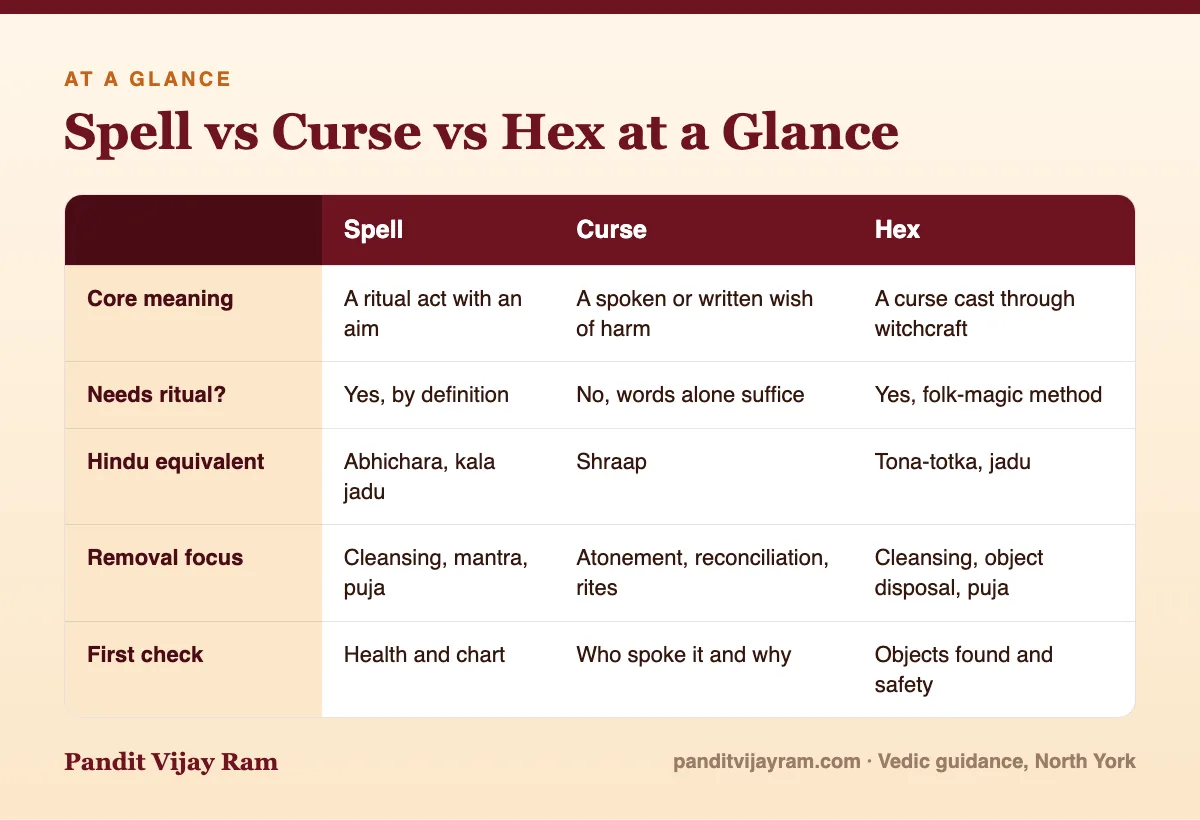
A spell is a ritual act with a specific aim, which may be harmful or harmless. A curse is an expressed wish that misfortune will befall someone, needing no ritual at all. A hex is an English folk term, popular in North America, for a curse delivered through witchcraft. The words overlap but are not identical.
Looking at each word's roots clears up much of the confusion.
- Spell. From an Old English word for speech or story. In magical traditions it means a formula, chant or ritual performed to produce a result. Love spells, money spells and protection spells all fall here. A spell is defined by its method.
- Curse. A pronouncement or wish for harm. It may be uttered once in rage, written, or handed down as a family belief. A curse is defined by its intent and words.
- Hex. From the German Hexe, witch. Pennsylvania German communities used hexerei for witchcraft, and "to hex" passed into American English meaning to bewitch. A hex is defined by its folk-magic source.
A related word, jinx, usually describes bad luck attached to a person or event, closer to the evil eye than to deliberate magic. If what you are describing is envy rather than ritual, our guide to evil eye and nazar removal is the better starting point.
In practice, the experience people report is similar for all three: a feeling that misfortune is being directed at them. The distinction becomes useful when deciding what to do next.

What are spells, curses and hexes called in Hindu and other traditions?
Hindu tradition speaks of abhichara or kala jadu for harmful ritual, shraap for a curse, and nazar or drishti dosh for the evil eye. Islamic tradition uses sihr for sorcery and ayn for the evil eye. Caribbean and Latin American traditions have their own vocabulary, each tied to a distinct religious or folk framework.
Here is a rough map of equivalent terms. Each tradition has its own context, so the match is never exact.
- Ritual working (spell): abhichara or kala jadu in Hindi-speaking homes; tona-totka for smaller folk rites; sihr in Islamic usage; trabajo in Spanish-speaking communities; rootwork or conjure in African American hoodoo.
- Spoken curse: shraap or shaap in Sanskrit and Hindi; laʿna in Arabic; maldición in Spanish.
- Envy and gaze: nazar, drishti or buri nazar; ayn in Arabic; mal de ojo in Latin America.
Hindu scripture is full of curses. In the epics, sages pronounce shraap on kings and even gods, and the stories nearly always describe a path of release: penance, service or a later act of grace. That narrative pattern shapes how curse removal is approached today.
Caribbean Obeah, Haitian Vodou and Latin American brujería each deserve to be understood on their own terms. Vodou in particular is a religion with clergy and ritual, not simply a source of hexes. Our guide to Obeah, jadu and brujería describes these traditions respectfully. For the three-way difference between kala jadu, nazar and planetary affliction, see kala jadu vs nazar vs graha dosh.
How is curse removal different from spell removal?
Spell removal targets a ritual influence: cleansing, protective recitation and, if needed, a puja to lift it. Curse removal looks at the relationship and words behind the curse. For a shraap, the tradition often prescribes atonement, reconciliation or ancestral rites, because the curse is understood to be bound to a moral wound.
The practical differences are clearer side by side.
- Spell removal. Focus on the influence and on strengthening you. Steps include confirmation, a sankalp, purification of body and home, daily recitation such as the Hanuman Chalisa or Durga Kavach, and a closing havan with a kavach. Our step-by-step guide on how to remove a spell covers this in full.
- Curse removal. Focus on the source of the words. Was a parent or elder deeply hurt? Is there an ancestral pattern? Remedies may include prayaschit (atonement), asking forgiveness where possible, pitru tarpan or shraddh for ancestors, charity, and Mahamrityunjaya japa.
- Hex removal. Usually treated like spell removal, since a hex implies a ritual source, with added attention to any objects found at home.
A chart often shows which applies. Pitru dosh or a heavily afflicted ninth house may point toward an ancestral curse. A sudden onset in a calm chart, with a known enemy, is more often read as a ritual working.
Many cases mix elements. That is why Vijay Ram ji's curse and hex removal begins with listening and a reading, then shapes the remedy to the specific cause rather than applying one package to everyone.
How do I know which one I am dealing with?
Ask where the trouble seems to come from. Harsh words spoken by a wronged person suggest a curse. A ritual object, a known practitioner or sudden targeted setbacks suggest a spell or hex. Envy after good news suggests nazar. Unclear or long-term patterns usually point to the chart, which a reading can check.
This decision rule helps people find their starting point.
- Were angry words of harm spoken to you or your family? If an elder, former partner or someone you wronged said "you will never be happy", explore curse removal and reconciliation first.
- Did something physical appear? Threads, lemons, powders or dolls at your door suggest a ritual working. Handle them safely, then consider spell or hex removal.
- Did trouble start after public good news? A wedding, a new house or a promotion followed by setbacks fits nazar more than deliberate magic.
- Has it run in the family for generations? Look at ancestral rites and pitru dosh.
- None of the above? Check health, home and finances, then let the chart speak. A difficult dasha is the most common explanation of all.
Whatever label applies, ordinary causes still come first. Illness, money pressure and family stress produce every symptom people associate with curses. If fear has become constant, talk to your family doctor as well as a spiritual guide.
The wider set of guides on curses and envy sits in our evil eye and curses hub.
Can a curse or hex be removed completely?
No honest practitioner can promise complete or lasting removal of anything. What tradition offers is relief, protection and a change in the relationship to the problem. Many people feel markedly lighter after removal and steady practice, while some discover the real cause was ordinary and needed a different kind of help.
Expectations shape experience, so it helps to be clear about what removal can and cannot do.
- It can bring a sense of release, calm a frightened household, and give a structure of prayer that supports resilience.
- It can address the moral side of a curse through atonement and reconciliation, which often heals family rifts.
- It cannot treat illness, repair a failing business plan, or undo legal and financial problems on its own.
- It cannot stop a living person from harassing you. That needs police and support services.
Be cautious of anyone selling removal as a one-time fix that never needs revisiting. Tradition expects ongoing light practice, such as a daily lamp and a protective recitation, much as health needs ongoing care.
Also be wary of sellers who insist your curse is "generational" and needs ever-larger rituals. A real ancestral concern is shown in the chart and addressed with known rites, not with escalating fees. Retaliation is never part of honest removal either; our article on return to sender spells explains why.
The bottom line
Spell vs curse vs hex is a question of method and origin: ritual, spoken wish or folk witchcraft. Spell and hex removal centre on cleansing and protection, while curse removal also looks at the hurt behind the words through atonement and ancestral rites. In every case, ordinary causes come first and no honest practitioner promises complete removal.
Key takeaways
- A spell is a ritual act, a curse is a spoken wish of harm, a hex is folk-magic witchcraft.
- Hindu terms include abhichara for harmful ritual and shraap for a curse.
- Curse removal often includes atonement, reconciliation and ancestral rites.
- A simple decision rule based on the source points to the right first step.
- No honest practitioner promises complete or lasting removal.