
How Long Does Black Magic Removal Take?

When you believe someone has worked against you, waiting feels unbearable. Every bad night seems like proof, and the first question families ask me is how long black magic removal takes. That is a fair question, and it deserves an honest answer rather than a promise. I sit with people from North York, Scarborough and across the GTA who have already been told by someone that it will all be over by the weekend. It rarely works that way, and a timeline built on fear only adds to the strain. This guide sets out realistic time ranges by severity, explains why traditional rituals run in cycles of 11, 21 or 41 days, and names the habits that quietly slow things down. It also covers how to track progress without obsessing, and when the length of a problem is a signal to see a doctor or counsellor instead. In more than forty years of practice I have learned that patience, routine and honesty about ordinary causes matter more than the size of any ritual. Nothing here replaces medical, legal or mental-health care.
How long does black magic removal usually take?
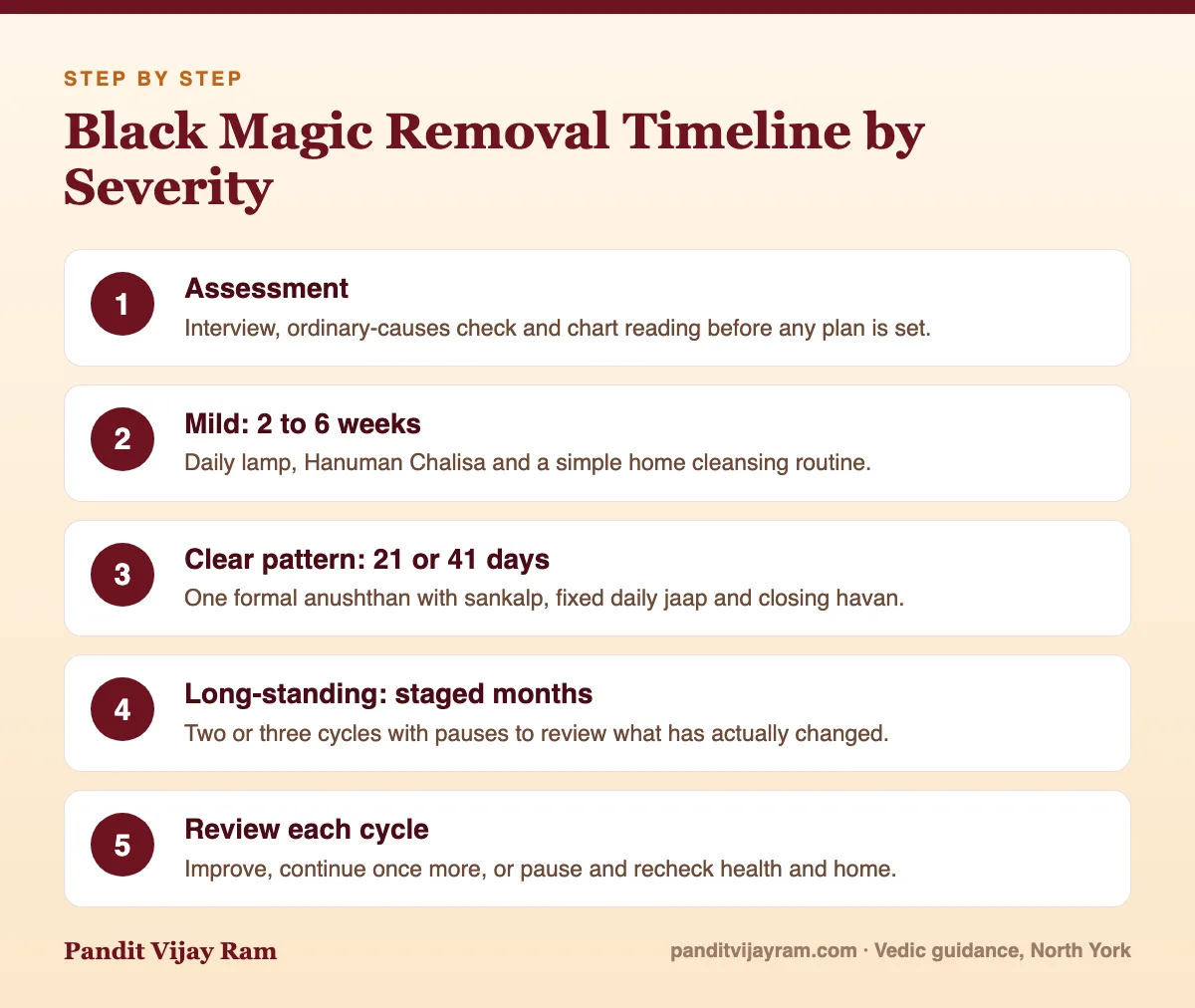
There is no single number. A mild or uncertain case often settles over two to six weeks of daily prayer and protection. A clearer case is usually worked through one 21-day or 41-day anushthan. A problem that has run for years may need two or three stages spread over several months.
I sort cases into three broad bands after the first consultation, not before it. The band decides the plan, and the plan decides the time.
- Suspicion with mixed signs. Sleep is poor, money is tight and arguments have increased, but ordinary causes explain much of it. Here the work is light: a daily lamp, Hanuman Chalisa, a simple home cleansing and a check of the birth chart. Many people feel steadier within two to six weeks.
- A clearer pattern. Troubles started suddenly, cluster around one relationship or house, and the chart does not account for them. This usually calls for one formal anushthan with a sankalp, fixed daily recitation and a closing havan, lasting 21 or 41 days.
- Long-standing or layered trouble. The difficulty has run for years, several family members are affected, or earlier rituals were left half-finished. I work these in stages, pausing between each to see what has actually shifted. Expect months, not weeks.
These bands are rough guides drawn from observation, not a contract. Two people in the same band can move at very different speeds. The black magic removal service page explains how each stage is structured, and nobody should be asked to commit to a long programme before an assessment has been done.

Why do black magic removal rituals last 21 or 41 days?
Vedic and folk practice treat steady repetition over a set cycle as the heart of a remedy. Twenty-one and forty-one day periods give a sankalp time to take root, build a habit of prayer, and close with a havan. The number marks a discipline, not a deadline for results.
Fixed cycles appear across Hindu devotional life. The forty-one day mandala vow observed by Sabarimala pilgrims is one well-known example, and many families recite the Hanuman Chalisa daily for forty days when facing a crisis. Shorter cycles of 7, 11 or 21 days are common for a specific mantra jaap.
In a removal anushthan the cycle usually has three parts:
- Opening. A Ganesh prayer, a sankalp stating the person's name, gotra and purpose, and the first set of recitations.
- Middle days. The same mantra count at roughly the same hour, a ghee lamp, simple sattvic food and no alcohol. Consistency matters more than volume.
- Closing. A havan with ahuti, charity such as feeding the hungry, and a protective thread or kavach where it suits the case.
People sometimes read the 41-day figure as a countdown to relief. I explain that the cycle shapes the practice; it does not set the date the trouble ends. Some feel lighter in the first week, others only after the closing havan, and some need a further stage. If you want to understand the fire ceremony itself, the post on havan for spiritual cleansing walks through it. For cycles used in milder cases, compare the ranges in how long negative energy removal takes.
What slows down black magic removal?
Progress slows when daily practice is skipped, when health or money problems are left untreated, when the household stays in open conflict, and when the person keeps switching healers. Constant checking for new signs also feeds anxiety, which can look exactly like the problem it is meant to measure.
When a case stalls, I look at the person's week before I look at anything spiritual. The same few patterns come up again and again.
- Gaps in practice. Reciting for three days, stopping for five and starting again resets the discipline. A short daily routine beats a long irregular one.
- Ordinary causes left alone. Thyroid trouble, sleep apnoea, untreated depression, mould in a basement apartment or a failing furnace can all mimic the signs people attribute to jadu. These need a family doctor or a tradesperson, and no ritual replaces that.
- Ongoing conflict. If the household fights every evening, peace has nowhere to settle. Calm conversation, and sometimes family counselling, does real work here.
- Healer-hopping. Starting a new ritual every fortnight with a different practitioner means none of them is ever completed.
- Symptom hunting. Checking every dream, every lost item and every headache keeps the mind on high alert.
- Alcohol and late nights. Tradition asks for restraint during an anushthan, and sleep science agrees that rest supports recovery.
None of this is about blaming the person. It is about removing the friction so that prayer and protection can do their part. Aftercare habits that hold the gains are covered in whether black magic can come back after removal.
Can black magic be removed in one day?
A single session can bring real calm, and a havan or blessing can be done in an afternoon. But anyone promising that deep-seated trouble will vanish in hours is selling certainty nobody holds. Treat same-day promises, urgency and escalating fees as warning signs and step back.
I do not dismiss one-day work. A well-conducted havan, a nazar utara or a single Hanuman puja can leave a family feeling noticeably lighter, and for mild cases that may be enough with a little follow-up at home.
The trouble starts with the sales pitch. Over the years many people have come to me after paying someone who said the problem would be gone by sunset, then said a second, larger ritual was needed, then a third. The pattern is predictable:
- A dramatic diagnosis delivered within minutes, often naming a relative.
- A deadline: act today or something terrible will happen.
- A small first fee followed by much larger ones.
- Secrecy, such as being told not to tell your family or doctor.
An honest practitioner explains that spiritual work unfolds over time, gives a plan with clear stages, and tells you when to stop. If you are unsure about someone, the checklist in how to choose a black magic removal specialist gives ten questions to ask before paying anything. Losses to fraud can be reported to the Canadian Anti-Fraud Centre.
How do I know if black magic removal is working?
Look for gradual, ordinary improvements rather than dramatic signs: steadier sleep, fewer arguments, a calmer mind during prayer, and daily tasks feeling manageable again. Keep a short weekly note instead of a daily symptom log. If nothing has moved after a full cycle, review ordinary causes and the plan.
I ask people to write three lines every Sunday: how they slept, how the home felt, and one thing that went well. After a few weeks the notes show a trend that memory alone cannot, because a fearful mind remembers bad days far more vividly than good ones.
Healthy signs tend to be modest. You fall asleep sooner. The house feels less tense at dinner. A task you had been avoiding gets done. Prayer feels like comfort rather than a battle.
Use this simple decision rule at the end of each cycle:
- Clear improvement: move to a lighter maintenance routine.
- Some improvement: continue one more cycle, then reassess.
- No change: pause the ritual work and look again at health, finances, relationships and the home before doing more.
- Getting worse, or thoughts of self-harm: see your family doctor promptly, and in a crisis call or text 988, Canada's Suicide Crisis Helpline.
Timelines are a tool for honesty, not pressure. The magic and entities guides collect related reading, and if you would like a reading to place your situation in one of the bands above, you can get in touch.
The bottom line
How long black magic removal takes depends on the severity band, the steadiness of daily practice and whether ordinary causes have been dealt with. Traditional 21-day and 41-day cycles shape the discipline but do not promise a finishing date. Progress shows up as gradual calm, best tracked through a short weekly note. Same-day promises and rising fees are reasons to pause, and a worsening picture is a reason to see a doctor.
Key takeaways
- Mild concerns often ease over a few weeks of steady prayer and protection.
- A formal anushthan usually runs 21 or 41 days and ends with a havan.
- Skipped practice, untreated health issues and household conflict slow progress.
- Promises of same-afternoon removal are a common sign of fraud.
- If nothing improves after a full cycle, review ordinary causes before adding rituals.