
How to Remove a Spell Cast on You: Vedic Steps

If you have already ruled out the ordinary causes and still feel that someone's ill will is sitting on your life, the next question is practical: what do I actually do? Many people searching how to remove a spell find either frightening rituals or vague advice. I want to give you the real Vedic order of work, as it is practised by families in North York and in Hindu homes everywhere. You will learn why confirmation comes first, how a sankalp sets the intention, which purification steps belong to the body and which to the home, what recitations carry the protective weight, and where a puja or havan fits. You will also see the honest limits: what this process cannot promise and which situations belong with a doctor or the police. In more than four decades of guiding people through removal, I have found that calm, consistent devotion achieves what dramatic midnight rituals only claim to. This is a framework, not a substitute for proper assessment of your own situation.
What is the first step to break a spell?
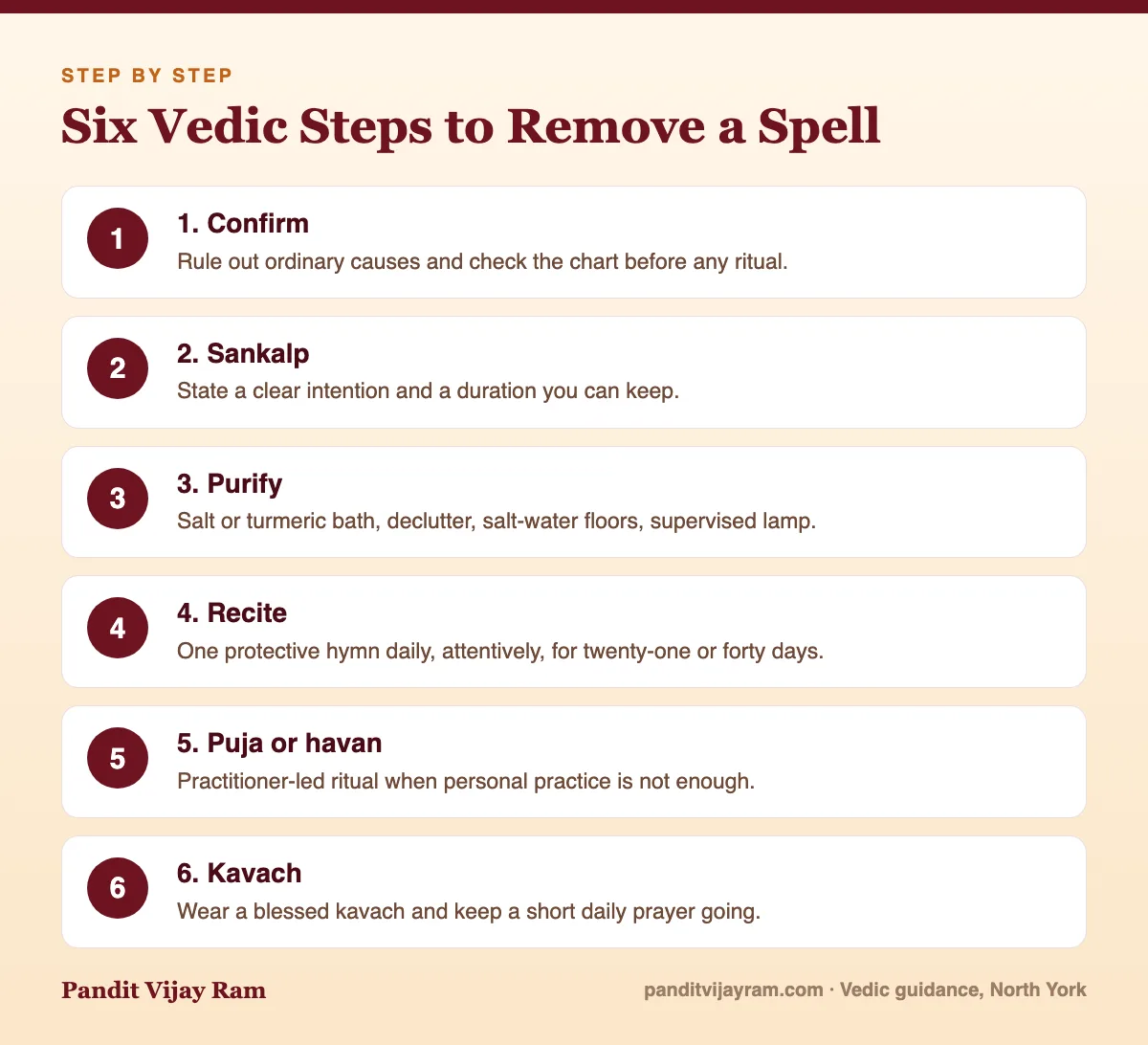
The first step is confirmation, not ritual. Check health, home and circumstances, then have a chart or prashna reading to see whether the trouble is spiritual at all. Removing a spell that is not there wastes effort and feeds fear, while the real cause, perhaps a planetary period or illness, goes untreated.
Spell removal done without confirmation resembles taking antibiotics for a sprained ankle. It may feel like action, but it misses the point. Vijay Ram ji begins every case with three questions: what has been happening, what has already been checked, and what does the chart say about this period?
Our companion article on the signs someone has cast a spell on you lays out that triage in detail. If you have not worked through it yet, start there.
When the assessment does point to deliberate ill intention, the tradition calls this abhichara, harmful ritual directed at another. The response is not to fight fire with fire. It is to strengthen the person's own connection to the divine so that the harmful influence has nothing to hold on to. Every step below follows that principle.
Two things should be clear before any step begins. First, no ritual replaces medical treatment, counselling or legal protection. Second, the aim is your own peace and protection, not harm to whoever you suspect. A removal done in anger tends to keep the mind tied to the very person you want to be free of. More context on how practitioners approach this sits in the magic and entities hub.
What is a sankalp and why does spell removal need one?
A sankalp is a formal spoken intention made before a Vedic practice, naming yourself, your lineage, the purpose and the duration. In spell removal it turns scattered worry into a clear commitment, such as reciting a mantra daily for forty days for protection and peace. Without it, practice tends to drift.
A traditional sankalp is taken with water in the right palm, facing east or north, after a short prayer to Ganesha. You state your name, your gotra if you know it, the place where you are, and what you are undertaking. The water is then released onto the ground or into a small plate.
For removal work a sankalp might be as simple as: "I, [your name], undertake to recite the Hanuman Chalisa every morning for forty days, for protection of myself and my family and for peace of mind." Keep the wording about your own protection. Do not name a suspected person or ask for anything to happen to them.
Choose a duration you can genuinely keep. Twenty-one and forty days are traditional cycles, and our article on how long black magic removal takes explains why longer cycles exist. Breaking a sankalp is not a disaster, but it weakens the habit; if you miss a day, simply continue and add one day at the end.
Families sometimes take a joint sankalp, with each member committing to a small part. That shared effort often settles a tense household as much as any ritual element.
How do you cleanse yourself and your home during spell removal?
Purification works on two levels. For the body, a ritual bath with a little rock salt or turmeric, fresh clothes, and a few minutes of quiet prayer. For the home, decluttering, washing floors with salt water, and a lamp with camphor or guggul in each main room, always with windows open and flames supervised.
Here is a sensible order, done once at the start and then lightly each week.
- Declutter. Remove broken items, old offerings and anything you associate with the conflict. Donate what is usable.
- Bathe. Add a pinch of rock salt or a little turmeric to warm bathwater. Patch-test turmeric first, and skip salt on broken skin.
- Wear clean clothes in light colours, and keep the clothes from the day of the worst distress washed and set aside.
- Wash floors with water and a spoonful of salt, working from the back of the home toward the main door.
- Light a lamp in the puja corner and carry camphor or guggul smoke briefly through each room. Ventilate, keep it away from smoke detectors, children and pets, and never leave a flame alone.
Condo and rental residents can use salt water, sound and a battery diya instead of smoke. If you were given a specific bath after a formal ritual, follow the instructions in our guide to the ritual bath after black magic removal rather than inventing your own recipe.
Purification prepares the ground. It is not the removal itself, and repeating it obsessively several times a day usually reflects anxiety rather than spiritual need.
Which mantras or prayers remove a spell?
The most widely used protective recitations in Hindu homes are the Hanuman Chalisa, the Bajrang Baan for intensive periods, the Durga Kavach recited with the Devi Mahatmya, and the Mahamrityunjaya mantra. Choose one as the steady base, recite it daily at the same time, and add others only on guidance.
Each recitation carries a slightly different emphasis in tradition.
- Hanuman Chalisa. Forty verses in Awadhi praising Hanuman as the remover of fear and obstacles. Easy for beginners; best recited on Tuesdays and Saturdays, though daily practice is common.
- Bajrang Baan. A more forceful hymn to Hanuman, traditionally kept for difficult periods and recited with discipline. Many teachers suggest guidance before taking it on.
- Durga Kavach. The armour hymn that invokes the goddess to protect each part of the body; suited to those devoted to the Devi.
- Mahamrityunjaya mantra. A short Rig Vedic prayer to Shiva for protection and steadiness, often recited 108 times on a rudraksha mala.
Quality beats quantity. Eleven attentive recitations bring more than a hundred rushed ones. If pronunciation worries you, listen to a respected recording and recite along; sincerity is valued above perfect Sanskrit.
Our article on mantras for black magic removal covers meanings and cautions for each in more depth. For households who would like a priest to lead a formal recitation, a Hanuman puja and havan can be arranged at home or remotely.
When does spell removal need a puja, havan or practitioner?
A practitioner is worth involving when personal practice has been steady for several weeks without relief, when distress is severe, when a whole family is affected, or when the chart shows heavy afflictions alongside suspected ill will. Formal puja or havan then closes the process, followed by a blessed kavach.
Self-practice handles many situations well. Some call for more structure.
- Persistent distress after a full forty-day cycle, with ordinary causes ruled out.
- Several family members reporting the same heaviness or nightmares.
- A clear chart affliction, such as a difficult Rahu or Saturn period, that needs graha shanti alongside protection.
- Suspicious objects found at home, which call for both safe handling and spiritual cleansing.
In those cases Vijay Ram ji may suggest a havan with specific mantras and samagri, an anushthan carried out over several days, or a protective puja for the family. He will explain what each step is for and what it cannot do. The ritual closes with a purnahuti, the final offering, and often a kavach or raksha sutra energised during the ceremony.
What happens after matters as much as the ritual. Our guide to protection after spell removal describes the maintenance kit. To discuss your own situation, see Vijay Ram ji's spell and black magic removal service.
No practitioner can promise a result or a deadline. Anyone who does, or who asks for ever-larger sums to finish the work, is selling fear.
The bottom line
Knowing how to remove a spell starts with confirming the cause, because a planetary period or an illness needs a different response. A clear sankalp, simple purification of body and home, and one steady protective recitation form the core of Vedic removal. Where personal practice is not enough, a practitioner-led puja or havan and a blessed kavach complete the process, without any promise of outcome or any harm wished on others.
Key takeaways
- Confirm the problem is spiritual before starting any removal practice.
- A sankalp names your intention and duration and keeps practice steady.
- Purify body and home simply, with fire safety and ventilation in mind.
- One daily protective recitation, done attentively, is the backbone of removal.
- Formal puja, havan and kavach suit persistent or family-wide cases.