
After Spell Removal: Rebuilding Protection With Kavach and Daily Practice

The ritual is over, the house feels lighter, and you are wondering what happens now. Many people expect removal to be the end of the story, then feel anxious when an ordinary bad day arrives. Questions about protection after spell removal come to me from families in North York almost as often as questions about removal itself. This guide focuses on the protective tool kit that tradition gives you for the months that follow: the kavach or amulet, the raksha sutra, the daily lamp and a short raksha mantra. You will learn what each item is, how it is energised, how to wear and care for it, when to renew it, and how to dispose of it respectfully. There is also a simple daily routine and honest guidance on what protection cannot do. In over forty years I have noticed that people who keep a small, steady practice after removal rarely return in fear, while those who stop everything at once sometimes do. The kit is modest, but it works best when it becomes part of ordinary life.
What is a kavach and how does it protect you?
A kavach, meaning armour, is either a protective hymn recited for defence or a physical amulet, often a metal locket holding a yantra or mantra, energised through puja. Tradition holds that it keeps the wearer surrounded by the deity's protection. Its strength is understood to come from devotion and correct consecration, not from the object alone.
The word covers two related things.
- Recited kavach. Hymns such as the Durga Kavach recited with the Devi Mahatmya, the Hanuman Kavach or the Narayana Kavach invoke the deity to guard each part of the body. Reciting one daily is itself considered wearing armour.
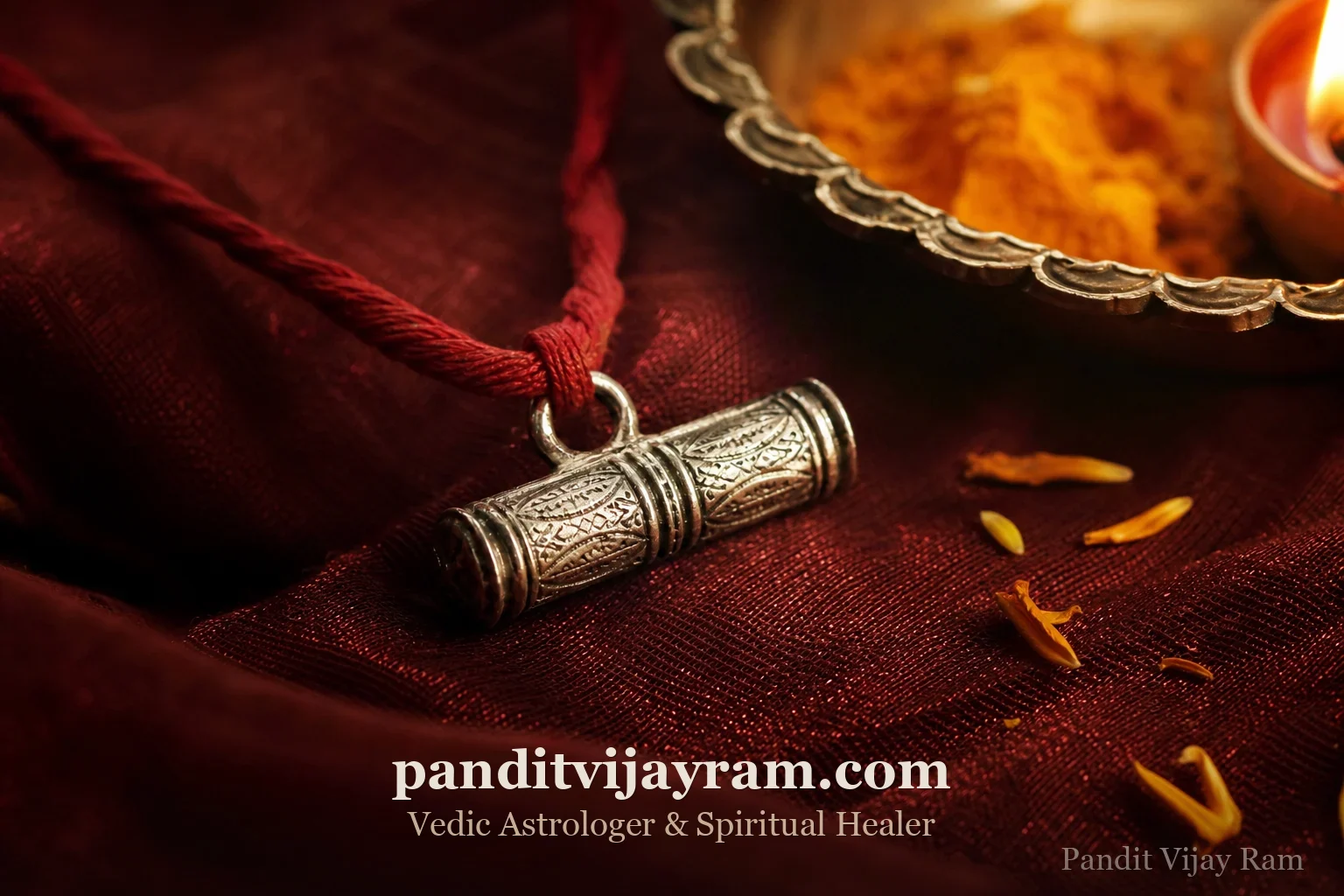
- Worn kavach. A small locket of copper, silver or panchdhatu containing an inscribed yantra, a written mantra, or blessed items such as a rudraksha bead. It is worn on a thread or chain at the neck or upper arm.
A worn kavach is traditionally made for a specific person. During prana pratishtha, the practitioner recites mantras over it, often for a set number of repetitions, so that it is understood to carry the deity's presence. A mass-produced locket that has never been through this process is, in traditional terms, simply jewellery.
Muslim families keep a comparable item called a taweez, containing Quranic verses, and many Caribbean and Latin American households have their own protective objects. Each tradition has its own rules. Vijay Ram ji's taweez and kavach service describes how he prepares them. For the removal stage that comes before all this, see how to remove a spell. Related guidance sits in the magic and entities hub.
What should be in a protection kit after spell removal?
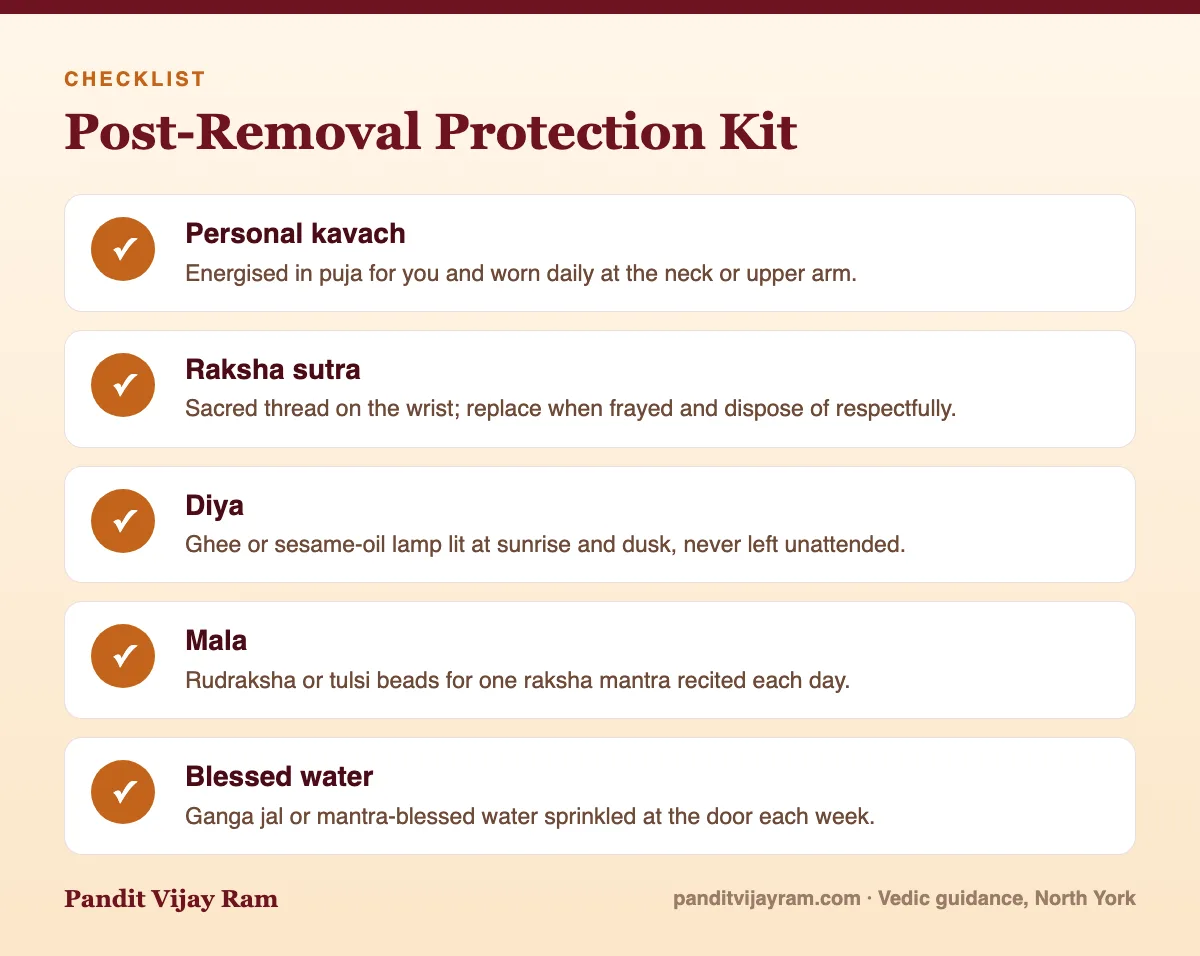
A practical post-removal kit has five items: a personal kavach energised in puja, a red or saffron raksha sutra, a brass or clay diya with ghee or sesame oil, a mala of rudraksha or tulsi for counting mantra, and a small container of ganga jal or clean water for sprinkling. Nothing more is required.
Here is each item and why it belongs in the kit.
- Kavach. Your main protective object, worn daily. Prepared for you, not bought off a shelf.
- Raksha sutra or kalava. The sacred thread tied on the wrist during puja, right wrist for men and unmarried women, left for married women in many families. Our guide to the kalava and mauli thread covers wearing and removal.
- Diya. A small lamp for morning and evening. Ghee is traditional for devotion; sesame oil is often used for Saturn and protection.
- Mala. One hundred and eight beads plus the guru bead, for keeping count without distraction. See our article on rudraksha and tulsi mala protection for choosing and care.
- Water. A copper or steel pot of ganga jal, or clean water over which a mantra has been said, for sprinkling at the entrance and corners on Tuesdays and Saturdays.
Keep these together on a clean shelf in your puja corner. Children's versions are simpler: a black thread or kala tika and a short prayer said by a parent are usually enough.
Resist the urge to buy more and more protective products. Fear tends to make people collect, and a cluttered shrine is harder to care for than a simple one.
How do you wear and take care of a kavach?
Wear your kavach after a bath, ideally first on a Tuesday or Saturday morning after a short prayer. Keep it clean and dry, remove it for surgery or scans, and avoid letting it touch the floor. Many traditions remove it in a bathroom or at a cremation, and re-energise it with a brief mantra afterwards.
Practical rules, with the ones people over-worry about marked clearly.
- First wearing. Bathe, sit before your lamp, recite the mantra you were given eleven times, and put the kavach on.
- Daily care. Wipe it with a soft dry cloth. If it gets wet, dry it promptly to protect the thread and metal.
- Medical settings. Always remove it when a hospital asks you to. Wrap it in a clean cloth and put it back on afterwards with a short prayer. Nothing is lost.
- Intimacy, menstruation and bathing. Customs differ widely between families. Follow your family's practice or the instructions your practitioner gave; there is no need for anxiety about it.
- Accidental drops. Pick it up, touch it to your forehead, say a brief prayer and continue. A dropped kavach is not a broken one.
- Thread wear. Replace a fraying thread before it snaps. Use red, black or yellow cotton as advised.
If a kavach breaks open or the yantra inside becomes damaged, take it to your practitioner. Do not try to repair or refill it yourself.
Keep your expectations honest. A kavach is a support for faith and a reminder to pray. It does not replace locks, sensible choices, medical care or police if someone is threatening you.
What daily practice keeps protection strong after spell removal?
A ten-minute daily practice is enough for most people: light the lamp at sunrise, recite one raksha mantra or the Hanuman Chalisa, touch your kavach and offer a brief prayer for the household. At dusk, light the lamp again. Weekly, sprinkle water at the entrance and give a small charity.
Raksha means protection, and several short mantras are traditionally used for it. Choose one rather than collecting many:
- Hanuman: Om Hanumate Namah, or the full Hanuman Chalisa on Tuesdays and Saturdays.
- Durga: Om Dum Durgayei Namah, suited to devotees of the Goddess.
- Shiva: the Mahamrityunjaya mantra, often recited eleven or twenty-one times.
- Narasimha: a protective prayer used in many Vaishnava homes.
A sample day looks like this. Morning: bathe, light the diya, recite your mantra on the mala, touch the kavach. Midday: nothing special, simply live well. Evening: light the lamp again at dusk, say a short prayer of thanks, and switch off screens a little earlier.
Each week, add three small habits: sprinkle the water from your kit at the main door on Tuesday or Saturday, wash the floors with a little salt water, and give something to a food bank, temple or neighbour in need.
If symptoms that troubled you before removal return, do not assume the spell is back. Check sleep, health and stress first. Our article on whether black magic can come back after removal explains the common reasons symptoms recur.
When should a kavach be renewed or replaced?
Many practitioners suggest re-energising a kavach at an annual puja, after a major life event, or if it is damaged. Replace it if it breaks, is lost, or if a new chart reading calls for a different deity. Dispose of an old kavach respectfully by giving it to a temple or burying it in clean earth.
A kavach does not wear out by a fixed date, but traditional households use natural moments to refresh it.
- Festivals. Navratri, Hanuman Jayanti or Diwali are common times to bring the kavach to puja for re-energising.
- Life changes. A marriage, a move, a new job or a bereavement may prompt a fresh blessing.
- New dasha. If a reading shows a new planetary period, a practitioner may suggest a different deity or yantra.
- Damage or loss. Losing a kavach is not an omen. Simply arrange a new one and continue your daily prayer meanwhile.
For disposal, give the old kavach to a temple, or wrap it in a clean cloth and bury it in garden soil or a large plant pot. Please do not throw it into Lake Ontario or a local river; offerings in waterways harm wildlife and can break municipal rules. Old raksha sutras can be removed on an auspicious day, wrapped, and disposed of in the same way.
After a removal, your practitioner may also give specific aftercare instructions for the first weeks, covered in our guide to aftercare after negative energy removal. If you would like a kavach prepared for you, or an existing one re-energised, the kavach and taweez service explains the process.
The bottom line
Protection after spell removal rests on a modest kit: a personally energised kavach, a raksha sutra, a lamp, a mala and a pot of blessed water. Ten minutes of daily lamp and raksha mantra, with weekly charity and cleansing, keeps that protection alive far better than adding more objects. Renew the kavach at festivals or life changes, dispose of it respectfully, and keep ordinary safety and health care alongside.
Key takeaways
- A kavach is armour, either a recited hymn or a worn amulet energised in puja.
- The post-removal kit is small: kavach, raksha sutra, diya, mala and blessed water.
- Remove the kavach for medical care without worry and re-wear it with a short prayer.
- One raksha mantra each day matters more than many occasional rituals.
- Renew at festivals or life changes and dispose of old items in clean earth or at a temple.