
Hearing Footsteps or Voices at Night: What to Check

Few things wake a person faster than the sound of steps in the hallway when everyone else is asleep. Some people hear a soft murmur, as if someone is talking in the next room, and lie very still wondering what it is. People from North York, Downsview and Markham have described exactly this to me, often after weeks of poor sleep and quiet worry. Hearing footsteps at night is common, and in my experience it usually has an ordinary source that can be found with patience. In this guide you will learn which sounds a house or condo makes after dark, how your own ears and brain can create sounds at the edge of sleep, when hearing voices means you should speak to a doctor, and what a calm spiritual practice looks like once those checks are done. I have heard many such accounts over more than forty years, and I always begin the same way: with a notebook, a torch and an open mind rather than with fear.
Why do I hear footsteps at night when no one is there?
Most phantom footsteps come from the building itself or the people around it. Upstairs neighbours, ductwork expanding as the furnace cycles, floor joists settling as temperatures drop, and water moving through pipes all produce rhythmic thumps. Animals in walls and attics add scratching and pattering. At night the house is quiet, so these sounds seem louder.
Sound travels in surprising ways, especially in GTA condos and older semi-detached houses. A footstep two floors up can seem to come from your own hallway, because the noise travels through concrete, steel and shared walls rather than through the air.
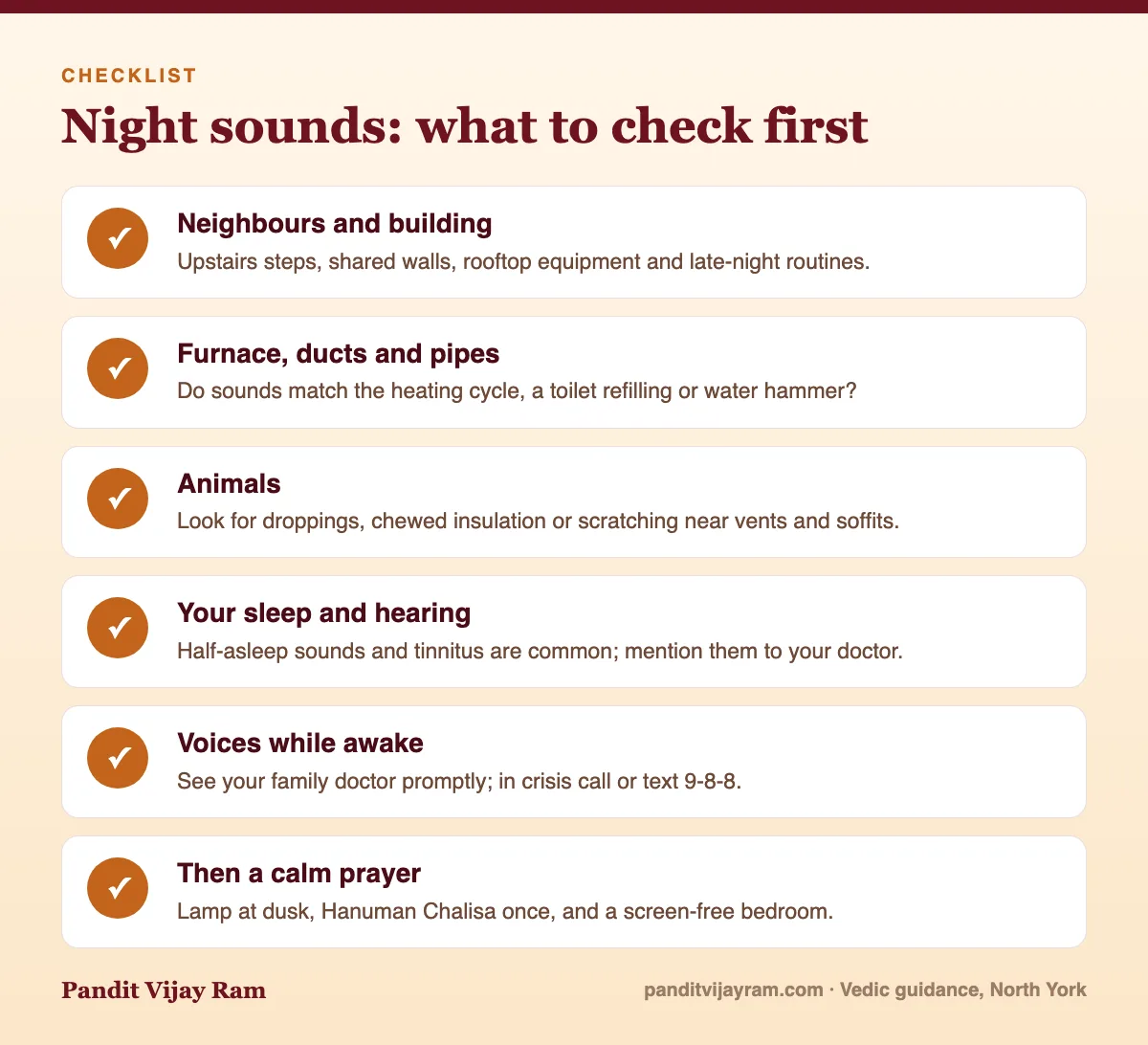
Common sources I ask people to consider:
- Neighbours. Shift workers, a child walking to the bathroom, or someone pacing on a phone call. Shared walls and floors carry these well.
- Heating and cooling. Metal ducts tick and bang as they warm and cool. The pattern often matches the furnace turning on and off.
- Plumbing. Water hammer, a running toilet refilling, or a neighbour's shower draining can produce knocks that sound like steps.
- Wood movement. Floors, stairs and roof trusses contract as the house cools after sunset, producing single creaks or slow sequences.
- Animals. Raccoons, squirrels and mice are active after dark. Raccoons in particular can sound surprisingly heavy.
The guide to haunted house signs versus old-house noises explains the building side in more depth, including seasonal patterns.

How can I find the source of noises in the night?
Keep a simple log for a week or two. Write down the time, what you heard, where it seemed to come from and what else was happening, such as the furnace running or rain. Record a short audio clip on your phone if you can. Patterns usually appear quickly and point to a cause.
A log turns a frightening night into a puzzle, and puzzles are easier to solve when you are calm. Here is the method I suggest.
- Note the time and length. Sounds that happen at the same minute each night often match a timer, a furnace cycle or a neighbour's routine.
- Note the direction. Above, below, inside a wall, or from one particular room.
- Record it. Leave your phone recording by the bed. Listen back in the morning, when you are rested. Many sounds lose their mystery in daylight.
- Check the thermostat. See whether the noises line up with the heating or cooling turning on.
- Look for animal signs. Droppings, chewed insulation, scratches near vents or soffits. Call a licensed wildlife or pest service rather than handling animals yourself.
- Ask a neighbour kindly. A friendly question often solves the whole thing.
If you live alone and feel unsafe, it is reasonable to install a door camera or ask a friend to stay over. If you ever believe someone is actually inside your home, call 911 straight away. Your safety comes before any question of spirits.
Can my ears or brain create sounds at night?
Yes. In the drowsy state between waking and sleep, called hypnagogia, many healthy people briefly hear footsteps, a knock, their name being called or a loud bang. Tinnitus can produce ringing, humming or rhythmic whooshing that is more noticeable in silence. These experiences are common and usually harmless, but they are worth mentioning to a doctor.
The brain does not switch off like a light. As it drifts into sleep, it can produce short, vivid sensations that feel completely real. People describe hearing a door open, someone saying their name, or footsteps approaching the bed. When they sit up, there is nothing there. This is a recognised part of normal sleep, especially when someone is overtired, stressed, or keeping irregular hours.
Hearing itself can also play tricks:
- Tinnitus is the perception of sound without an outside source. It may be ringing, buzzing, or a pulse-like whoosh that can feel like distant steps.
- Earwax, infection or hearing loss can change how ordinary sounds are perceived.
- Medications, including some sleep aids, can affect perception or dreams.
If you hear a pulsing sound in time with your heartbeat, sudden hearing changes, or sounds alongside dizziness or headaches, see your family doctor promptly. A related guide on shadow figures at night explains the visual side of the same half-asleep state.
When does hearing voices mean I should see a doctor?
See your family doctor if you hear voices while fully awake, if they speak to you or about you, if they are frightening or tell you to do things, or if they come with changes in mood, sleep, thinking or behaviour. These can be signs of a health condition that responds well to care. Seeking help early is wise.
A single strange sound as you fall asleep is common. Voices that continue while you are fully alert are different, and I always encourage people to treat them as a health question first. This is not a judgement about anyone's faith or sanity. Hearing voices has many causes, including extreme stress, lack of sleep, grief, some medications, substance use, infections, hearing problems and mental-health conditions. A doctor can look at all of these.
Please seek help promptly if:
- the voices comment on you, argue, or give instructions;
- you feel watched, followed or that your thoughts are being interfered with;
- you are not sleeping for several nights, or family say you seem very different;
- you have thoughts of harming yourself or anyone else.
In Canada, if you are in crisis, call or text 9-8-8 at any hour, or call 911 in an emergency. Spiritual practice can sit beside medical care, but never instead of it. The guide on possession or mental illness discusses this balance carefully.
What prayer helps if I feel afraid of noises at night?
Once ordinary causes are checked, a short, regular evening practice can steady the mind and home. Light a lamp at dusk, recite the Hanuman Chalisa or a simple mantra such as Om Namah Shivaya, wash your feet before bed and keep the bedroom calm and screen-free. Consistency matters more than length or volume.
Fear makes every sound louder. A simple routine lowers that fear by giving the evening a shape. Here is the practice I suggest to people who have done their checks and still feel unsettled.
- Dusk lamp. Light a ghee or sesame-oil diya near the entrance or the home shrine around sunset. Sit with it for a minute.
- Recitation. The Hanuman Chalisa is the traditional choice for fear at night, and it is suitable for every age. Read it slowly, once, rather than racing through many repetitions.
- Before bed. Wash your hands, face and feet, and set your phone away from the bed.
- If you wake. Breathe slowly and repeat a name of God you love, such as Ram, Shiva or Durga, until you feel calm.
Families who want a fuller household practice will find guidance on home protection with the Hanuman Chalisa and Sundarkand. For deeper concern, the magic and entities hub brings related guides together.
When should I speak to a spiritual practitioner?
Consider a practitioner when you have kept a log, ruled out neighbours, building noises, animals and hearing problems, seen your doctor if voices are involved, and still feel the home is disturbed. A good practitioner will review what you have already checked, not dismiss it, and will suggest steps in proportion to the concern.
Spiritual guidance is most useful when it builds on what you already know. Bring your log, your recordings and any notes from your doctor or landlord. That helps the conversation stay grounded.
When someone describes night sounds to me, I usually ask:
- Does the sound happen in daylight as well, or only at night?
- Did it start after a move, a loss, a renovation or a change in medication?
- Do other people in the home hear the same thing?
- How are you sleeping, eating and coping during the day?
Often the answers point to stress or the building, and the remedy is rest, repair and a simple evening routine. Sometimes a family wants a home blessing, a havan or a kavach to feel settled, and that is a reasonable choice. The spirit and ghost removal service explains how a consultation is approached, starting with ordinary explanations. Be cautious of anyone who tells you on the first call that the sounds are a dangerous spirit and that you must pay urgently; that is fear-selling, not guidance.
The bottom line
Hearing footsteps at night usually has a source in the building, the neighbours, animals or the half-asleep brain, and a simple log helps you find it. Voices heard while fully awake are a reason to see your doctor, and 9-8-8 is there in a crisis. Once those checks are done, a lamp at dusk, the Hanuman Chalisa and a calm bedtime routine bring steadiness to the home.
Key takeaways
- Footsteps at night are most often neighbours, ducts, pipes, settling wood or animals.
- Keep a log and record sounds on your phone to find patterns.
- Brief sounds while falling asleep are common and usually harmless.
- Voices heard while fully awake are a reason to see your family doctor.
- A short, steady evening prayer routine helps once ordinary causes are ruled out.