
Shadow Figures at Night: What They Usually Are

A dark outline in the hallway, a figure in the doorway that vanishes when you turn, a shape at the corner of your eye as you drift off. Shadow figures are one of the most common things people describe to me, and one of the most frightening. Families in North York, Don Mills and Thornhill often whisper the question as if saying it aloud might make it worse. In this guide I want to take the fear down a notch. You will learn how the eye behaves in low light, why the edge of sleep produces vivid images, which eye and health symptoms mean you should book an appointment soon, and how to respond calmly if you also want spiritual reassurance. I will also explain how I decide, in a consultation, whether a sighting needs anything more than better sleep and a brighter night light. Over more than forty years of practice I have seen far more shadows explained by tired eyes and a dark corridor than by anything else, and saying so has never stopped anyone from praying.
Why do I see shadows out of the corner of my eye?
The edges of your vision are built to detect movement, not detail. In dim light, peripheral vision relies on cells that see shapes poorly and in no colour, so a coat on a hook, a moving curtain or a passing car's light can register as a figure. When you look straight at it, central vision corrects the picture.
Human eyes have two kinds of light-sensing cells. Cones, packed into the centre of the retina, give sharp detail and colour in good light. Rods, spread across the edges, work in dim light but produce a blurry, grey image. They are excellent at noticing motion, which kept our ancestors alert to anything approaching.
That design explains a lot of night-time sightings:
- Low detail. A chair, laundry pile or door frame becomes a vague upright shape.
- Motion bias. A flicker from a television, a car's headlights through blinds or a pet moving makes the brain flag something alive.
- Pattern-seeking. The brain is wired to find faces and bodies, a habit known as pareidolia, so ambiguous shapes become people.
- Fading. If you stare at one spot in the dark, the surrounding image can seem to shift or dissolve, which feels like movement.
Try a simple test. Stand where you saw the figure at the same time of night with the same lighting. Look slightly away from the spot. Many people find the shadow reappears exactly where a lamp, mirror or doorway creates it.
Changing the lighting often solves the problem. A low, warm night light in the hallway gives the eye enough information to stop guessing.

Are shadow people a sign of sleep problems?
Often, yes. As you fall asleep or wake up, the brain can produce hypnagogic or hypnopompic images, which are dream pictures that appear while your eyes are open. Dark figures standing by the bed are a classic example. They become more frequent with sleep deprivation, irregular hours, stress and some medications.
The boundary between waking and sleep is not a clean switch. For a few moments the dreaming brain and the waking brain overlap, and images from one appear in the other. People commonly report:
- a tall figure at the foot of the bed or in the doorway;
- a shape leaning over them that disappears when they sit up;
- insects, faces or patterns on the ceiling;
- a voice calling their name as they drift off.
These experiences can be very vivid and are not a sign of madness. They are more likely when you are short of sleep, working nights, travelling across time zones, under heavy stress, or taking medicines that affect sleep. When they come with being unable to move, the experience is called sleep paralysis, which is explained in sleep paralysis or jinn.
What helps:
- Keep regular sleep and wake times for at least two weeks.
- Stop screens and heavy meals an hour before bed.
- Cut back on caffeine after midday and alcohol at night.
- Keep a dim night light so waking eyes have something real to see.
- Ask your doctor or pharmacist whether any medicine you take lists vivid dreams or hallucinations as a side effect.
A calm, uncluttered bedroom also helps. The practical and devotional steps in cleansing a bedroom for peace fit well here.
When should I see a doctor or optometrist about seeing shadows?
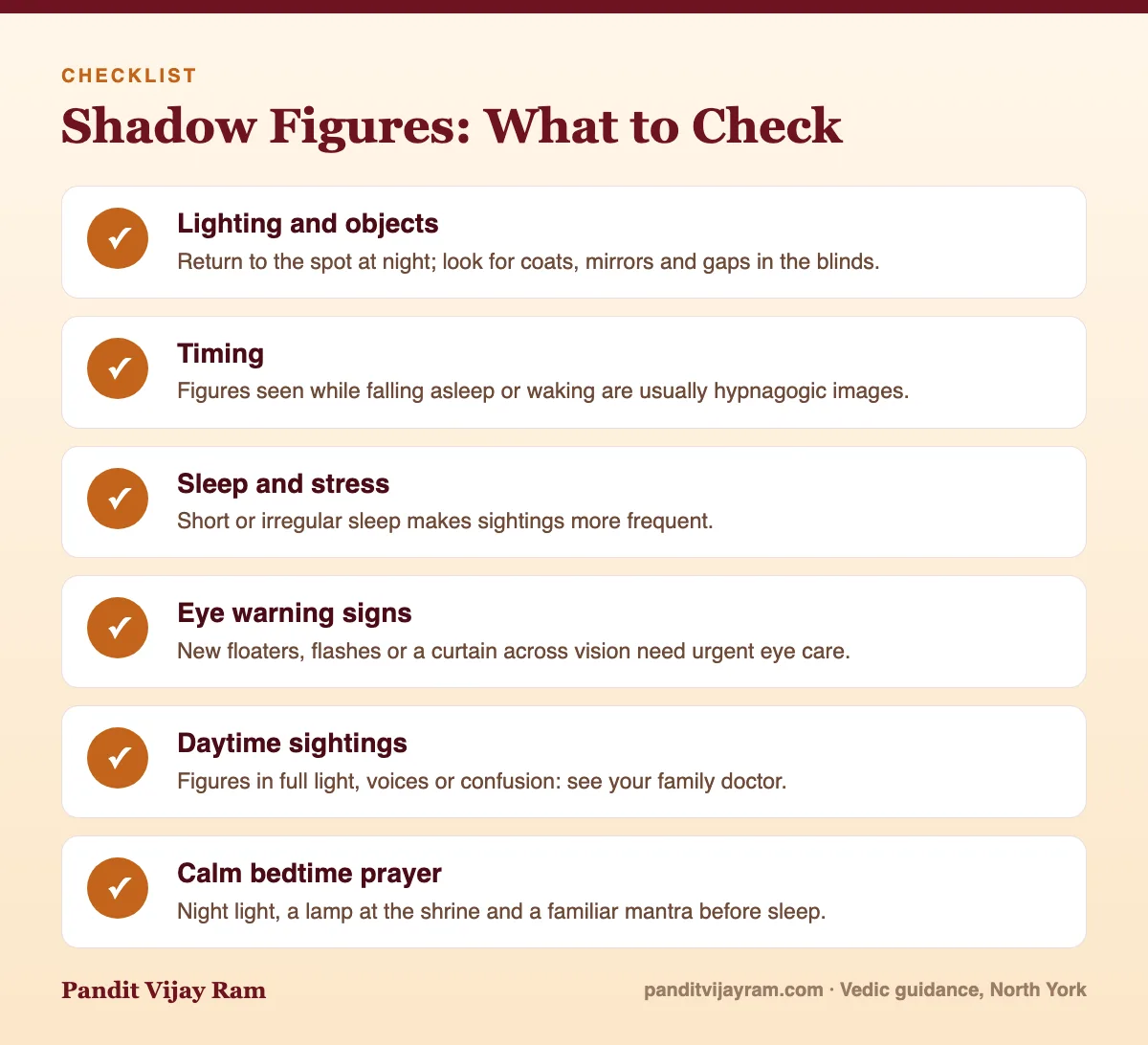
Get your eyes checked promptly if you notice new floaters, flashes of light, a shadow or curtain spreading across your vision, or sudden blurring. A curtain-like shadow can signal retinal detachment, which is an emergency. See your family doctor if figures appear in full daylight, with confusion, headaches, hearing voices or memory changes.
Most shadow sightings are harmless, but a few symptoms need medical attention. Use this guide.
Go to an emergency department or urgent eye clinic the same day if:
- a dark curtain or shadow moves across part of your vision and stays;
- you suddenly see a shower of new floaters or flashing lights;
- vision drops suddenly in one eye;
- you have sudden weakness, facial drooping or trouble speaking. Call 911 for these stroke signs.
Book an optometrist or family doctor soon if:
- you see shapes or figures in daylight, not just at the edge of sleep;
- you have migraines with visual aura, or new headaches;
- an older relative with poor eyesight describes people or patterns that are not there, which can happen with vision loss and is usually not a mental illness;
- a new medicine coincides with the sightings.
Seek mental-health support if sightings come with hearing voices, strong beliefs that others are plotting against you, or confused thinking. Call or text 988 if you or someone close is in crisis.
Getting checked is not a betrayal of faith. Spiritual care and medical care can both be part of looking after yourself, as the health and wellbeing page explains.
What does it mean spiritually to see a dark figure at night?
Traditions differ. Some Hindu families read a dark shape as an unsettled spirit or a sign of heavy energy, while Muslim households may think of jinn and Caribbean or Latino homes of a restless soul. In my practice, a single sighting is not treated as a message; repeated, shared experiences after practical checks deserve a closer look.
I respect the many ways families interpret night visions. In South Asian folklore, shadow forms are sometimes linked to a bhoot or pret, a soul that has not moved on. Other traditions speak of guardians, ancestors or warnings. These ideas give shape to a frightening moment and connect people to their elders.
What I caution against is building a large story on a small glimpse. Before reading meaning into a shadow, I ask:
- Did it happen when you were falling asleep or waking?
- Was the room dim, with a mirror, window or doorway nearby?
- Have you been sleeping poorly, grieving or under strain?
- Has anyone else in the home seen the same thing independently?
If the answers point to sleep and lighting, the kindest spiritual response is simply to pray and rest. If several family members report the same thing at different times, the home feels heavy in daylight too, and practical checks have been done, then a consultation can look at the wider picture. Related experiences, such as flickering lights and cold patches, are discussed in flickering lights and cold spots.
How can I feel safe at night after seeing a shadow figure?
Combine practical comfort with a short, steady prayer. Add a warm night light, keep the bedroom tidy and move mirrors that catch the doorway. Before bed, light a lamp at your prayer place and recite a familiar mantra or verse. If you wake frightened, sit up, turn on the light and breathe slowly.
Fear at night grows in silence and darkness. A few changes break that cycle.
Practical comfort
- Use a low, warm night light in the bedroom and hallway.
- Hang coats and dressing gowns inside cupboards rather than on doors.
- Turn or cover mirrors that reflect the doorway from the bed.
- Close blinds fully so passing headlights do not sweep across the walls.
A gentle bedtime practice
- Wash your hands and face.
- Light a diya at the prayer place for a few minutes, then put it out before sleep, or use a battery lamp.
- Recite the Hanuman Chalisa or Om Namah Shivaya eleven times, slowly.
- Place a little holy water or Ganga jal on your forehead if that is part of your family custom.
- Lie on your side and focus on slow breathing.
If you wake and see a shape, do not lie frozen. Sit up, switch on the light and look directly at the spot. Naming what you see, a coat, a chair, a shadow from the window, quickly calms the body.
If unease continues after weeks of good sleep and medical checks, the negative energy removal service begins with a careful conversation rather than a ritual. Other guides on night-time experiences are in the magic and entities hub.
The bottom line
Shadow figures are usually the product of dim-light vision, half-sleep imagery and a tired, watchful brain. Better lighting and steadier sleep remove most of them within weeks. New floaters, flashes, a spreading shadow in your vision or daytime sightings need prompt medical attention. Alongside those checks, a lamp and a familiar prayer at bedtime can restore a sense of safety without feeding fear.
Key takeaways
- Peripheral vision in dim light turns ordinary objects into vague figures.
- Hypnagogic images at the edge of sleep often look like a person by the bed.
- A curtain-like shadow across your vision is an eye emergency.
- A night light, tidy room and regular sleep reduce most sightings.
- Spiritual steps work best as calm bedtime practice, not as a fight.