
Haitian Vodou Explained Respectfully: A Religion, Not "Black Magic"
Many people first hear the word Vodou through a film, a joke or a frightening rumour. That is a poor introduction to a religion practised by a great many Haitians and their descendants, including many families in Montreal, Toronto and New York. People sometimes ask me whether Haitian Vodou is a kind of black magic. My honest answer, from North York and after more than forty years of studying how people pray, is no: it is a religion, with its own priests, theology, music and moral teaching. This article explains its basic beliefs, the spirits called lwa, what happens at a ceremony, where the religion came from, and why it has been so widely misrepresented. I do not practise Vodou; I work only in the Vedic tradition, and I describe Vodou here as an outsider who respects it. If you are curious or seeking spiritual help in that tradition, the right people to ask are oungan and manbo in Haitian communities themselves.
What do followers of Haitian Vodou believe?
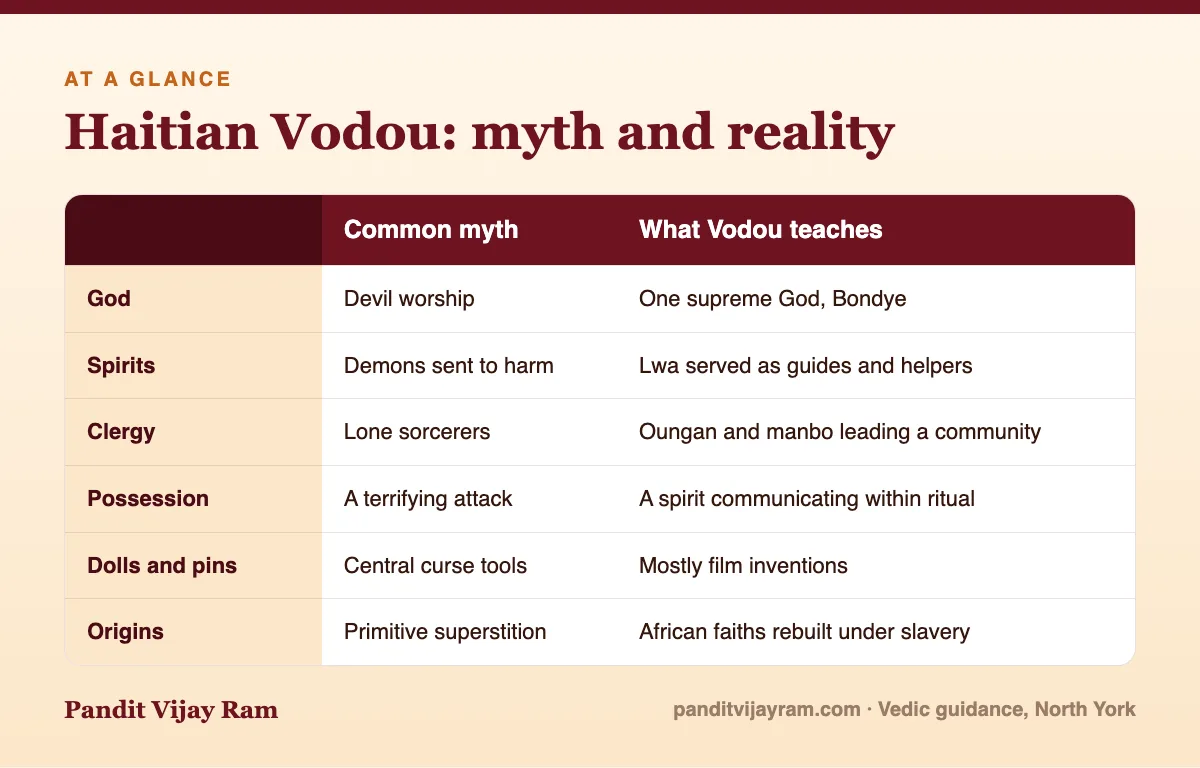
Followers of Haitian Vodou, often called sèvitè or servants of the spirits, believe in one supreme God, Bondye, who is distant from daily life. Between God and people stand the lwa, spirits who can help, guide and teach. Ancestors are honoured, and community, healing and balance are central values.
The name Bondye comes from the French Bon Dieu, good God. Practitioners generally say Bondye is too far above human affairs to be approached for daily needs, which is why the lwa matter so much. People "serve the spirits" (sèvi lwa) through offerings, songs, prayers and ceremony, and in return seek protection, advice and healing.
Key ideas include:
- Relationship: spirits and humans have obligations to each other, much like family.
- Ancestors: the dead remain part of the family and are remembered with care.
- Balance: illness and misfortune are often understood as relationships out of order, to be restored.
- Community: worship happens together in a temple house, called an ounfò.
Many practitioners also identify as Catholic, and Catholic prayers, saints and holy days are woven into Vodou practice. That blending reflects history, not confusion. The site's earlier explainer, voodoo, Vodou and hoodoo compared, discusses the spellings; this article stays with the religion itself.
Who are the lwa in Vodou?
The lwa are spirits served in Vodou, each with a personality, colours, songs, favourite offerings and areas of life. They are grouped into families called nations, mainly Rada and Petwo. Well-known lwa include Papa Legba, Ezili Freda, Ezili Dantò, Ogou, Danbala and the Gede, led by Baron Samedi.
A short introduction to some widely known lwa helps replace stereotypes with real figures:
- Papa Legba: guardian of the crossroads and gates, greeted first so that communication with other spirits can open.
- Danbala: an ancient serpent spirit associated with wisdom, purity and the colour white.
- Ezili Freda: spirit of love, beauty and refinement.
- Ezili Dantò: a fierce protective mother, especially honoured by women and those who have suffered.
- Ogou: a family of warrior spirits linked to iron, courage and politics.
- Gede and Baron Samedi: spirits of death and the cemetery, known for humour, frankness and care for children.
The Rada lwa are often described as cool and gentle, with strong roots among the Fon and other West African peoples. The Petwo lwa are hotter and more forceful, a family many scholars connect with Kongo traditions and the experience of slavery and revolution in Haiti. Fiery does not mean evil; it means intense.
For comparison, the Hindu idea of fierce protective forms such as Kali is explained in Kali puja and protection. People of many faiths have honoured divine power that is strong rather than mild.
What happens at a Vodou ceremony?
A Vodou ceremony is led by an oungan (priest) or manbo (priestess) in a temple house. Participants salute the spirits with drumming, songs and dance, draw sacred designs called vèvè on the ground, and make offerings. A lwa may come into a devotee in possession, speaking, advising and blessing those present.
Ceremonies vary by house, region and occasion, but common elements appear across many accounts:
- Opening prayers, often including Catholic prayers, followed by a salute to Papa Legba.
- Vèvè: intricate symbols traced on the floor in cornmeal or ash, each tied to a specific lwa.
- Drumming and song: rhythms and chants for each spirit, led by drummers and a song leader.
- The poto mitan: a central post through which spirits are said to travel.
- Possession: a lwa "mounts" a devotee, called the horse; the person may then speak, sing or give advice in the spirit's manner.
- Offerings and a meal: food, drink and sometimes animals are offered, and the community eats together.
Possession is understood within Vodou as an honour and a means of communication, not an attack. It occurs inside a ritual frame, supervised by experienced clergy. Outsiders often confuse it with the frightening possession scenes in films, which is a different idea entirely. Vodou also includes healing work by trained practitioners who may use herbs, baths and prayer, much as many traditions do.
Where did Haitian Vodou come from?
Vodou took shape in the French colony of Saint-Domingue, now Haiti, among enslaved Africans from many peoples, including the Fon, Yoruba and Kongo. They rebuilt their religious lives under brutal conditions, blending African traditions with each other and with Catholicism. Vodou is remembered as part of Haiti's revolution and national identity.
The word vodou itself comes from the Fon language of present-day Benin, where vodun refers to spirits or divine forces. Enslaved people brought many such traditions across the Atlantic, and in Haiti they merged into a shared religion with distinct regional styles.
Several historical points are widely discussed by historians:
- Bois Caïman: a ceremony remembered in Haitian tradition as a spark for the uprising that became the Haitian Revolution. Historians debate its details, but its symbolic place is secure.
- Persecution: colonial laws, and later campaigns by church and state, banned or attacked Vodou, destroying temples and sacred objects.
- Recognition: Haiti's government eventually recognised Vodou officially as a religion, a milestone celebrated by practitioners.
- Diaspora: Haitian migration carried Vodou to Montreal, Miami, New York and beyond.
Knowing this history explains why many Haitians feel hurt when Vodou is called "black magic". For people whose ancestors held on to it under slavery, it is a source of dignity and survival.
Why is Vodou called black magic, and what does Vijay Ram ji advise?
Vodou was labelled black magic by colonial authorities, missionaries, sensational writers and later horror films, often with racist overtones. The label ignores its theology, clergy and ethics. Vijay Ram ji does not practise Vodou; he advises people seeking help within it to approach a recognised oungan or manbo in their community.
Like every religion, Vodou has practitioners of different character, and some Vodou specialists, called bòkò, are said to work with "both hands", for good or harm. But judging a whole religion by its most feared figures would be unfair to any faith, including Hinduism.
A few points for readers:
- Use the spelling Vodou for the Haitian religion; "voodoo" often carries the film stereotype.
- Do not assume a Haitian neighbour or colleague practises it, or that practitioners wish anyone harm.
- If you fear someone is targeting you, treat threats as a police matter, whatever tradition is named.
- Beware of online sellers who use the word "voodoo" to sell curses, love spells or removal packages.
When people come to me worried about a "voodoo curse", I listen, look at ordinary causes, and offer Vedic prayer if they want it. The voodoo removal page describes that approach without disrespecting Vodou. If a doll or object has frightened you, the history in voodoo dolls: myths and history may help. More guides are gathered in the magic and entities hub.
The bottom line
Haitian Vodou is a religion with a creator God, the lwa, ancestors, clergy and community, not a system of black magic. It grew from African traditions held together by enslaved people in Haiti and remains a source of identity and dignity. Vijay Ram ji works only in the Vedic tradition and encourages those seeking Vodou guidance to approach its own priests and priestesses.
Key takeaways
- Haitian Vodou is a religion with a supreme God, Bondye, and spirits called lwa.
- Oungan and manbo lead ceremonies with song, drumming, vèvè and offerings.
- Possession in Vodou is understood as communication with a spirit, not an attack.
- The religion grew from Fon, Yoruba and Kongo traditions under slavery in Haiti.
- Calling Vodou black magic repeats colonial and Hollywood stereotypes.