
Voodoo, Hoodoo and Witchcraft Spells: How Removal Differs by Tradition
The word voodoo is used online to sell almost anything, from "revenge dolls" to emergency curse-breaking packages. That loose use does a disservice to a living religion and confuses people who are genuinely frightened. Readers in North York and across the GTA come from Haitian, Jamaican, Trinidadian, Guyanese, Latin American and South-Asian families, and many grew up hearing about Vodou, Obeah, hoodoo or brujería in very different ways. This article explains voodoo spell removal with care. You will learn why Haitian Vodou should be understood as a religion, how Louisiana Voodoo and hoodoo differ from it, what witchcraft means across several traditions, and how each one typically approaches cleansing or uncrossing. You will also see how Vedic practice responds when someone believes such work has been done against them, and when your own tradition's clergy may be the better choice. In four decades of serving a diverse city, I have learned that respect for another's faith is itself protective; contempt only adds to fear.
What is the difference between voodoo, Vodou and hoodoo?
Haitian Vodou is an African diasporic religion with priests, temples and a supreme creator served through spirits called lwa. Louisiana Voodoo is a related but distinct New Orleans tradition. Hoodoo is African American folk magic, often called rootwork or conjure, which is practised by people of many faiths rather than being a religion itself.
The three words are often mixed up, so it helps to set them apart.
- Haitian Vodou. A religion that developed among enslaved West and Central Africans in colonial Haiti, blending their traditions with elements of Roman Catholicism. Followers honour Bondye, the distant creator, and serve the lwa through song, drumming, offerings and possession ceremonies. Clergy are the oungan (priest) and manbo (priestess). Most of its practice concerns healing, community, ancestors and guidance.
- Louisiana Voodoo. A New Orleans tradition with Haitian, West African, French and Catholic influences, famous in popular culture and tourism.
- Hoodoo. A body of folk practice developed by African Americans in the southern United States. It draws on roots, herbs, minerals, candles and the Bible, especially the Psalms. Many practitioners are Christian.
The "voodoo doll" stuck with pins owes far more to films and souvenir shops than to Haitian religious practice. Treating Vodou as simply "black magic" repeats an old colonial prejudice. Our explainer on Obeah, jadu and brujería traditions takes the same respectful approach to Caribbean and Latin American practice. Wider guides are collected in the magic and entities hub.
What does witchcraft mean in different traditions?
Witchcraft is an umbrella word. It can mean modern Wicca, a pagan religion with ethical codes; European folk magic; brujería in Latin America; Obeah in the Caribbean; or sihr in Islamic teaching. Each has its own meaning, moral rules and approach to protection, so one word cannot describe them all.
A short orientation to the main uses of the word:
- Wicca and modern paganism. A contemporary religion that honours nature and deities. Many Wiccans follow the Rede, "an it harm none, do what ye will", and treat harmful spells as unethical.
- European folk magic. Village healers and cunning folk once offered charms, herbal remedies and protection against bewitchment.
- Brujería. In much of Latin America, a brujo or bruja may be feared or respected depending on context, and healing curanderos offer limpias to cleanse.
- Obeah. A Caribbean practice of spiritual power and healing, historically criminalised under colonial law in several islands.
- Sihr. The Islamic term for sorcery, addressed through ruqyah, the recitation of Quranic verses.
In Hindu homes the closest equivalents are kala jadu and abhichara. The vocabulary differs, but a common thread runs through many traditions: harmful work is condemned, and protection through faith is preferred. For help with these concerns from a Vedic standpoint, see Vijay Ram ji's witchcraft and sihr removal page. Where the concern is the egg cleansing familiar to Latino families, our comparison of limpia and Vedic nazar removal may help.
How does each tradition remove a spell?
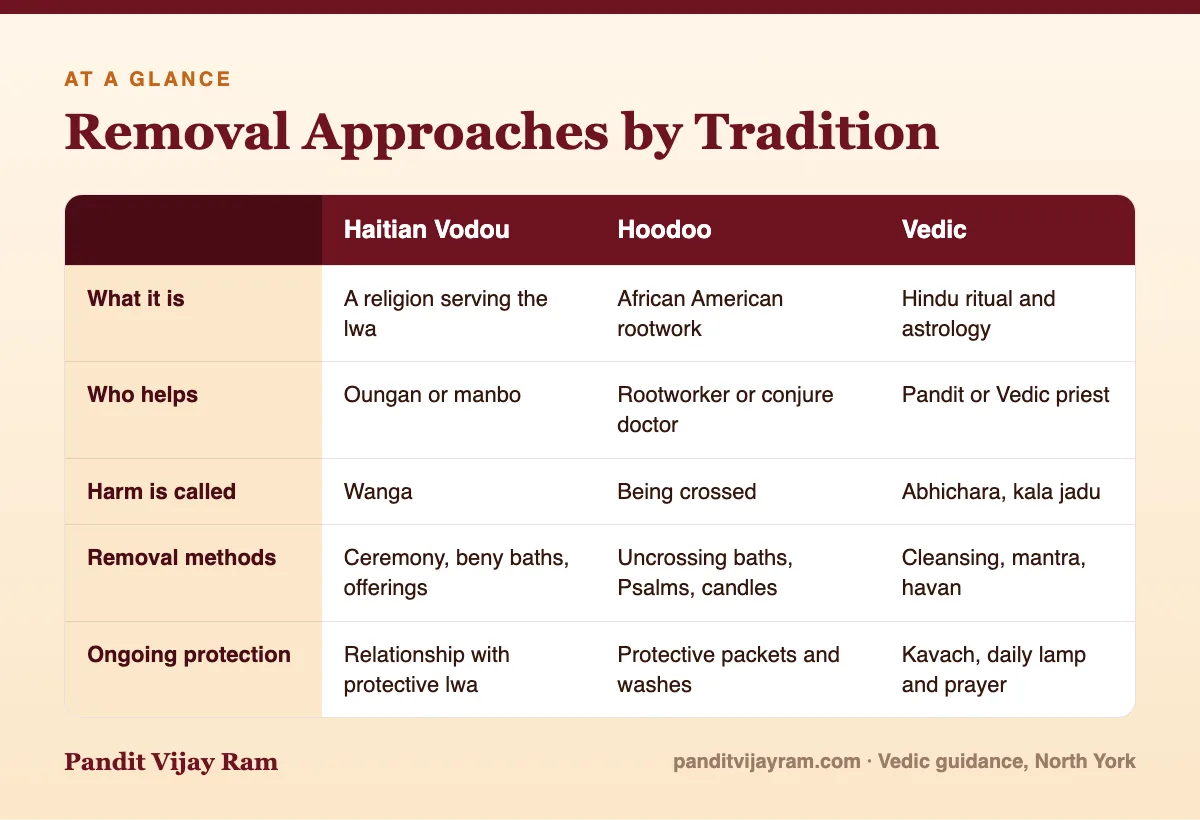
Removal methods reflect each tradition's beliefs. A Vodou priest may hold ceremonies and prescribe baths with the help of the lwa. Hoodoo uses uncrossing baths, floor washes and Psalms. Wiccans use cleansing, banishing and protective circles. Islamic ruqyah relies on Quranic recitation. Vedic practice uses cleansing, mantra, puja and kavach.
Here is a broad comparison. Practice varies by house, lineage and region, so treat this as orientation rather than instruction.
- Haitian Vodou. A person troubled by a suspected wanga or harmful working consults an oungan or manbo, who may divine the cause, call on protective lwa, and prescribe spiritual baths, called beny, and offerings. Removal sits within a religious relationship with the spirits and the temple.
- Hoodoo. Rootworkers speak of being crossed and use uncrossing work: herbal baths, floor washes, candles, protective packets and the reading of particular Psalms.
- Wicca and modern witchcraft. Cleansing with salt, water or smoke, casting a protective circle, and banishing rituals aimed at removing an influence rather than harming its source.
- Islamic tradition. Ruqyah recitation, protective surahs such as Al-Falaq and An-Nas, and prayer. Vijay Ram ji's ruqyah healing page describes this respectfully.
- Vedic tradition. Assessment of the chart, a sankalp, cleansing of body and home, Hanuman or Durga recitation, havan, and a blessed kavach.
Notice the shared structure: diagnosis, cleansing, protective prayer, and an object or practice to maintain protection. Different languages of faith often arrive at similar shapes.
Can a Vedic healer remove a voodoo or hoodoo spell?
A Vedic healer works within the Vedic framework, strengthening the person through cleansing, mantra and puja whatever the suspected source. Many people from other backgrounds find this helpful. If you belong to Vodou, hoodoo or another tradition, your own clergy may understand the specific practice better, and that choice deserves respect.
The Vedic view is that protection comes from the person's connection to the divine, not from matching the technique of whoever caused harm. So when someone tells Vijay Ram ji that a Vodou or hoodoo working has been done against them, he does not attempt to imitate or reverse that tradition's methods. He looks at the chart and the situation, then applies the protective practices of his own lineage.
That approach has a few consequences worth knowing:
- No retaliation. Nothing is sent back to anyone, whatever the tradition.
- No disrespect. The other religion is not treated as evil. A harmful act by one person does not define a faith followed by millions.
- Honest referral. If you practise Vodou or another tradition yourself, he may suggest you also speak to a trusted priest or elder in that community.
- Ordinary causes first. As always, health, home and life stresses are checked before any spiritual conclusion.
For a consultation about a suspected working, see Vijay Ram ji's voodoo removal service. If you are not sure whether what you face is a spell, a curse or a hex, our guide to spell, curse and hex removal sorts out the terms.
How do I avoid voodoo spell removal scams?
Be wary of anyone who claims a "voodoo curse" from a quick glance, sells dolls or revenge packages, demands urgent payment, or offers to send the spell back. Genuine clergy of any tradition explain, take time, and do not frighten you. Report fraud and threats to the Canadian Anti-Fraud Centre and police.
The exotic image of voodoo makes it a favourite for online scammers. Common patterns include:
- Instant diagnosis. "I can see a powerful voodoo curse on you" from a single message or photo.
- Escalating fees. Each ritual "reveals" a stronger curse needing more money.
- Threats. Warnings that you or your children will suffer if you stop paying.
- Revenge offers. Packages to make the sender suffer, which no ethical clergy of any tradition provides.
- Borrowed authority. Claims to be a "high priest" with no community, temple or lineage you can verify.
Genuine Vodou clergy belong to a community and a house; genuine rootworkers usually have a local reputation; genuine Vedic priests can explain each step of a puja. If you have lost money, contact your bank and the Canadian Anti-Fraud Centre. If you have received threats, keep records and contact police.
Finally, look after yourself. Fear of a spell, especially one from an unfamiliar tradition, can disrupt sleep and mood. A family doctor can help with that, and a calm conversation with someone who respects your background often eases the worry considerably.
The bottom line
Voodoo spell removal depends on which tradition is involved: Haitian Vodou is a religion with its own clergy, hoodoo is rootwork with uncrossing baths and Psalms, and witchcraft spans many distinct paths. Each approaches removal through diagnosis, cleansing and protective prayer in its own language. A Vedic healer applies cleansing, mantra and puja without retaliation or disrespect, and honours your choice to consult your own tradition's clergy.
Key takeaways
- Haitian Vodou is a religion with priests, temples and the lwa, not simply black magic.
- Hoodoo is African American rootwork practised by people of many faiths.
- Witchcraft is an umbrella term covering Wicca, folk magic, brujería, Obeah and more.
- Most traditions share a structure of diagnosis, cleansing and protective prayer.
- Vedic removal protects without retaliation and respects other faiths' clergy.