
Voodoo Dolls: Myths, History and Why They Scare People
Few objects cause as much fear from so little material as a small cloth figure with pins in it. People write to me after finding a doll in a car, after receiving one as a cruel joke, or after a late-night video convinced them someone is "working" on them. Families in North York, Scarborough and Etobicoke have shown me photos with shaking hands. This guide explains where the voodoo doll image actually comes from: ancient image magic, European poppets, central African power figures, and a long run of horror films. You will also learn how dolls are really used in Haitian Vodou, a living religion that is often blamed for a stereotype it did not create, and what to do, practically and spiritually, if a doll has frightened you. I practise only in the Vedic tradition. In more than forty years I have seen that naming the history of an object often takes away half of its hold on a person's mind.
Where does the voodoo doll idea really come from?
The pin-stuck doll comes mainly from older European and Mediterranean image magic: Egyptian and Greek figures bound or pierced in curse rites, and English and continental poppets used in folk magic. Writers and filmmakers later attached this European object to Haitian and Louisiana Vodou, creating a stereotype that stuck.
The idea that harming an image harms the person is ancient. Scholars call it sympathetic magic, a term made famous by the anthropologist James Frazer, who described a "law of similarity" in which like affects like. Examples include:
- Egyptian execration figures inscribed with enemies' names and broken or buried;
- Greek and Roman figurines bound, twisted or pierced and placed with lead curse tablets;
- medieval and early modern European poppets of wax, cloth or clay used in love or harm spells.
Poppets appeared as evidence in European and colonial American witch trials. Accusers sometimes claimed that figures stuck with pins had been found in a suspect's home or wall, and those claims helped send people to their deaths.
So when a modern shop sells a cloth doll and calls it "voodoo", it is really selling a European folk object under an African-Caribbean name. The guide to voodoo, Vodou, hoodoo and witchcraft explains those terms in more depth.

Are voodoo dolls part of Haitian Vodou?
Pin dolls are not a central part of Haitian Vodou. Dolls do appear in some Vodou settings, as offerings to the spirits, as decorations on altars, or tied to trees in sacred spaces, usually to carry a prayer or remember someone. The revenge doll is largely an outsider's invention.
Haitian Vodou is a religion with priests and priestesses (oungan and manbo), temples, songs, drumming and a large community of spirits called the lwa. Its core concerns are relationships: with God, with the lwa, with ancestors and with one another.
Within that religious life, figures and dolls can play modest roles:
- dolls dressed for a particular lwa and placed on an altar;
- figures left as gifts at sacred trees or cemetery crosses;
- objects used in healing work, alongside herbs, prayer and song.
None of these resemble the horror-film scene of a sorcerer jabbing pins into a doll to hurt an enemy. In New Orleans, shops selling pin dolls to tourists grew from the popularity of that film image, not from the religion's own priorities.
Central African traditions add one more thread. Kongo nkisi nkondi figures, often studded with nails, were used to seal oaths, seek justice and heal. Each nail recorded an agreement or a plea. Outsiders who saw them assumed they were tools of cursing. Museums now explain them more accurately. For a respectful account of the religion itself, read Haitian Vodou explained.
How did Hollywood make voodoo dolls so frightening?
Sensational travel books about Haiti and early horror films presented Vodou as dark sorcery and gave audiences the image of a doll, a pin and a scream. Television, comics and souvenir shops repeated it until most people assumed it was real religious practice. The fear is learned from fiction, not from the tradition.
During the American occupation of Haiti, some foreign writers published lurid accounts of zombies, curses and "voodoo" rites. These books sold well and shaped early horror cinema. Films and pulp novels used Haitian and African-diaspora religion as a shorthand for menace, often with racist imagery.
Several features of that portrayal remain common:
- a dark-skinned sorcerer, often unnamed, controlling white victims;
- a doll with pins as the visual proof of power;
- drums and chanting used only to signal danger;
- no sense of the religion as a community with ethics and families.
Scholars of religion and Haitian writers have criticised this portrayal for decades. Many Haitians, including the large Haitian community in Quebec, find it painful to see their faith reduced to a horror prop.
Understanding this history helps when you feel afraid. The fear you carry may have been taught by a film you watched as a child. That does not make your feelings silly; it simply means they can change.
Can a voodoo doll actually hurt someone?
There is no reliable evidence that pushing pins into a doll can physically injure a distant person. What can happen is real distress: fear, poor sleep, anxiety and a sense of being targeted. Finding a doll left deliberately may also be harassment, which is a safety matter in its own right.
Researchers have studied the nocebo effect, in which expecting harm can bring on real symptoms such as headaches, nausea or pain. A person who believes a doll has been made of them may feel exactly those things. That is not imagination in the dismissive sense; the body genuinely responds to fear.
This leads to a useful way of thinking:
- The object itself is cloth, stuffing and metal.
- The message behind it may be hostility from a person who wants you scared.
- The fear it causes is real and deserves care.
Psychologists have even used "voodoo doll" tasks in laboratory studies of aggression, with participants sticking pins into a doll representing a partner or stranger as a harmless measure of anger. That shows how widely the image is understood as symbolic.
If you have physical symptoms, please see your family doctor. If you feel overwhelmed, call or text 9-8-8. Spiritual protection can help settle the mind, and the voodoo removal page explains how Vedic prayer is offered to people who want it, without claiming that the doll had power over them.
What should you do if you find a voodoo doll?
Stay calm, photograph the doll where it lies, and handle it with gloves or a bag. If it was left at your home, car or work, treat it as possible harassment and report it to police, especially alongside threats. Then dispose of it respectfully and, if you wish, say a prayer from your own faith.
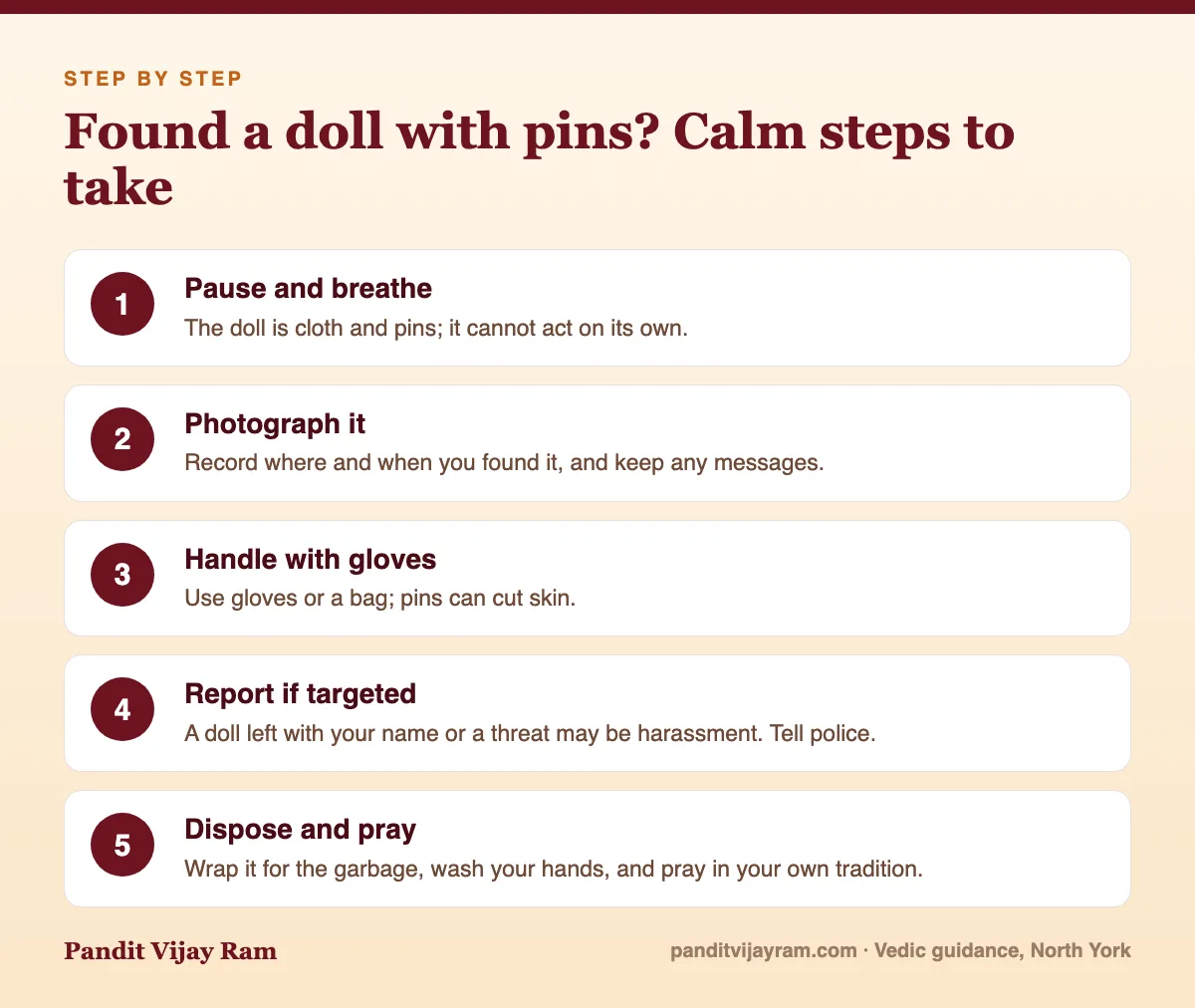
A clear sequence helps when fear is high:
- Pause. Take a few slow breaths; the doll cannot act on its own.
- Document. Photograph it, note where and when you found it, and keep any related messages.
- Handle safely. Use gloves or turn a plastic bag inside out over your hand; pins can cut.
- Report if targeted. A doll left with your name, photo or a note may be part of harassment. Police can advise.
- Dispose. Wrap it and place it in household garbage, or follow your faith's custom.
- Pray if you want to. Light a lamp, recite a protective prayer, and wash your hands and face.
Our step-by-step guide to finding a suspicious object covers other items such as lemons, threads and powders. Further guides sit in the magic and entities hub. If a doll came from a joke shop or a child's toy box, as many do, a short laugh may be the best remedy of all.
The bottom line
The voodoo doll is mostly a European poppet wearing a borrowed name, made famous by sensational books and horror films rather than by Haitian Vodou. There is no reliable evidence it can injure anyone, though the fear and any harassment behind it are real and deserve care. Document, report if targeted, dispose calmly, and pray in your own tradition if it helps.
Key takeaways
- The pin-stuck doll comes mostly from European poppets and ancient image magic.
- Haitian Vodou uses dolls mainly as offerings and altar objects, not for revenge.
- Hollywood and sensational writing created the popular voodoo doll image.
- A doll cannot be shown to injure, but fear and harassment are real.
- Photograph, handle with gloves, report threats and dispose of it calmly.