
Narasimha Mantra for Protection From Negative Spirits
When fear takes hold at night, many devotees remember one image: a small boy who refused to stop praying, and a God who burst out of a stone pillar to protect him. That is the story behind the Narasimha mantra, one of the most loved protective verses in the Vaishnava tradition. Families in North York, Brampton and Scarborough often ask me whether this mantra is safe to chant at home, which version to use, and how to pronounce it without mistakes. These are sensible questions, because Narasimha is a fierce form and people want to approach him with respect. In this guide you will find the story of Prahlada and Hiranyakashipu, the full verse with its meaning, other Narasimha prayers such as the kavach, and a simple routine you can follow at home. In more than forty years of guiding recitation, I have found that this mantra helps most when it is chanted as an act of trust, the way Prahlada chanted, rather than as a weapon against anyone. Ordinary worries about health, sleep or your home still deserve attention first.
Who is Narasimha and why is he called on for protection?
Narasimha is the fourth avatar of Vishnu in most traditional lists, appearing as half man and half lion. The Bhagavata Purana tells how he emerged from a pillar to protect his devotee Prahlada from the demon king Hiranyakashipu. Because he came specifically to shield a defenceless devotee, he is invoked against fear and harm.
The story is told most fully in the seventh book of the Bhagavata Purana, and also in the Vishnu Purana and other texts. Hiranyakashipu, king of the asuras, had won a boon from Brahma that seemed to make him impossible to kill. He could not be slain by man or beast, inside or outside, by day or by night, on the ground or in the sky, by any weapon.
His young son Prahlada, however, was devoted to Vishnu. The king tried again and again to break that devotion, and then to kill the boy. Each attempt failed. One version links this to Holika, the king's sister, who tried to burn Prahlada and was herself consumed, an event remembered at Holi.
At last the king struck a pillar and mocked Prahlada: is your Vishnu in this too? Narasimha emerged from it. He was neither man nor beast. He seized the king at twilight, which is neither day nor night, on the threshold, which is neither inside nor outside, on his own lap, which is neither ground nor sky, and used his claws rather than a weapon.
The lesson devotees draw is that no cleverness can shut God out, and that the sincere devotee is never alone. That is why Narasimha is called on when someone feels surrounded by fear. For related stronger hymns, see the guide to protective mantras and the Bajrang Baan.
What is the Ugram Viram Narasimha mantra and what does it mean?
The best-known Narasimha mantra reads: Ugram viram maha-vishnum jvalantam sarvato-mukham, nrisimham bhishanam bhadram mrityor mrityum namamy aham. It means, roughly: I bow to the fierce and heroic great Vishnu, blazing, facing every direction, Narasimha, terrifying yet auspicious, who is death even to death itself.
This verse is often called the Narasimha mantraraja, the king among his mantras, and it is traditionally associated with the Nrisimha Tapaniya Upanishad. Here is a word-by-word sense to help you chant it with meaning.
- Ugram – fierce, intense.
- Viram – heroic, courageous.
- Maha-vishnum – the great, all-pervading Vishnu.
- Jvalantam – blazing, shining like fire.
- Sarvato-mukham – with faces in all directions, seeing everything.
- Nrisimham – the man-lion.
- Bhishanam – frightening, awe-inspiring.
- Bhadram – auspicious, kind, good.
- Mrityor mrityum – the death of death.
- Namamy aham – I bow down.
Notice the pairing of bhishanam and bhadram. Narasimha is terrifying to what harms, and gentle to the one who takes shelter. Prahlada was never afraid of him. That is the attitude the verse invites.
A shorter form many families use is Om Namo Bhagavate Narasimhaya, which is easy for beginners and children. Mantras that add seed syllables (bija) or tantric elements are a different matter, and I suggest learning those only from a teacher in that lineage.
How do you pronounce the Narasimha mantra correctly?
Say it slowly, syllable by syllable, before trying to chant at speed. Nrisimham is pronounced roughly nri-SIM-ham, with a soft nasal m. Jvalantam begins with a clear j-v blend, and mrityor has a short r sound like ri. Listening to a temple priest or a reliable recording helps more than any written guide.
I am honest with people about this: written guides can only take you so far. Sanskrit has sounds that English spelling does not capture well, and regional pronunciation varies between, for example, South Indian and North Indian temples. Both are offered sincerely. What matters is that you learn from one careful source and stay consistent.
A few practical points:
- Break it into four parts. Ugram viram maha-vishnum / jvalantam sarvato-mukham / nrisimham bhishanam bhadram / mrityor mrityum namamy aham. Learn one part a day.
- Respect the long vowels. The second a in namamy is long, as in father.
- Do not rush the conjuncts. Jva, nri and mri are one smooth sound each, not two separate syllables.
- Record yourself. Compare your chant with your teacher's after a week.
- Be gentle with mistakes. Tradition teaches that sincere devotion is never wasted. Correct yourself without anxiety.
If you want guidance on the right counting beads, the article on rudraksha and tulsi malas explains why tulsi is traditionally used for Vishnu's forms.
What other Narasimha prayers are used for protection?
Besides the Ugram Viram verse, devotees recite the Narasimha Kavacham, a protective hymn traditionally attributed to Prahlada, and the Lakshmi Narasimha Karavalamba Stotram attributed to Adi Shankaracharya. Many also observe Narasimha Jayanti, which falls on the fourteenth lunar day of the bright half of Vaishakha, with worship at dusk.
Each prayer has a slightly different mood, and families often choose according to need.
- Narasimha Kavacham. A kavach, meaning armour, names the parts of the body and asks Narasimha to guard each one. Tradition places this hymn in the mouth of Prahlada and attributes it to the Brahmanda Purana. It is longer and is often read once daily during a period of difficulty.
- Lakshmi Narasimha Karavalamba Stotram. A gentle hymn asking Narasimha, with Lakshmi beside him, to offer a helping hand. Its refrain, mama dehi karavalambam, means give me the support of your hand. It suits people who feel low or overwhelmed rather than frightened.
- Narasimha Jayanti. Devotees fast through the day and worship at twilight, the hour of Narasimha's appearance. Dates shift each year with the lunar calendar, so check a local panchang.
For choosing an auspicious day for any protective practice, see the guide to the best day for spiritual cleansing. Readers drawn to the Mother's form of protection may also find the Durga Saptashati path helpful.
Is it safe to chant the Narasimha mantra at home?
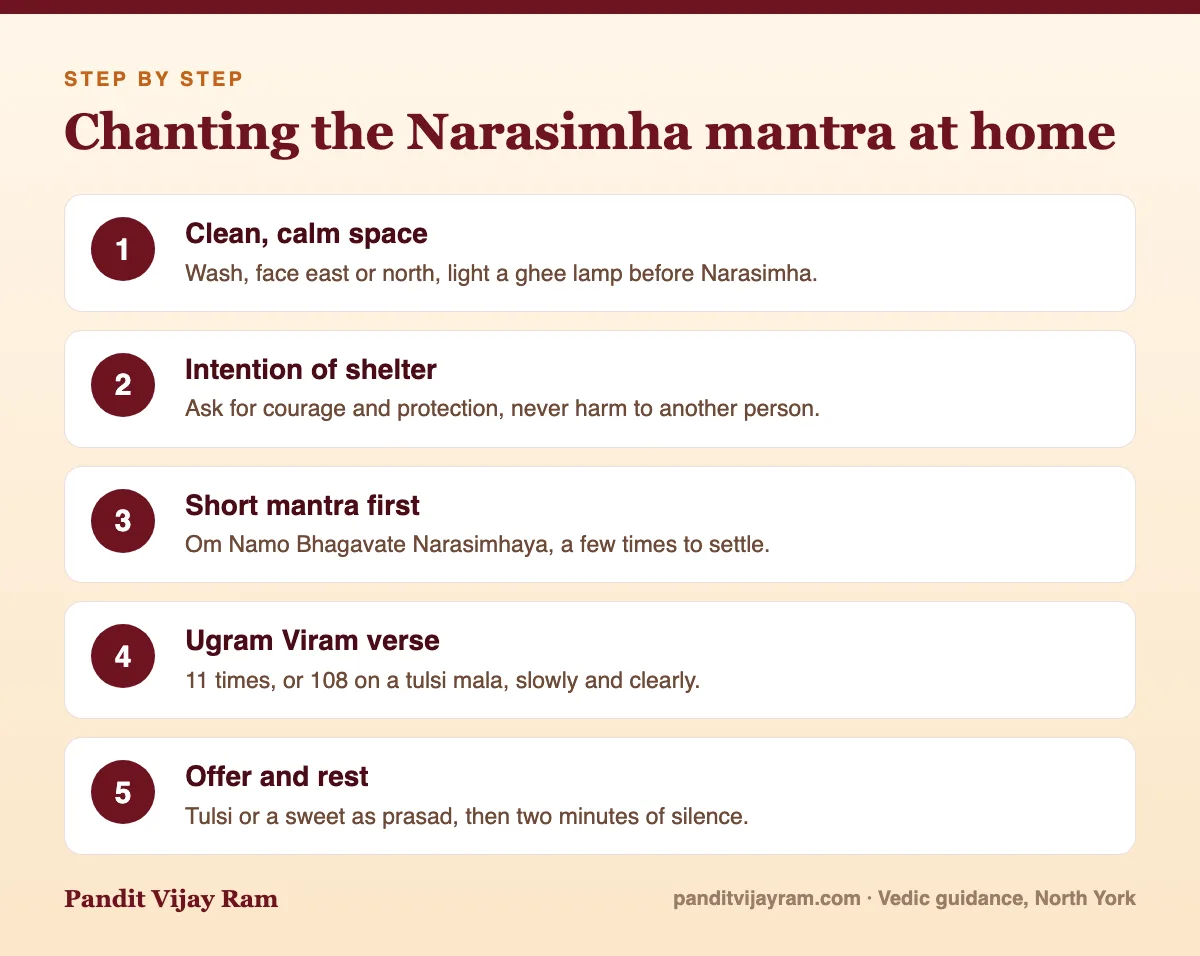
Yes, the Ugram Viram verse and Om Namo Bhagavate Narasimhaya are widely chanted in homes, including by children. Approach it with devotion and cleanliness, keep a steady count, and never chant it to harm or frighten another person. Longer or tantric Narasimha practices should be learned from a qualified teacher, not from internet videos.
People sometimes hear that Narasimha is too fierce for a family home. In mainstream Vaishnava practice that is not the teaching. Temples and households across India chant his name daily. His fierceness is directed at what threatens the devotee, and he is pictured in many homes as the calm Lakshmi-Narasimha, with the goddess seated on his lap.
What tradition does ask for is respect:
- Intention. Pray for protection and courage, not for revenge. Using any mantra against another person goes against its spirit.
- Steadiness. A daily count of 11 or 108, kept for several weeks, is better than 1,008 repetitions done in a panic.
- Cleanliness. Wash before chanting and keep the space tidy. Many keep a simple vegetarian diet on chanting days.
- Health first. If fear, poor sleep or strange experiences are affecting daily life, see your family doctor alongside your practice.
If you would like a guided anushthan, the puja and anushthan page describes how a longer, structured recitation is planned. For persistent disturbance at home, the spirit and ghost removal service begins with a careful look at ordinary causes, and the magic and entities hub gathers related guides.
The bottom line
The Narasimha mantra salutes the man-lion form of Vishnu who protected Prahlada, and it is chanted for courage and shelter from fear. Learn the Ugram Viram verse slowly from a reliable voice, keep a steady daily count, and treat pronunciation mistakes gently. Above all, chant as Prahlada did, from trust rather than anger, and keep caring for your health and home alongside your prayer.
Key takeaways
- Narasimha appeared from a pillar to protect the child devotee Prahlada, as told in the Bhagavata Purana.
- The Ugram Viram verse means he is terrifying to harm and auspicious to the devotee.
- Learn pronunciation from one reliable source and practise in short sections.
- A steady 11 or 108 repetitions daily is better than intense, anxious chanting.
- Never use a protective mantra to harm another person, and see a doctor for ongoing distress.