
Can You Give Yourself Nazar? Self-Inflicted Evil Eye Explained

You catch your reflection on a good hair day, think you look wonderful, and by afternoon you have a pimple, a stained shirt and a headache. Or you tell a friend you never get colds, and the next morning you are sneezing. Many people then wonder: can you give yourself nazar? Families in North York, Etobicoke and Brampton ask me this with a half-laugh, but the worry underneath is real for some. A few people become so afraid of their own pride that they stop enjoying anything good. This article explains what tradition actually says about self-nazar, why the belief feels so convincing, and when it may point to anxiety rather than spiritual trouble. It also offers simple, humility-based habits that settle the worry without fear, and an honest note on removing nazar from yourself. In more than forty years of practice, I have found that the answer to self-nazar is almost always gratitude, not ritual.
Can you put nazar on yourself according to tradition?
Yes, many South-Asian families believe you can. The idea, often called khud ki nazar or apni hi nazar, is that dwelling with pride on your own looks, health, child or success exposes it the same way an envious stranger's glance would. Tradition sees it as mild and treats it with gratitude and modesty rather than fear.
In the household view, nazar is not only about other people. It is about how good fortune is held. Something precious that is constantly displayed, praised and examined, even by its owner, is thought to lose its protection.
Examples elders often give:
- The mirror. Admiring your own face or outfit at length before an event.
- The boast. Saying aloud that your business never has a slow month, or that your baby always sleeps through.
- The tally. Repeatedly counting savings, gold or achievements.
- The comparison. Feeling quietly superior to a sibling or neighbour.
Notice what these share. Each turns a blessing into a possession to be shown off. The belief carries an ethical lesson: good things come by grace, and holding them too tightly invites a fall. Some families say a similar thing about praising your own child, which is explored tenderly in can a mother give her own child nazar.
No major scripture, Hindu or otherwise, spells out a doctrine of self-nazar. It belongs to folk wisdom, and it is best read as a gentle teaching about humility rather than a hidden danger. The wider family of evil-eye ideas is gathered in the evil eye and curses hub.

Why does it feel like saying something good jinxes it?
Psychologists who study tempting fate find that most people, across cultures, feel a bad outcome is more likely after a boast. We notice and remember the times a boast was followed by trouble and forget the many times it was not. Good streaks also tend to end naturally, which makes a boast look like the cause.
The jinx feeling is almost universal. English speakers knock on wood. Many South-Asian families say nazar na lage even about themselves. Behind these habits sit a few well-understood quirks of the mind.
- Vivid memory for irony. The time you said you never get lost, then took a wrong exit on the 401, sticks in memory because it was funny or painful. The hundreds of uneventful boasts vanish.
- Boasts arrive at peaks. We tend to brag when something is going unusually well. Unusual streaks end on their own, so a slide after a boast is likely whatever you say.
- Attention to the thing praised. Once you have said your skin is clear, you look at it more closely and notice every blemish.
- Relaxing your guard. Feeling invincible can mean skipping the routine that kept things going: sleep, preparation, the extra check.
None of this disproves anyone's faith. It explains why the pattern feels so reliable, and it takes the fear out. Self-nazar, read this way, is a reminder to stay steady when things go well. A related experience, feeling unwell after other people praise you, is explained in why you may feel unwell after being praised.
Is fear of your own nazar a sign of anxiety?
Sometimes. A light belief in self-nazar is harmless. But if you avoid mirrors, refuse to enjoy good news, repeat protective rituals many times a day, or feel intense dread after any compliment, that pattern looks more like anxiety or obsessive worry. A family doctor can help, and treatment works well.
I take this part seriously because the belief can grow into something heavy. When a person tells me they have started covering mirrors for fear of their own eyes, I do not reach for a ritual. I gently suggest a doctor, because that is distress that needs care.
Signs the worry has gone beyond tradition:
- Avoidance. Not looking in mirrors, not wearing nice clothes, not sharing exam results with your own parents.
- Repetition. Saying protective phrases or doing rituals many times a day, and feeling unable to stop.
- Checking. Constantly inspecting your face, body or belongings for signs that something has gone wrong.
- Joylessness. Feeling you are not allowed to be happy in case it is taken away.
- Sleep and appetite changes lasting more than a couple of weeks.
These patterns are common, and they respond well to counselling and, where needed, medical treatment. Please speak with your family doctor. If you ever feel overwhelmed or unsafe, call or text 9-8-8, the Suicide Crisis Helpline, at any hour.
Faith can still have a place. Many people find that a short daily prayer, practised alongside proper care, feels steadier than a dozen anxious rituals.
How do you protect yourself from your own nazar?
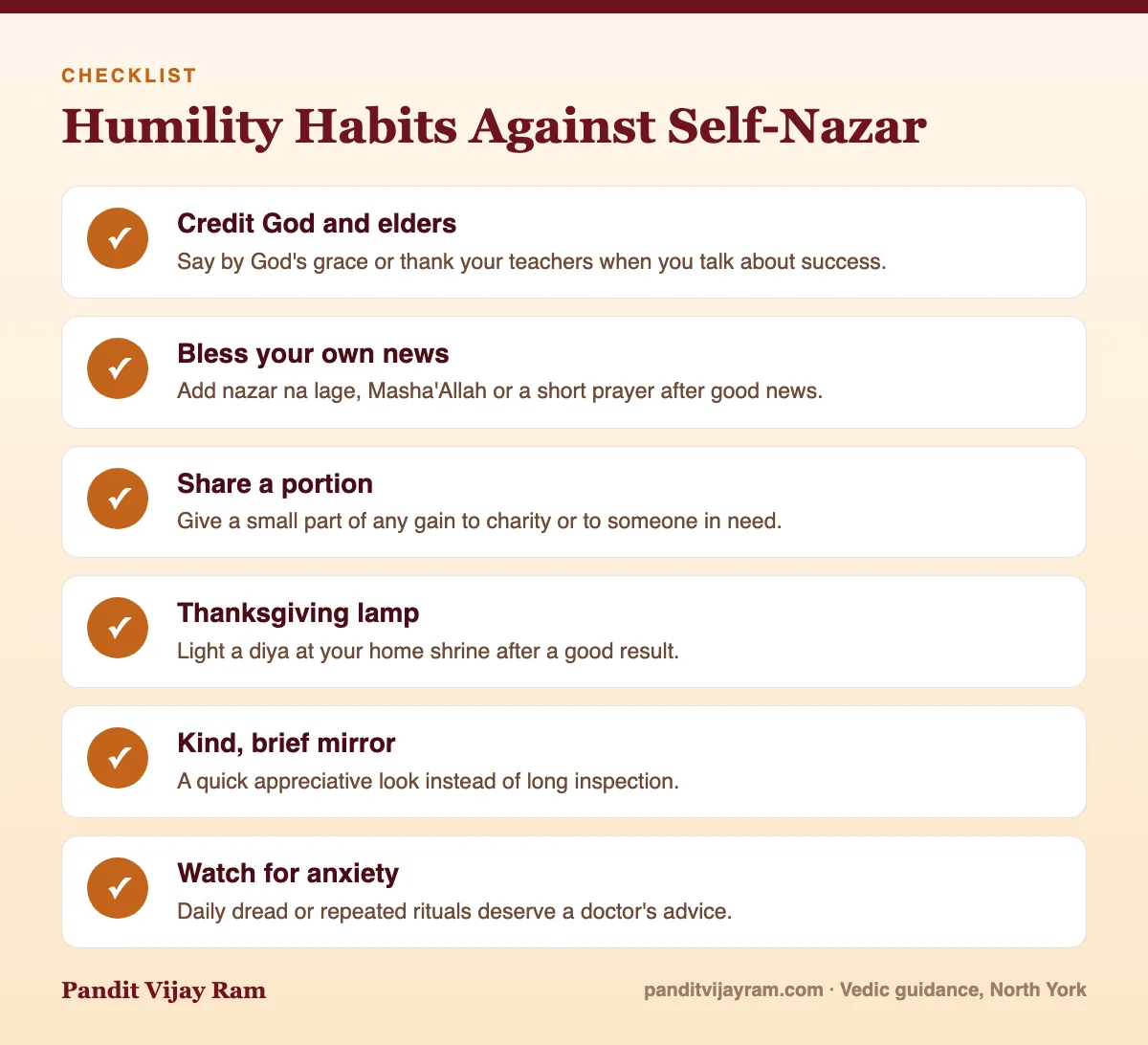
Tradition answers self-nazar with humility rather than objects. Credit good fortune to God or your elders, say a short blessing over your own good news, share some of what you gain with others, and keep a modest, grateful tone. A lamp lit in thanks after a success is a simple, widely used household practice.
These habits come from several traditions and suit almost anyone. Choose two or three; there is no need to do them all.
- Give credit away. Say Bhagwan ki kripa se, by God's grace, or thank your parents and teachers when you speak about a success. It changes the feeling of the sentence.
- Bless your own news. After saying something good about yourself, add nazar na lage or a brief prayer. Muslims commonly say Masha'Allah about their own blessings too.
- Share a portion. Give a little of a raise, a bonus or a business gain to charity, a temple, a gurdwara or someone who needs it. Sikh families call this practice dasvandh.
- Light a lamp in thanks. After good results, light a diya before your home shrine and simply say thank you.
- Touch an elder's feet. Seeking blessings from parents and grandparents before and after milestones keeps achievement connected to family.
- Look kindly in the mirror. Brief, appreciative glances rather than long inspections, either admiring or critical.
Discretion helps as well. You do not have to hide good news, but you can choose your audience. That theme is explored in nazar after sharing good news online.
Can you remove nazar from yourself without help?
Yes. Many people do a simple self nazar utarna: holding salt, or mustard seeds with dry red chillies, in the right hand, circling it over the head and body, and dropping it into a flame or running water. Tradition prefers that someone who loves you does it, but doing it yourself is accepted.
The usual household method, adapted for doing it alone:
- Hold a pinch of rock salt, or a few mustard seeds with one or two dry red chillies, in your right fist.
- Circle it seven times around your head, then down the front of your body to your feet, with a short prayer to your chosen deity.
- Dispose of it: drop the salt in the sink with running water, or place the chillies and seeds on a steel plate over the stove with the fan on. Never leave a flame unattended.
- Wash your hands and feet, and sit quietly for a minute.
The mustard and salt practice is explained in more depth in rai namak for nazar, and the full home method appears in how to remove nazar at home.
An honest limit: if you are repeating this every day and still feel uneasy, the ritual is not the missing piece. Look at sleep, stress and mood, and speak to a doctor. If you would like a calm second view after that, the evil eye and nazar service can help you sort out what is really going on.
The bottom line
Can you give yourself nazar? Folk tradition says yes, but it treats self-nazar as a mild reminder to hold good fortune with humility. Psychology explains much of the jinx feeling through memory, peaks and attention, which takes the fear out of it. Gratitude, sharing and a simple self nazar utarna are enough for most people, while persistent dread deserves care from a doctor.
Key takeaways
- Many South-Asian families believe pride can invite your own nazar.
- The jinx feeling is common and largely explained by memory and timing.
- Constant fear of your own gaze may be anxiety and deserves medical help.
- Crediting God, sharing gains and lighting a thanksgiving lamp are traditional protections.
- A simple self nazar utarna is acceptable when you have no one to help.