
Mantras for Evil Eye Protection: Hanuman, Durga and Narasimha

When nazar is suspected, most families reach first for salt and chillies. Fewer know that the tradition also offers specific verses for the purpose, short enough to learn in a day and gentle enough for a child to hear. People in North York, Thornhill and Markham often ask me for a mantra for evil eye protection that is not the general Gayatri or Mahamrityunjaya they already know. This article gives three such verses, one each to Hanuman, Durga and Narasimha. For each, you will find the words in simple transliteration, a plain translation, when it is traditionally recited and how many repetitions suit nazar. There is also a seven-day routine for a household that feels unsettled, guidance on chanting on behalf of a child, and honest notes on what mantras can and cannot do. In more than forty years of teaching these verses, I have found that a short prayer said steadily and with understanding brings more calm than a long one rushed through in fear.
Which mantra is best for protection from the evil eye?
There is no single best mantra; there is the one that suits you. Hanuman's verse suits those who feel fearful or drained, Durga's suits mothers protecting children and households, and Narasimha's suits those who feel targeted or exposed. Each is short, safe for householders and traditionally used specifically against nazar and envious attention.
Each of these deities carries a particular meaning in protection.
- Hanuman. The devoted servant of Rama, fearless and untouched by fear himself. Families turn to him when someone feels weak, anxious or easily affected by others. His worship is traditionally strong on Tuesdays and Saturdays.
- Durga. The mother who protects. In the Devi Mahatmya, the gods praise her after her victory and ask her to guard them on every side. That makes her verse natural for homes, babies and families. Fridays and the nine nights of Navratri are her traditional times.
- Narasimha. The man-lion form of Vishnu who appeared to protect the child devotee Prahlad from his own father's cruelty. He is remembered as the protector of the innocent when danger comes from close by.
These verses are different from the general purifying mantras covered in mantras for negative energy removal, and gentler than the intensive recitations for black magic in Bajrang Baan and black magic mantras. For nazar, which tradition treats as mild, a short verse is the right size.

What is the Hanuman mantra for nazar?
The Manojavam verse is widely recited to Hanuman for protection: Manojavam marutatulyavegam, jitendriyam buddhimatam varishtham, vatatmajam vanarayutha mukhyam, shri ramadutam sharanam prapadye. It means: I take refuge in Rama's messenger, swift as the mind and the wind, master of the senses, wisest of the wise, son of the wind, leader of the vanaras.
This verse is commonly recited from the Rama Raksha Stotra, a hymn whose very name means Rama's protection. It is short, rhythmic and easy for children to learn, which is one reason families favour it for nazar.
Why it suits the evil eye in particular:
- It is a prayer of refuge. The final words, sharanam prapadye, mean I take shelter. Nazar is felt as exposure, and refuge is its natural answer.
- It names self-mastery. Jitendriyam, one who has conquered the senses, reminds the person chanting that they need not be shaken by every glance or comment.
How to use it for nazar: recite it seven times before leaving for a crowded event, or eleven times when someone comes home feeling drained after a gathering. On Tuesdays or Saturdays, light a lamp with sesame or mustard oil before Hanuman's image and recite it twenty-one times.
A shorter name-mantra, Om Namo Bhagavate Anjaneyaya, is often used by those who cannot yet manage the full verse. Families who want a fuller observance can arrange a Hanuman puja and havan.
Which Durga mantra protects against the evil eye?
A verse from the fourth chapter of the Devi Mahatmya is used for protection: Shulena pahi no devi, pahi khadgena chambike, ghantasvanena nah pahi, chapajyanihsvanena cha. It asks the goddess to protect us with her spear, her sword, the sound of her bell and the twang of her bowstring. Mothers often recite it for children.
The Devi Mahatmya, also called the Durga Saptashati or Chandi Path, is a section of the Markandeya Purana. In its fourth chapter, after the goddess defeats the buffalo demon, the gods sing her praises and ask for her protection. This verse comes from that hymn, and the next verse asks her to guard the east, west, north and south.
Why it suits nazar:
- It surrounds. The bell and bowstring are sounds, which travel in every direction. Families say the verse makes a circle of protection, much like the circling done in nazar utarna.
- It speaks as us. The word nah, us, makes it a prayer for the whole family, not just the person chanting.
- It is motherly. Ambika means mother.
How to use it: a mother can recite it seven times while gently moving her right hand over her child's head. For a house that feels unsettled after visitors, recite it eleven times facing each direction in turn, beginning with the east. On Fridays or during Navratri, recite it after lighting a ghee lamp. A fuller observance is possible through a Durga puja and havan.
When should you chant the Narasimha mantra for protection?
The Narasimha verse is chanted when a person feels exposed, targeted or afraid of someone close: Ugram viram mahavishnum, jvalantam sarvatomukham, nrisimham bhishanam bhadram, mrityor mrityum namamyaham. It honours Narasimha as fierce, heroic, blazing and facing every direction, terrible yet auspicious, the death of death itself. Recite it calmly, never in anger.
This verse is often called the Narasimha mantra raja, the king of Narasimha mantras.
The story behind it matters. Prahlad was a child devoted to Vishnu, and his own father tried repeatedly to harm him. Narasimha appeared at twilight, on a threshold, neither man nor beast, to protect the boy. For many families, that makes this the verse for times when unease seems to come from inside the circle of relatives or colleagues, which is exactly when nazar worries become most painful.
Guidance for chanting it well:
- Chant it for protection, not punishment. Narasimha protects the innocent. Asking him to harm anyone goes against the spirit of the verse and against everything I teach.
- Keep it sattvic. Bathe first, sit facing east or north, and chant with a calm voice.
- Counts. Three times daily as protection, or eleven times in the evening for a week when you feel exposed.
- Bija mantras. Short seed syllables of Narasimha exist, but tradition gives them with personal guidance. The verse is enough for householders.
If you suspect someone close is behind repeated difficulties, protective prayer is only part of the answer. Boundaries, communication and, where there is harassment, the police, matter more.
How many times should you chant a mantra for nazar?
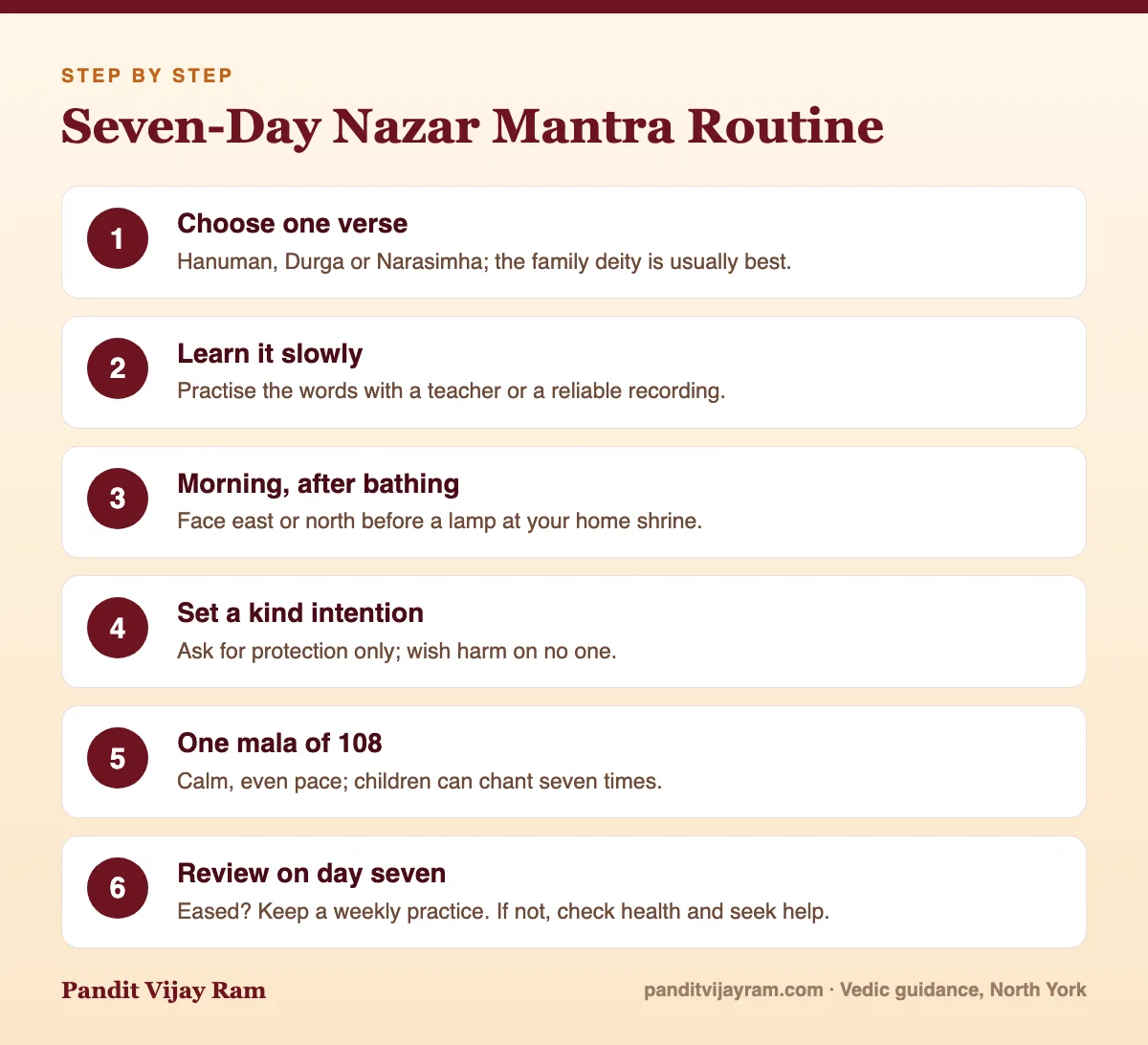
For nazar, small counts are traditional: seven repetitions while circling or blessing a person, eleven for a household or after a gathering, twenty-one on the deity's weekday, and one mala of one hundred and eight for a seven-day protective routine. Steadiness and attention matter more than large numbers, and children can chant fewer.
Here is a simple guide matched to situations people actually face.
- Before a wedding, party or exam: 7 times, quietly, before leaving home.
- After a gathering, if someone feels drained: 11 times, with the person sitting comfortably, while an elder does nazar utarna or simply places a hand on their head.
- For a baby or child: a parent chants 7 times on the child's behalf. The child does not need to chant.
- For the house after many visitors: 11 times, moving from the entrance to the centre of the home.
- Weekly practice: 21 times on Tuesday or Saturday for Hanuman, Friday for Durga, or Saturday evening for Narasimha.
- A seven-day routine: one mala of 108 each morning, set out in the steps below.
A few practical points. Learn the pronunciation from someone who knows it, or a reliable recording, but do not let fear of mistakes stop you. Tradition holds that sincere devotion carries more weight than perfect sound. If you want to combine the mantra with the physical custom, the method is described in how to remove nazar at home.
Can a mantra alone remove the evil eye?
For ordinary nazar, a steady mantra practice is often all a family needs, especially alongside rest. But a mantra cannot treat illness, end a conflict or replace a doctor. If symptoms persist after a week of practice, or include fever, pain or low mood, look for ordinary causes and get medical help first.
I have watched these verses steady anxious mothers, settle restless homes and give frightened students something to hold on to. Mantra is strongest when it walks alongside practical action.
A short self-check after seven days of practice:
- Has the feeling eased? If yes, reduce to a few repetitions on the deity's weekday.
- Is there a physical symptom? Headaches, fever, weight change or poor sleep need a doctor, whatever you believe about the cause.
- Is the household tense? Arguments and stress feel like nazar. Talking, or family counselling, may help more.
- Is the worry growing? If you feel compelled to chant for hours, that is anxiety, not devotion. Please speak with your doctor, and call or text 9-8-8 if you feel overwhelmed.
If, after all of that, something still feels wrong, a consultation through the evil eye and nazar removal service can look calmly at the chart and circumstances. More guides on the subject are in the evil eye and curses hub.
The bottom line
A mantra for evil eye protection need not be long or difficult. The Manojavam verse to Hanuman, the Shulena pahi verse to Durga and the Ugram viram verse to Narasimha each answer nazar with refuge, not fear. Small, steady counts of seven, eleven or one mala suit most situations, and persistent symptoms always deserve practical and medical attention alongside prayer.
Key takeaways
- Hanuman, Durga and Narasimha each have a short verse traditionally used against nazar.
- Choose the deity your family already worships for the quickest sense of calm.
- Seven, eleven or twenty-one repetitions suit most nazar situations.
- Parents can chant on behalf of babies and children.
- Mantras support, but never replace, rest, conversation and medical care.