
Nazar Dosh in the Kundli: Is There an Astrological Evil Eye?
Search online and you will find pages promising to detect nazar dosh in kundli charts and remove it with a costly package. It is a reasonable question to ask: if astrology maps the influences on a life, should it not show the evil eye too? Many clients in North York and Vaughan bring me exactly this question, often after being told their chart is full of nazar. My honest answer surprises them. The classical texts of Jyotish do not describe a nazar dosh at all. What they do describe are placements that make a person more sensitive, more anxious, or more exposed to the moods of others, and periods when life feels heavier. This article explains which planets and houses astrologers actually look at, what a chart can and cannot tell you about the evil eye, how a careful reading separates sensitivity from fear, and which remedies make sense. In more than forty years of reading charts, I have learned that naming a placement accurately calms people far more than naming a dosh.
Is nazar dosh a real term in Vedic astrology?
Not in the classical sense. Texts such as the Brihat Parashara Hora Shastra, Brihat Jataka and Phaladeepika discuss many yogas and doshas, but none is called nazar dosh. The term grew from folk belief and modern practice, where astrologers borrowed chart factors for sensitivity and attached the evil-eye label to them.
It helps to separate three layers that often get mixed together.
- Classical Jyotish. The founding texts describe planets, houses, signs, dashas and a long list of named yogas. They discuss enemies, disease, hidden troubles and mental distress. They do not name a specific combination for the evil eye.
- Folk belief. Nazar is a household idea, handled by mothers and grandmothers with salt, chillies and a kala tika. It never needed a chart.
- Modern practice. Some astrologers now speak of nazar dosh or nazar yoga, usually meaning a weak Moon with Rahu or Saturn, or planets in the 8th and 12th. This is interpretation, not scripture.
Some astrologers also consult the badhaka house, an idea of obstruction discussed in the Kerala horary text Prasna Marga, when someone asks about troubles from outside. Even there, it describes obstacles in general rather than nazar specifically.
Why does this matter? Because a client who is told she has a nazar dosh tends to feel targeted. A client told she has a sensitive Moon, and that she absorbs the moods around her, has something she can work with. The broader difference between nazar, black magic and chart problems is set out in kala jadu vs nazar vs graha dosh. A similar honest look at another modern label appears in kaal sarp dosh explained honestly.

Which planets and houses are linked to the evil eye in a horoscope?
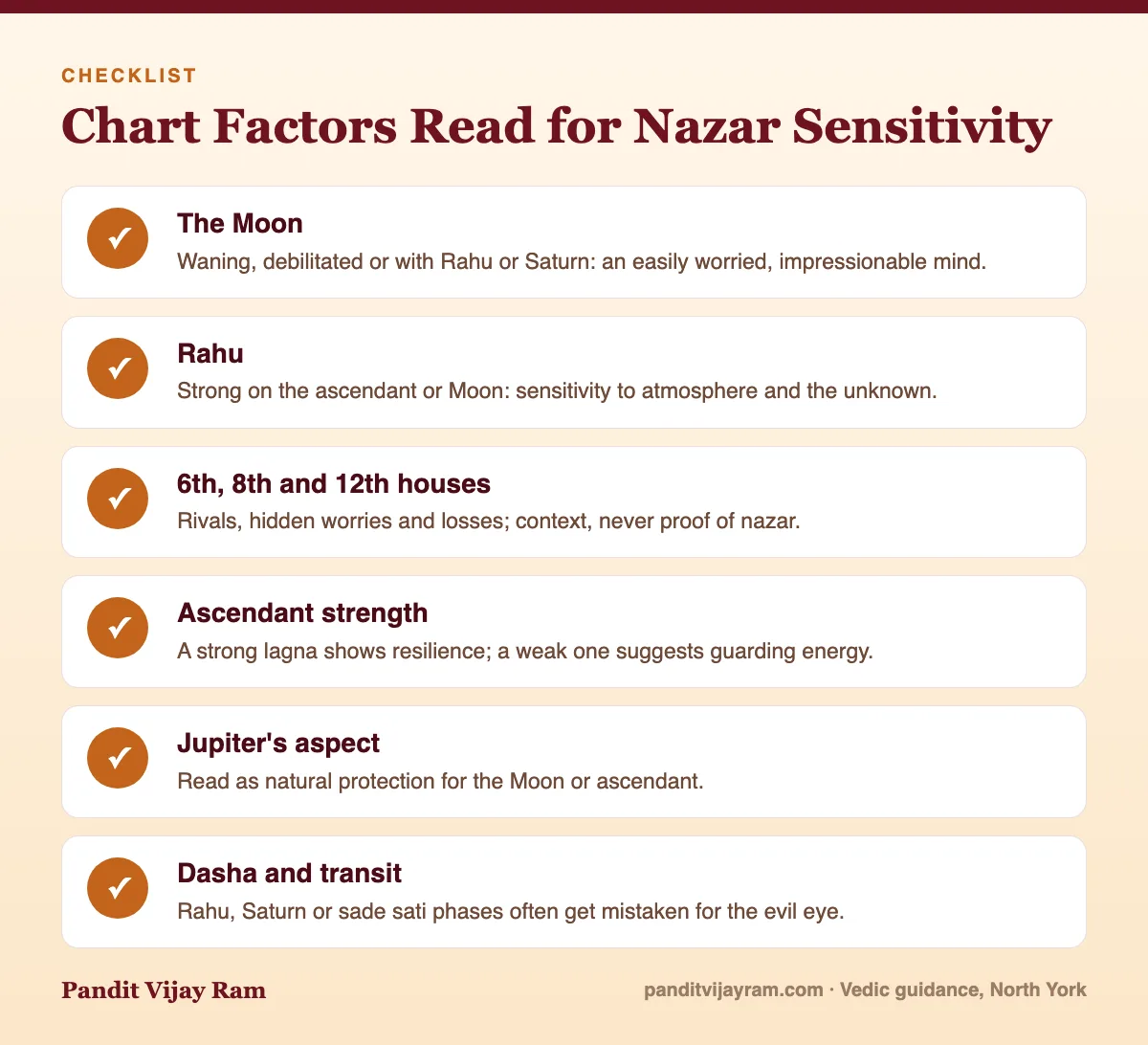
Astrologers most often point to the Moon, which governs the mind and emotional sensitivity, and Rahu, linked to fear, illusion and unseen influences. They also look at the 6th house of enemies and illness, the 8th of hidden and sudden events, the 12th of losses and isolation, and the strength of the ascendant.
Here is a plain guide to what each factor means, and what it does not mean.
- The Moon. A Moon that is waning, debilitated in Scorpio, or closely joined by Rahu, Ketu or Saturn suggests an impressionable, easily worried mind. It does not mean someone has harmed you.
- Rahu. Strong Rahu, especially on the ascendant or with the Moon, is read as heightened sensitivity to atmosphere, fear of the unknown and vivid imagination. It also brings ambition and unconventional success.
- The 6th house. Rivals, competition, disputes and health routines. Planets here can show workplace jealousy, which people later call nazar.
- The 8th house. Secrets, sudden changes, inheritance and research. Afflicted, it can show anxiety about hidden threats.
- The 12th house. Expenses, sleep, retreat and foreign lands. It is often prominent in the charts of newcomers to Canada who feel unsettled.
- The ascendant and its lord. A strong ascendant is traditionally read as resilience. A weak one suggests a person who tires easily and should guard energy.
- Jupiter. Its aspect on the Moon or ascendant is widely read as protective, a natural counterweight.
No single factor proves anything. A chart is read as a whole, and a sensitive placement in one area is usually balanced by strengths elsewhere. Rahu's wider role is explained in Rahu and Ketu afflictions and remedies.
Can a kundli tell if someone has put nazar on you?
No. A birth chart describes your own temperament, strengths and timing. It cannot identify another person's glance, intention or envy. At most, it suggests whether you are more sensitive to surrounding moods, and which periods might feel heavier. Anyone who claims to read a named culprit from your kundli is overstating what astrology does.
This is the honest limit, and it is an important one. Astrology in the Vedic tradition is about your karma as reflected in planetary patterns. It does not show a photograph of who looked at you at a party.
What a careful reading can add:
- Timing. The Moon transiting the 8th sign from your natal Moon, called chandrashtama, lasts a little over two days each month and is traditionally a time to rest and avoid big decisions. Some people notice they feel drained then, and blame nazar.
- Dashas. A Rahu or Saturn period can feel heavier for years, and small troubles during it get read as the evil eye.
- Transits. Sade sati, Saturn's long passage over the natal Moon, brings pressure that is easily confused with outside harm. See sade sati or a curse.
- Temperament. A watery, Moon-heavy chart may simply describe a person who feels everything deeply.
When a chart shows none of these, I say so plainly. Sometimes the most useful thing a reading does is take the dosh label off a person and let them breathe.
How does an astrologer check a chart when you fear the evil eye?
A careful astrologer starts with your life, not your chart: what happened, when, and what ordinary causes have been checked. Then they look at the Moon, ascendant, current dasha and transits, compare them with the timing of the trouble, and only then suggest whether nazar, a planetary phase or ordinary stress fits best.
This is the sequence I follow, and the one I would encourage you to expect from anyone you consult.
- Listen first. When did the trouble begin? Was there a celebration, a new job, a move? Have you seen a doctor about sleep, mood or pain?
- Confirm the birth data. An error of an hour can change the ascendant and every house. If the time is uncertain, I say so and read more cautiously.
- Read the Moon and ascendant. These two show emotional sensitivity and resilience better than any special yoga.
- Check the running dasha. Is the person in a Rahu, Ketu, Saturn or 8th-lord period?
- Check transits. Sade sati, Rahu over the Moon, or Saturn over the ascendant.
- Match timing to events. If the trouble began with a new planetary period, the chart explains it better than nazar does.
- Conclude modestly. Sensitive chart, hard phase, likely nazar after an event, or none of these. Then suggest steps that fit.
A reading done this way is available through the kundli and horoscope service. If what you want is simply to settle a recent nazar, the nazar removal service is the more direct route.
What remedies help a chart that seems sensitive to nazar?
Remedies follow the planet involved. For a sensitive Moon, Monday prayer to Shiva, water offered to the rising sun or moon, and steady sleep help. For Rahu, Durga worship and charity on Saturdays are traditional. A Jupiter mantra strengthens protection. Gemstones need a full chart check, and no remedy should be sold through fear.
Remedies in Jyotish are meant to strengthen what is weak, not to fight an invisible enemy. That framing changes how people practise them.
- For the Moon. Simple Monday worship of Shiva, offering water or milk on a Shivling, wearing white or silver, and keeping a regular sleep schedule. A pearl is sometimes advised, but only after the full chart is checked, as it does not suit everyone.
- For Rahu. Reciting a Durga stotra, lighting a lamp on Saturdays, and charity to people who are struggling. Avoid gemstones for Rahu without careful guidance.
- For Saturn's weight on the Moon. Service, patience, Hanuman worship and help for the elderly or labouring poor.
- For overall resilience. Jupiter mantra on Thursdays, respect for teachers and elders, and learning.
- Alongside all of these. A gentle household nazar utarna after crowded events, if it comforts you.
Be wary of packages labelled nazar dosh nivaran that require large payments, secret rituals, or warnings of disaster if you refuse. That is fear selling, not Jyotish. The wider set of guides on this topic sits in the evil eye and curses hub.
Remedies also never replace medical care. A sensitive Moon can coincide with anxiety or depression, and a doctor should be part of the picture whenever low mood or poor sleep persists.
The bottom line
Nazar dosh in kundli is a modern phrase rather than a classical dosh, and no chart can name a person who has cast the evil eye. What a chart can show is sensitivity through the Moon, Rahu and the 6th, 8th and 12th houses, and the timing of heavier phases. Remedies should strengthen those weak points calmly and never be sold through fear.
Key takeaways
- Classical Jyotish texts do not define a nazar dosh.
- The Moon, Rahu and the 6th, 8th and 12th houses are read for sensitivity, not proof.
- A chart cannot identify who has cast nazar on you.
- Hard dashas and transits are often mistaken for the evil eye.
- Remedies strengthen weak planets; fear-based packages are a warning sign.