
Family Curse vs Pitru Dosh: Telling an Inherited Pattern From an Ancestral Debt

Every family has its stories. Three generations of men who died young. Daughters whose marriages keep breaking. A business that grows, then collapses, in every generation. Sooner or later someone says the family is cursed, and someone else says it is pitru dosh. Clients in North York and Mississauga often ask me to settle the question of family curse vs pitru dosh, usually after hearing both explanations from different relatives. The honest answer is that there are three possibilities, not two, and the third is the most common: patterns passed down through genes, habits and hard history. This article explains each one clearly, shows how they differ in what they look like and how they are confirmed, and gives a simple way to tell them apart. It also shows which remedies suit which cause, so effort is not wasted. In more than forty years of looking at family charts, I have found that naming the right cause lifts a great deal of blame from both the living and the dead.
What is the difference between a family curse and pitru dosh?
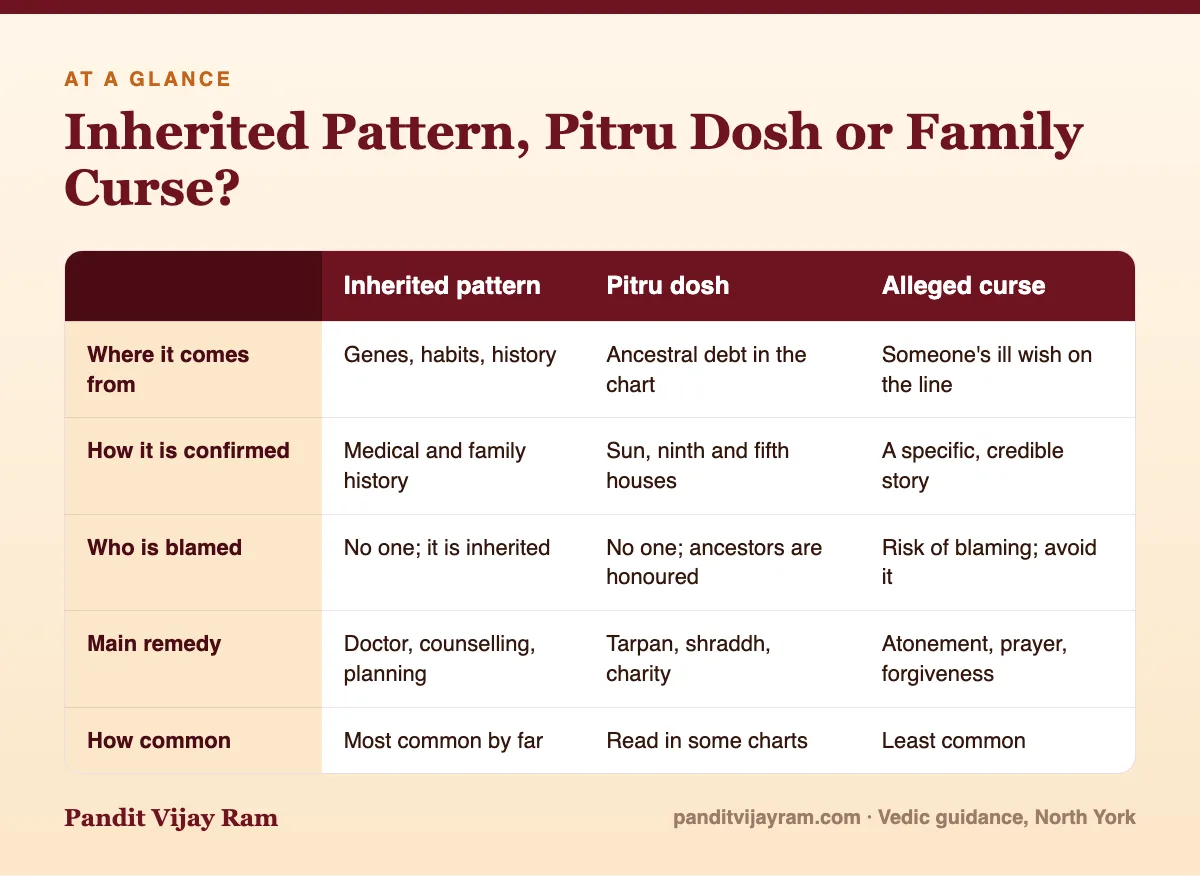
A family curse is believed to come from outside: someone wronged by an ancestor, or angered by the family, wished harm on its descendants. Pitru dosh comes from within: the chart shows unfinished duties or suffering in the ancestral line that the present generation is asked to honour and resolve. One involves an accuser; the other involves remembrance.
The two ideas are often blended, but they rest on very different foundations.
- Khandani shraap, the family curse. Usually carried as a story. An ancestor took land unfairly, broke a promise to a holy person, or mistreated a servant, and words of anger were spoken. The belief is that those words follow the bloodline. The story often has a named source, even if no one can verify it.
- Pitru dosh, the ancestral debt. An astrological reading, not a story. In Vedic thought every person carries pitru rin, a debt to the ancestors, repaid through remembrance, rites and good conduct. When the chart shows strain in the houses and planets linked to ancestors, astrologers call it pitru dosh. Nobody is accused.
That difference changes how families feel. A curse invites fear of an enemy, sometimes long dead. Pitru dosh invites care for one's own forebears. The remedies follow: a curse is approached through protection, atonement and forgiveness, and pitru dosh through tarpan, shraddh and charity in the ancestors' names, which are described fully in clearing pitru dosh with shraddh remedies.
Neither, however, is the first thing to check. That is the ordinary inheritance every family carries.
Which family patterns look like a curse but are not?
Many patterns that feel like curses are inherited in ordinary ways: genetic illnesses such as heart disease, diabetes or depression; money habits learned at the kitchen table; conflict styles copied between generations; addiction; and the lingering effects of war, Partition, migration or poverty. These are real, serious, and usually respond to practical help.
Before reaching for a spiritual explanation, I ask families to look at what they have actually inherited.
- Health. Early heart attacks, diabetes, certain cancers, kidney disease and mood disorders run strongly in families. Men dying young across generations is often cardiovascular. A doctor can arrange screening, and sometimes genetic counselling.
- Habits. Children absorb how parents handle money, anger, alcohol and work. A grandfather who gambled, a father who borrowed, a son in debt: that is a learned pattern before it is anything else.
- Relationships. Marriages that end the same way in each generation often share a style of conflict, silence or control that nobody named.
- History. Families who survived Partition, war, displacement or deep poverty often carry fear, secrecy and hardship forward. Researchers describe this as intergenerational or transgenerational trauma.
- Circumstance. Where a family lives, what work it does and what support it has shape outcomes for decades.
None of this denies faith. It means the most powerful remedy may be a cardiac check-up, a budgeting plan or family counselling. When repeating conflict is the main problem, the family problem guidance service can sit beside those steps. Hurtful words spoken during a family quarrel are a separate matter, explored in a curse from a family argument.
How does pitru dosh show in a kundli?
Astrologers usually look at the Sun, which represents the father and lineage, and the ninth house of ancestors and dharma. An afflicted Sun, especially with Rahu or Saturn, Rahu in the ninth, or a troubled ninth lord are common indicators. The fifth house of children and past merit is also read. Interpretations vary between astrologers.
Commonly cited chart factors include:
- Sun with Rahu or Ketu. Often called a grahan, or eclipse, combination. It is the indicator mentioned most.
- Saturn afflicting the Sun or the ninth house.
- Rahu or Ketu in the ninth house, or an afflicted ninth lord.
- A strained fifth house, read for children, continuity and merit carried from the past.
- Patterns in several family charts. When the same affliction appears across siblings or generations, astrologers give it more weight.
An honest note. Some editions of the Brihat Parashara Hora Shastra include a chapter on curses from past lives, among them a father's curse, read mainly in connection with children through the fifth house and the Sun. The broad, modern use of pitru dosh for almost any family difficulty goes well beyond that. As with other labels, such as the one discussed in nazar dosh in the kundli, ask any astrologer to name the exact placement and explain it.
Also remember that these combinations are common. Many people have the Sun with Rahu and lead settled lives. A factor in the chart describes a theme to attend to, not a sentence. A careful reading through the pitra dosh consultation looks at the whole chart before naming it.
How can you tell a generational curse from pitru dosh?
Look at the evidence each one would leave. An inherited pattern shows up in medical history, money habits and family behaviour. Pitru dosh shows up in the chart and often alongside neglected ancestral rites. An alleged curse rests on a specific story of wrongdoing and ill wish. Check them in that order, ordinary causes first.
This is the order I work through with families. Most questions are answered by step two or three.
- Write the pattern down. Who was affected, at what age, and how? Vague impressions shrink or sharpen once they are on paper.
- Check health history. Ask relatives what illnesses people actually had. Share the list with your family doctor. A medical pattern changes everything about the next step.
- Look at habits and history. Debt, drinking, violence, silence, displacement. Name them honestly and kindly.
- Read the charts. If ancestral indicators appear clearly in several family charts, pitru dosh becomes a reasonable spiritual lens alongside the practical one.
- Ask about rites. Has anyone done shraddh or remembered the ancestors in recent generations, especially after migration? Neglected remembrance is part of the traditional picture of pitru dosh.
- Only then, the story. Is there a specific, credible account of an ancestor wronging someone? If so, atonement and prayer for forgiveness fit. If the story is vague or recent gossip, set it aside.
Be wary of anyone who tells you the family is cursed within minutes, names a relative as the cause, or demands large sums to break it. That is not a reading; it is pressure.
What helps each one, and when should a family get outside help?
Inherited patterns need doctors, counsellors, financial planning and honest family conversation. Pitru dosh is addressed through remembrance: tarpan, shraddh, charity and prayer in the ancestors' names. An alleged curse is approached through atonement, protective prayer and forgiveness, never retaliation. Seek outside help when health, safety, money or mood is affected.
Matching remedy to cause saves families years of frustration.
- For inherited patterns. Screening for heart disease, diabetes and other conditions; counselling for depression, anxiety, addiction or trauma; a credit counsellor or financial planner for repeating debt; family therapy where conflict repeats.
- For pitru dosh. Monthly tarpan on Amavasya, an annual shraddh, food and charity given in the ancestors' names, and simply telling their stories to the children. Remembering them well is itself the remedy.
- For an alleged curse. Prayaschitta, atonement, through charity and service connected to the original wrong, prayer for the forgiveness of the person said to have been hurt, and a steady protective practice. The meaning of a shraap from an elder is explored in shraap, the curse from an elder, and focused help is available through the curse and hex removal service.
Get outside help promptly if anyone in the family is unwell, unsafe, sinking into debt, or struggling with low mood. Your family doctor is the first call for health. For crisis, call or text 9-8-8 any time. If family members are being accused or threatened over a curse story, step back from the accusation and protect the people involved.
Many of these themes are gathered in the evil eye and curses hub.
The bottom line
The question of family curse vs pitru dosh has a third answer that comes first: ordinary patterns of health, habit and history passed between generations. Pitru dosh is a chart-based call to remember and honour the ancestors, while an alleged curse rests on a story of wrongdoing and is met with atonement rather than fear. Naming the right cause lets a family choose the remedy that actually helps.
Key takeaways
- Most repeating family troubles are inherited through genes, habits and hardship.
- Pitru dosh is an astrological reading of ancestral debt, not an accusation.
- A family curse rests on a story of wrongdoing and calls for atonement.
- Check health history and habits before reading the chart or the story.
- Anyone naming a curse within minutes and demanding large sums is a red flag.