
Chakra Clearing vs Aura Clearing: Which One Do You Need?
People often arrive asking for one thing when they mean the other. They have read about blocked chakras online, or a friend mentioned a heavy aura, and now they want to know which session to book. The question of chakra clearing vs aura clearing deserves a straight answer rather than a sales pitch. Families from North York, Markham and across the GTA ask me this every month, and the honest reply usually starts with a few questions about sleep, stress and daily routine. This guide explains what each practice means in its source traditions, how the methods differ, and a simple way to decide which fits your situation. You will also learn where modern wellness language has stretched the old ideas, and what neither practice can do. In more than forty years of Vedic practice, I have found that most people feel lighter after the gentler outer work, and only some need the slower inner discipline. Neither replaces a doctor, a counsellor or a good night's sleep, and I will say so plainly throughout.
What is the difference between chakras and the aura?
Chakras are described as wheels of subtle energy along the central channel of the body, from the base of the spine to the crown. The aura is a looser modern word for the field said to surround a person. Chakras are inner centres; the aura is the outer envelope that collects everyday residue.
The word chakra means wheel in Sanskrit. In tantric and yogic texts, chakras sit along the sushumna nadi, the central channel, and each is linked to a seed sound, an element and a quality of awareness. The common seven-centre list, from muladhara at the base to sahasrara at the crown, became popular in the West through translations and later adaptations. Older sources actually vary in how many centres they name.
The aura has a different history. Vedic writing speaks of tejas (radiance) and ojas (vital strength), and of the koshas, five sheaths from the physical body to the bliss sheath. The idea of a coloured field you can see or photograph is largely a modern, Theosophy-influenced idea. I use the word because clients use it, but I translate it back into older terms.
A practical way to hold the two:
- Aura – the outer layer that picks up the mood of crowds, arguments, hospitals and long commutes.
- Chakras – inner patterns of attention, breath and emotion that change slowly with practice.
If you want the broader vocabulary of blocks, prana and nadis, our guide to what blocked energy means in Vedic terms goes deeper. The wider family of methods sits on the cleansing and protection hub.
How is aura clearing done in the Vedic tradition?
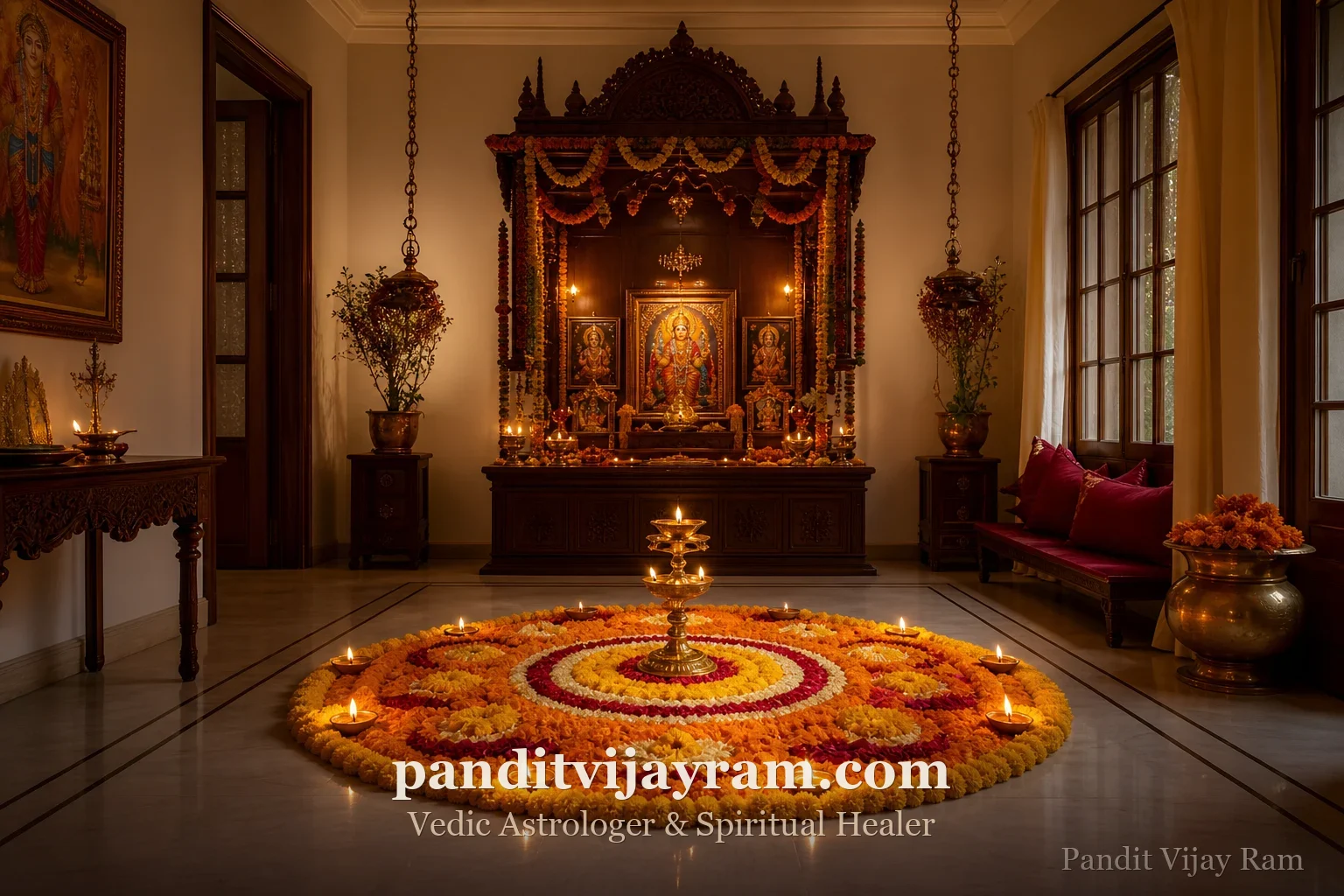
Vedic-style aura clearing uses outer, sensory methods: a ghee lamp, camphor aarti, smoke from guggul or loban, a sprinkle of Ganga jal, and steady mantra. The person sits still while the practitioner works around them. It is short, gentle and repeatable, and it asks little of the person receiving it.
In practice, outer clearing borrows from the daily puja. I light a ghee diya, offer camphor in a clockwise circle around the person, and wave dhoop smoke from head to feet. A few drops of Ganga jal are sprinkled with a mango or tulsi leaf. Throughout, a protective mantra is chanted, often the Gayatri or the Mahamrityunjaya.
Some households use a pinch of rock salt circled around the head and then dissolved in running water, a custom close to nazar removal. Others prefer a bath with neem leaves. The common thread is that the person stays passive while the method works on the surface layer.
Things that make outer clearing a good first step:
- It takes ten to twenty minutes and needs no training on your part.
- It suits children, elders and people who are unwell and cannot sit in long meditation.
- It is easy to repeat at home once you have seen it done.
There are limits. If the heaviness returns every evening, the cause may be your workplace, a strained relationship or poor sleep rather than anything subtle. The aura cleansing service page explains how I assess this before doing any ritual. For smoke and flame safety indoors, read the separate guide to using camphor safely at home.
How do you clear your chakras through yogic practice?
Chakra work in the yogic tradition is something you do, not something done to you. It combines pranayama, seed-syllable chanting, steady posture and focused attention on one centre at a time. Results come slowly over weeks of daily practice, and a teacher's guidance matters more than any single session.
Each centre has a bija or seed syllable. The commonly taught set is LAM for the base, VAM for the sacral, RAM for the navel, YAM for the heart, HAM for the throat, and OM for the brow. A beginner chants each one softly while resting attention at that point, moving upward.
Breath work comes first. Nadi shodhana, alternate-nostril breathing, is the usual starting place because it is calm and simple. Stronger methods, such as kapalbhati or long breath retention, should only be learned in person. They are not suitable for anyone pregnant, with high blood pressure, heart conditions or a history of panic.
A simple daily pattern many teachers recommend:
- Sit upright on a folded blanket for a few minutes of quiet.
- Do five to ten rounds of alternate-nostril breathing.
- Chant the seed syllables from base to brow, three times each.
- Rest in silence and notice, without judging, where attention drifts.
Be wary of anyone who claims to open your kundalini in one sitting. Classical texts treat that awakening as the fruit of years of discipline, and rushed methods can leave people anxious and unsettled. Our page on pranayama for energetic cleansing covers breath practice in more detail.
Should I get chakra clearing or aura clearing?
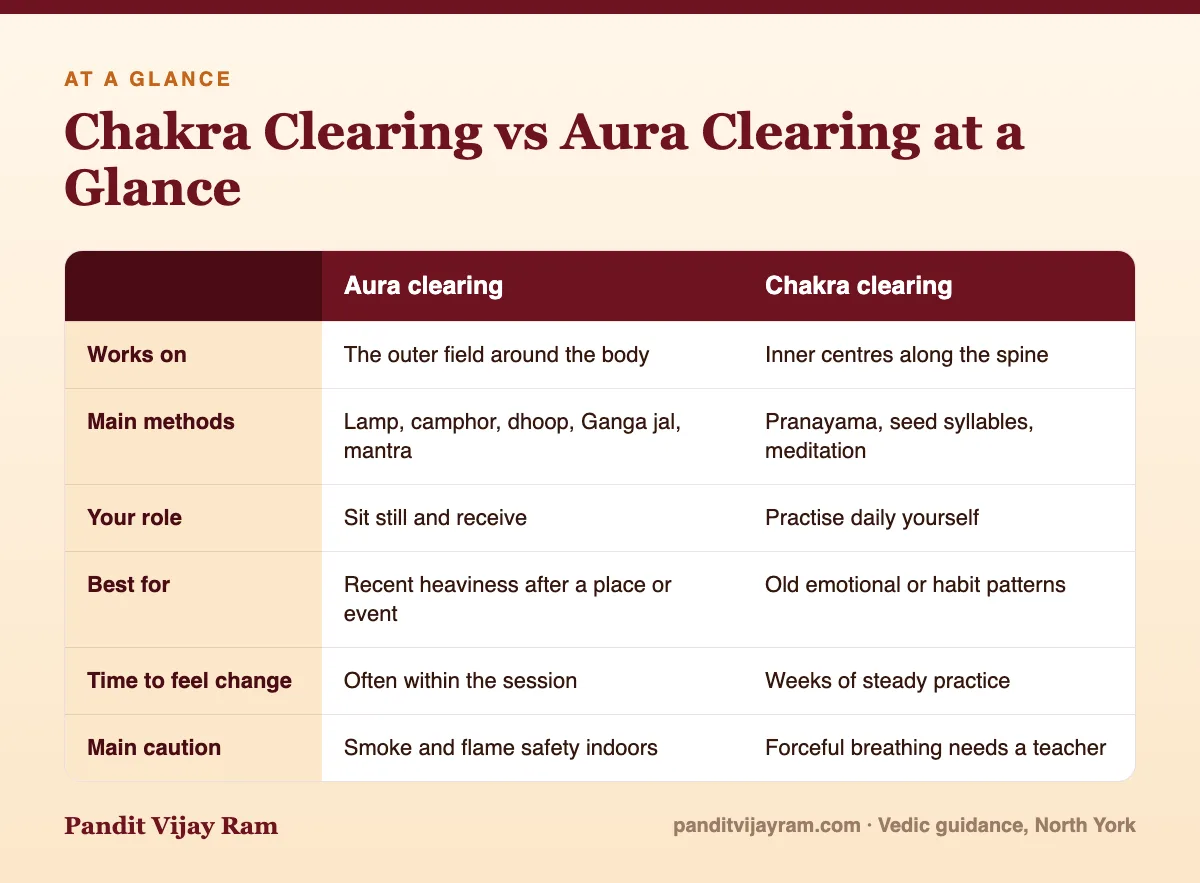
Choose aura clearing when the heaviness is recent, linked to a place or event, and you want quick relief. Choose chakra work when the pattern is old, emotional or tied to habits, and you are willing to practise daily. Many people start with outer clearing and add inner practice later.
Here is the decision rule I use in consultations. Answer each question honestly.
- Did the feeling start after a specific event? A crowded wedding, a hospital visit, a bitter argument or a move. If yes, start with aura clearing.
- Has the same emotional pattern repeated for years? The same fear before every exam, the same anger in every relationship. If yes, inner chakra practice and possibly counselling suit you better.
- Can you give fifteen minutes a day? If not, chakra work will not take root. Outer clearing is more realistic for now.
- Is there a physical symptom? Chest pain, dizziness, lasting fatigue or low mood. See your family doctor before either.
- Is the whole household affected? Then the issue may be the home, and a space cleansing makes more sense than personal work.
Many readers find a mixed plan works: one outer clearing to settle things, then a short daily breath and mantra practice. If you are unsure whether you need cleansing or a deeper clearing at all, the comparison of energy clearing and energy cleansing may help. You can also try the self-check questions on our spiritual energy tools page.
Is chakra healing backed by science?
No. There is no scientific evidence that chakras or auras exist as physical structures, and devices that claim to photograph or measure them are not reliable. Breath practice and meditation do have studied effects on stress and calm. Treat chakra and aura work as faith and contemplative practice, not medicine.
I would rather you hear this from me than discover it later. Chakras are described in religious and meditative texts as subtle, not anatomical. No dissection or scan has found them, and they are not meant to be found that way. The same is true of the aura. So-called aura photography records heat, moisture and camera settings, not the state of your soul.
That does not make the practices empty. Slow breathing, chanting and sitting still have measurable effects on heart rate and stress for many people. Ritual also gives shape to intention, and many families find that a lamp and a prayer help them feel steady.
Where people get hurt is when the language is stretched too far. Watch for these warning signs:
- Claims that clearing a chakra will fix a thyroid, a heart or fertility on its own.
- Pressure to buy crystals, sprays or repeat sessions to keep a centre open.
- Diagnosis of a blocked chakra over a short phone call, followed by a large ritual quote.
- Advice to stop prescribed medicine.
If low mood, panic or exhaustion has lasted more than a couple of weeks, see your family doctor. In a crisis, call or text 9-8-8. Spiritual work can sit alongside proper care, never in place of it. Our health and wellbeing guidance explains how I keep that line clear.
The bottom line
Chakra clearing vs aura clearing comes down to inner discipline against outer relief. Aura work is quick, gentle and suits recent heaviness tied to a place or event, while chakra practice is slow, daily and suits long-standing patterns. Neither is proven by science, and both should sit beside medical and emotional care rather than replace it. Start simple, notice what changes, and add depth only when you are ready.
Key takeaways
- Chakras are inner centres; the aura is the outer field that gathers daily residue.
- Aura clearing is done to you with lamp, smoke, water and mantra.
- Chakra work is done by you through breath, seed syllables and attention.
- Recent, event-linked heaviness usually needs the outer work first.
- Physical or lasting emotional symptoms need a family doctor before any ritual.