
How to Remove Negative Energy From Your Car
A car is more than transport for many families. It carries children to school, parents to the temple and you through a Highway 401 rush hour every day. So when a vehicle feels wrong, people notice. Perhaps a used car came with a strange smell and a run of small breakdowns, or a new one has had two near misses in its first month. Questions about negative energy from your car come to me regularly from families in North York, Vaughan and Mississauga, and I always begin with the mechanic before the mantra. This article explains the traditional vahan puja for new vehicles, how to cleanse a second-hand car, which nazar customs are safe in a moving vehicle, and the safety limits that matter far more than any ritual. In forty years of blessing homes, shops and vehicles, I have learned that the best car blessing is one performed by a calm, rested driver in a car that has passed its safety inspection. Prayer then adds steadiness, not a licence to take risks.
Can a car really carry negative energy?
Tradition treats a vehicle like any space people spend time in: it can hold the mood of past owners, accidents and arguments. Practically, a car that feels wrong often has a real cause such as an exhaust leak, hidden damp, a worn part or a tired driver. Check those first, then bless the car.
In Hindu custom, a new vehicle is welcomed almost like a family member. It receives a tilak, a garland and a prayer before its first proper drive. Sikh families may do an ardas, Muslim families recite a dua for travel, and Christian families sometimes ask a priest to bless the car. All of these share the idea that travel carries risk and that the vehicle deserves protection.
When people describe a car with "bad energy", I listen for practical clues first:
- Headaches, drowsiness or nausea while driving. This can signal exhaust fumes entering the cabin. Carbon monoxide is colourless and odourless. Stop driving the car and have the exhaust and heater checked.
- A musty or sour smell. Water leaks under carpets and clogged cabin filters breed mould.
- Repeated small breakdowns. A used car with a poor service history will keep failing until the root fault is fixed.
- Near misses. Fatigue, phone use and unfamiliar controls cause more of these than anything unseen.
Once the car is mechanically sound and the driving habits are honest, a blessing has room to do its proper work: settling the mind of the people who use it. For homes with the same unsettled feeling, start with the guide to cleansing negative energy from your home.
How is vahan puja done for a new car?
Vahan puja is the Hindu blessing for a new vehicle. Ganesha is invoked first, the car is washed, a swastika or Om is drawn on the bonnet in kumkum, a kalava is tied to the mirror, a coconut is broken, and four lemons are placed under the tyres to be driven over before the first journey.
Many families book the puja on an auspicious day from the panchang, often a Thursday, a festival such as Dussehra or Akshaya Tritiya, or a date chosen by their pandit. Here is the usual order:
- Wash the car and park it facing east or north if the driveway allows.
- Ganesha prayer with Om Gan Ganapataye Namah, as he removes obstacles at the start of any undertaking.
- Mark the bonnet with a small swastika or Om using kumkum or sindoor mixed with a little water. Some families also mark the steering wheel.
- Offer flowers and a garland of marigolds across the front grille.
- Tie a kalava around the rear-view mirror stem, short enough not to swing.
- Break a coconut in front of the car and share the pieces as prasad.
- Place four lemons under the four tyres and drive slowly forward over them, a custom said to absorb nazar.
- Aarti outside the car, with the lamp held by the driver and then extinguished before anyone gets in.
If a dealership lot or condo garage makes this difficult, a shorter version in a temple parking area works well. Many GTA mandirs host vehicle blessings on festival days. The Ganesha puja service page explains how a priest can perform it at your home.
How do you cleanse a used car before driving it?
Treat a used car in two passes. First the practical pass: safety inspection, history report, full interior clean, new cabin filter and removal of anything the previous owner left. Then the spiritual pass: Ganga jal or salt water wiped on the seats and floor, a Ganesha or Hanuman prayer, and a kalava on the mirror.
Second-hand cars are where most "negative energy" questions come from. People worry about past accidents, a previous owner's illness or simply a stranger's leftover mood. I suggest this practical sequence:
- Get the paperwork. In Ontario, a used vehicle information package and a safety standards certificate are part of most private sales. A vehicle history report shows past collisions.
- Remove leftovers. Old air fresheners, coins, religious items from another faith, receipts and floor mats. Return religious items respectfully to a place of worship rather than binning them.
- Deep clean. Vacuum, shampoo the seats, and replace the cabin air filter. Smells that linger after this usually point to a leak.
- Wipe with salt water or Ganga jal. A cloth dampened with a little rock salt in water, wiped over the dashboard, seats and floor, is a common household cleansing. Avoid salt on electronics and leather; plain water with a few drops of Ganga jal is gentler.
- Bless the car. Recite the Hanuman Chalisa or Ganesha mantra beside it, tie a fresh kalava, and keep the first drive short and to a temple if possible.
If the car was involved in a serious accident and that knowledge troubles you, it is reasonable to ask for a fuller cleansing. The negative energy removal service describes how I assess such cases, and a vastu consultation can look at where the car is parked at home.
What car nazar remedies are safe while driving?
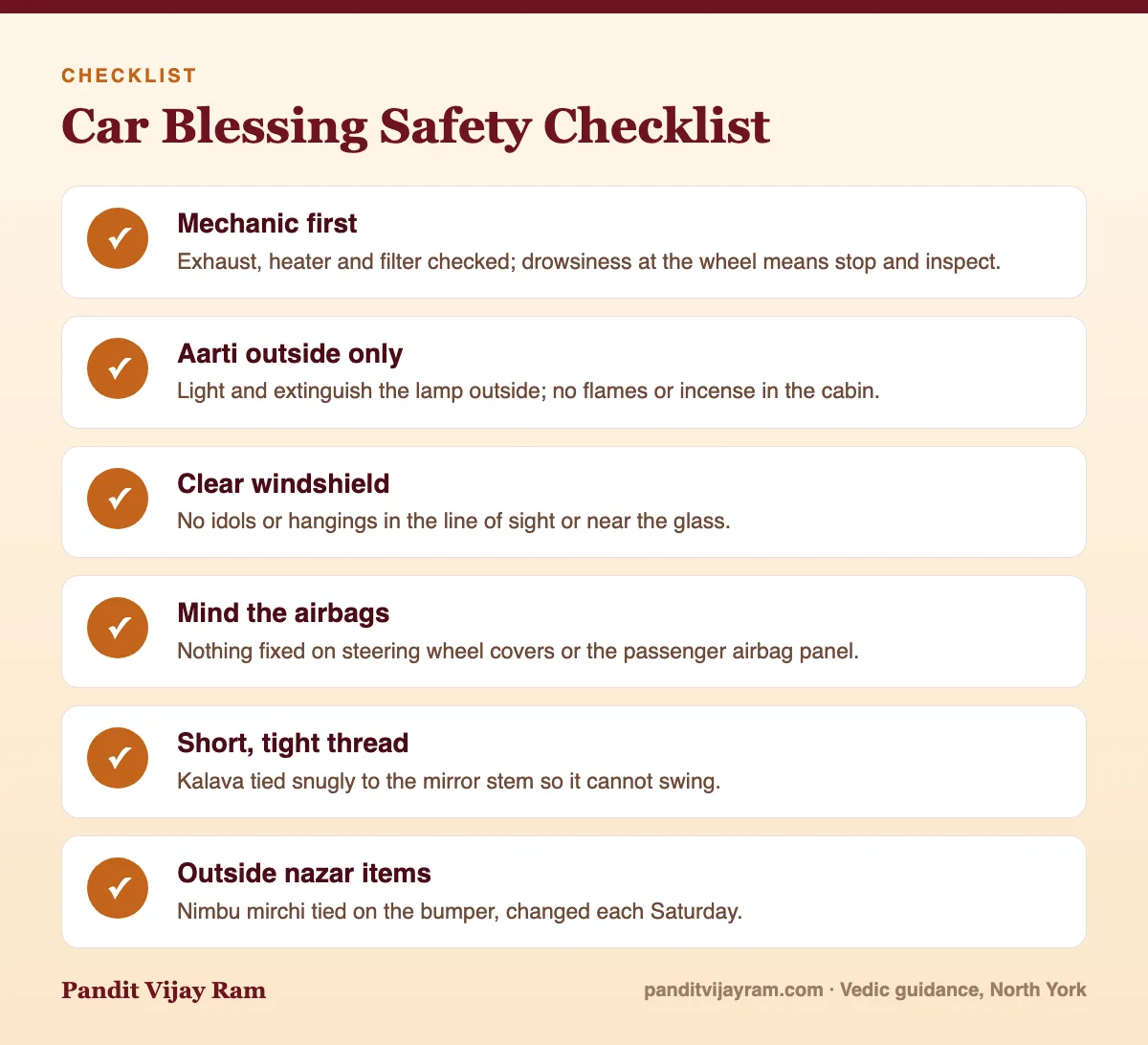
Safe car nazar customs are small and fixed: a kalava on the mirror stem, a nimbu mirchi or black thread on the front bumper outside, and a flat deity sticker low on the dashboard. Avoid anything that swings, blocks the windshield, distracts the driver or could become a projectile in a crash.
I have seen dashboards with three idols, a hanging rudraksha, a swinging Om pendant and a jar of incense. Each item was placed with love, and together they made the car less safe. Ontario's distracted-driving rules and simple physics both apply here. A loose metal idol can strike someone in a sudden stop.
Use this decision rule:
- Allowed: a short kalava or black thread tied tight around the mirror stem; a nimbu mirchi string or small black pot tied outside on the bumper or under the grille; a flat sticker or a small idol fixed with adhesive low on the dashboard, below the line of sight.
- Avoid: anything hanging that sways into view, idols on top of the dashboard near the glass, items near airbag covers on the steering wheel or passenger dash, and loose stones or malas on the console.
- Never: lit incense, camphor, candles or diyas inside a vehicle, parked or moving. Upholstery catches fire easily and the fumes are harmful in a closed space.
Replace the nimbu mirchi on Saturdays, as families traditionally do, and dispose of the old one outside the home. The meaning behind that custom is explained in our post on nimbu mirchi at the door, and protective threads are covered in the kalava guide.
When should you stop worrying about the car and look elsewhere?
If the car has been inspected, blessed and driven calmly yet you still feel dread every time you get in, look at the driver rather than the vehicle. Anxiety after an accident, poor sleep or pressure at work often show up behind the wheel. A doctor, a driving refresher or counselling may help more than another ritual.
Driving anxiety is common, especially after a collision or for newcomers learning winter roads. People sometimes interpret their own fear as something attached to the car. The pattern is usually telling: the fear appears in any vehicle, not just this one, and gets worse on highways or in snow.
Honest steps that help:
- Talk to your family doctor if you have flashbacks, panic or avoidance after an accident. These are treatable.
- Book a refresher lesson with a licensed driving instructor, particularly for winter driving.
- Keep a regular service schedule, so mechanical doubt does not feed the worry.
- Recite a short travel prayer before starting. The Hanuman Chalisa or the Gayatri Mantra once is enough.
If the car is a source of conflict in the family, such as arguments about who drives or money spent on it, that is a household issue. Our guide to constant fights at home may be more relevant than any vehicle remedy. Further protective guides sit on the cleansing and protection hub.
The bottom line
To remove negative energy from your car, fix the mechanical and driver-side causes first, then bless the vehicle with a simple vahan puja or a Ganga jal wipe and prayer. Keep nazar items small, fixed and out of the line of sight. Never burn anything inside a vehicle, and treat lasting fear behind the wheel as something a doctor or instructor can help with.
Key takeaways
- Headaches or drowsiness in a car need an exhaust check first.
- Vahan puja uses a coconut, kumkum swastika, kalava and four lemons.
- Cleanse a used car practically, then bless it.
- No flames, incense or camphor inside any vehicle.
- Dashboard idols must sit low and be fixed in place.