
Lemon Cleansing Ritual: Passing a Lemon Over the Body Explained

The lemon cleansing ritual is one of the first things many families try when a child is unsettled, a business slows down or a newly married couple seems to attract too much attention. A grandmother takes a lemon, circles it around the person, mutters a prayer and quietly takes it outside. In North York and across the GTA, people ask me about it for two reasons: some want to do it properly at home, and others have been told by someone that their lemon turned black and they now owe a large fee for removal. Both deserve a clear answer. Over forty years of Vedic practice, I have seen this small custom bring real comfort, and I have also seen it twisted into fear. This guide explains what nimbu utarna is, exactly how it is done and what is said, why the lemon is cut, how to dispose of it under Canadian conditions, where it slips into fear-selling, and the skin safety point most people never hear.
What is the lemon cleansing ritual and what is it for?
Nimbu utarna is a household folk ritual against nazar. A whole lemon, valued for its sourness and sharpness, is circled around the head and body to absorb envious or heavy attention. It is usually done for babies, brides and grooms, students before exams, people after travel, and family members who seem suddenly drained.
The lemon holds a special place in South-Asian protective customs. It hangs at doors as nimbu mirchi, it is placed under the wheels of a new car before its first drive, and it is circled around people. The idea is consistent: sourness and sharpness attract and hold harmful attention before it settles on what is admired.
People most often ask for the ritual in these situations:
- A baby cries for hours after a family event.
- A bride or groom has been the centre of attention for days.
- A student has done well and been praised widely.
- Someone returns from a long trip feeling flat and out of sorts.
- A family member seems tired and irritable after a stressful stretch.
Notice that each of these has an ordinary explanation too: overstimulation, exhaustion, jet lag, stress. The ritual does not replace rest, food, water or a doctor's visit. It is a way of closing a heavy moment with care.
Nimbu utarna is a folk practice, part of lok parampara, rather than a ritual laid down in the Vedas. Families vary in the number of circles, the prayer and the day. There is no single correct version, and no need for a specialist to perform it.

How do you pass a lemon over the body for nazar?
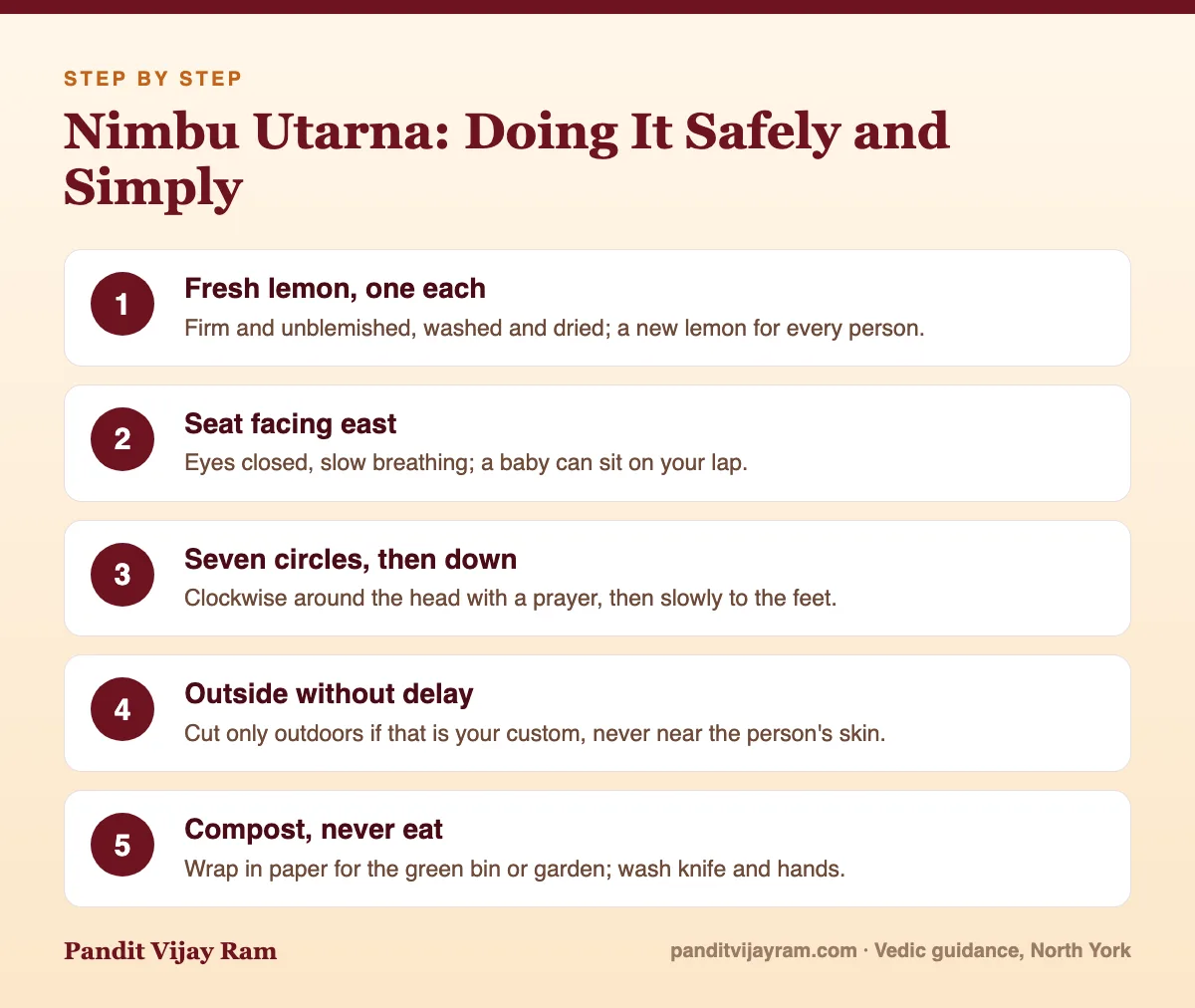
Seat the person facing east, take a fresh whole lemon in your right hand and circle it clockwise around their head seven times, then move it slowly down the body to the feet. Recite a short prayer throughout. Then take the lemon outdoors without delay, cut it if that is your custom, and discard it.
This is the method most North Indian and Gujarati families follow. Adjust it to your own household's custom.
- Choose the lemon. One firm, fresh, unblemished lemon. Wash and dry it.
- Seat the person. Have them sit comfortably facing east, or hold a baby on your lap. Ask them to close their eyes and breathe slowly.
- Circle the head. Hold the lemon in your right hand and circle it clockwise around the head seven times. Some families use twenty-one circles on a Saturday.
- Move down the body. Pass the lemon slowly over the shoulders, arms, chest, back and legs to the feet, without pressing.
- Pray throughout. Common choices are Om Hanumate Namah, the first lines of the Hanuman Chalisa, or simply: whatever nazar has touched this child, let it leave with this lemon.
- Go straight outside. Carry the lemon out without setting it down inside the home.
Tradition favours Saturday, Tuesday or Amavasya evenings, but if a child is distressed, any time is acceptable. Tradition says the person performing the ritual should not look back at the lemon after discarding it, a small act of letting go.
The older guide on removing nazar at home covers salt and chilli versions of the same motion.
Why is the lemon cut after the ritual, and what does a dark lemon mean?
Cutting the lemon, usually into four pieces with a clean knife outdoors, is said to break the nazar it absorbed. Some families add kumkum to the cut halves. A lemon that looks dry, dark or bruised inside usually reflects age, storage, cold or handling, not the strength of a curse.
The cutting step varies widely. Some families never cut the lemon. Others cut it into two or four pieces and throw them in different directions, or place a dot of kumkum or sindoor on each cut face. All of these are customs, not requirements.
Where people get frightened is the inside of the lemon. It is worth knowing what physically changes a lemon:
- Age. Older lemons dry out and the pulp shrinks and darkens.
- Cold injury. Lemons stored too long in a cold fridge can brown internally.
- Bruising. A lemon dropped or squeezed in a grocery bag browns where it was hit.
- Oxidation. Cut surfaces darken within minutes in open air.
Within faith, a family may still read a shrivelled lemon as having taken in heavy nazar. That reading can be held gently, as a reason to repeat the ritual or say an extra prayer. It is not evidence that someone has cursed you, and it is never a reason to pay a stranger. The comparison of egg cleansing and Vedic nazar rituals discusses reading signs in more depth.
How do you dispose of a lemon after nazar utarna in Canada?
Traditionally the lemon goes to a crossroads, flowing water or a spot away from the home. In Canadian cities, wrap the lemon or its pieces in paper and put them in the green bin, or bury them in a garden away from the doorway. Wash the knife and your hands, and never eat the lemon.
In India, a chauraha, a crossroads, is the classic place to leave a used lemon, on the idea that the nazar disperses in four directions. In Toronto, Brampton or Markham, a lemon on a street corner is litter, a hazard for cyclists and food for raccoons, and people who share the belief worry about stepping on it.
A respectful local version:
- Wrap it. Place the lemon, or its cut pieces, in newspaper or a paper bag.
- Compost it. Put it in the green bin, or bury it at the far edge of a garden, not beside the front door.
- Avoid shared spaces. Do not leave it in condo corridors, elevators or building garbage rooms unwrapped.
- No waterways. Avoid ravines, creeks and Lake Ontario.
- Clean up. Wash the knife in hot soapy water, and wash your hands and the person's face if juice touched them.
If wasting food troubles you, remember that composting returns the lemon to the soil, which suits the spirit of the ritual.
When does a lemon ritual turn into fear-selling?
Warning signs include a practitioner who cuts a lemon and claims to find blood, black liquid or a hidden object, who says only their lemons work, who prescribes a lemon every day for months at rising cost, or who says a death in the family will follow unless you pay. Genuine practice never needs fear.
The lemon ritual is cheap and simple, which is exactly why it is exploited. A few patterns appear again and again:
- The bleeding lemon. A knife coated with a chemical, or a pre-treated lemon, can make the juice turn red when cut. This is a known stage trick, not a sign of black magic.
- The hidden object. A lemon is swapped for one with a pin, hair or paper inside.
- The subscription. You are told to buy energised lemons daily for forty or ninety days at a fixed price that keeps rising.
- The threat. Your spouse or child is said to be in danger unless you act tonight.
- The secret. You are told not to tell your family.
An honest practitioner explains the custom, lets you do it yourself, asks about ordinary causes first, and never sets deadlines tied to fear. If you have paid someone under pressure, the Canadian Anti-Fraud Centre accepts reports, and the guide to negative energy removal scams explains other tactics.
If a heavy pattern persists after practical checks, a consultation through the negative energy removal service begins with conversation, not a lemon.
Is lemon juice on the skin safe during a cleansing ritual?
Passing a whole lemon over clothing or skin is harmless. Cut lemon juice left on skin can react with sunlight and cause phytophotodermatitis, a burn-like rash that may blister and leave dark marks. Keep cut lemons away from the person, wash off any juice, and keep the knife away from children.
Few people expect a lemon to hurt anyone, but citrus juice contains compounds that make skin sensitive to ultraviolet light. If juice drips onto a child's arm and they go outside on a sunny day, a red, blistering patch can appear a day or two later. It often looks like a burn or a rash and can leave brown marks for weeks.
Simple precautions:
- Keep the lemon whole while it is near the person. Cut it only outdoors, after the circling is finished.
- Wash any juice off with soap and water before going into the sun.
- Protect the eyes. Citrus juice stings badly. Ask the person to keep their eyes closed during the ritual.
- Mind the knife. Cut on a stable surface, away from children and pets.
- Check medical needs first. If a baby has a fever, is vomiting, or will not feed, see a doctor before any ritual.
If a rash appears, cool it with water and see a pharmacist or doctor. For a wider look at safe body practices, read the overview of spiritual body cleansing or browse the cleansing and protection hub.
The bottom line
The lemon cleansing ritual is a simple household way of drawing off nazar: circle a fresh lemon around the person seven times with a prayer, take it outside, and dispose of it respectfully. In Canada, compost or bury it rather than leaving it at a crossroads. A dark lemon reflects age or storage, not a curse. Watch for tricks and fees built on fear, and keep cut lemon juice off skin that will see the sun.
Key takeaways
- Nimbu utarna circles a whole lemon around a person seven times with a prayer.
- It is a folk custom families can do themselves without a specialist.
- Compost or bury the used lemon instead of leaving it on a street corner.
- Red juice, hidden objects and daily paid lemons are signs of fraud.
- Cut lemon juice on sunlit skin can cause a burn-like rash.