
How Long Does Negative Energy Removal Take? Realistic Timelines

Once people decide to seek help, the next question is almost always about time. How many sessions? Will I feel different next week? Why did someone tell me forty days? Understanding how long negative energy removal takes helps you plan, keeps expectations honest, and protects you from people who promise overnight change. Families in North York ask me this at nearly every first meeting, and the true answer depends on what the assessment found. This article sets out realistic ranges for the most common types of case, explains where the 21-day and 40-day cycles come from, and lists the factors that make a case shorter or longer. It also explains how to track progress sensibly and when to stop and reassess rather than simply adding more rituals. In more than forty years of practice, I have learned that a clear timeline with a review point is kinder than an open-ended promise. People cope far better when they know what the next few weeks will look like and what happens if things do not shift as hoped.
How long does negative energy removal usually take?
There is no single answer, because the cause varies. Simple cases often settle within a week of one cleansing plus home practice. Moderate cases take a few weeks of routine. Deeper or mixed cases usually follow a 21 or 40-day cycle, then a review. Ordinary causes take as long as fixing them takes.
Think of the timeline in three layers rather than one number.
- The ritual itself. A home cleansing may take an hour or two. A havan or puja takes a morning. A full anushthan runs over a set number of days.
- The settling period. After the main work, most people need a week or more of simple daily practice for things to feel steady.
- The review. At the end of the planned cycle, the practitioner and client look at what changed and decide whether anything more is needed.
That structure is why responsible practitioners talk in ranges and review points rather than promises. They also say clearly at the start what you will do yourself, because the daily lamp, mantra and home routine are part of the timeline, not an optional extra.
The timeline depends heavily on the assessment. If you have not yet had one, our article on how a practitioner assesses your case explains that first step. Without it, any estimate is guesswork.
Cases involving suspected black magic follow a somewhat different pattern, with more structured protection afterwards. Those are covered in our separate guide to how long black magic removal takes, so this article focuses on general negative energy.

What is a realistic timeline for each type of case?
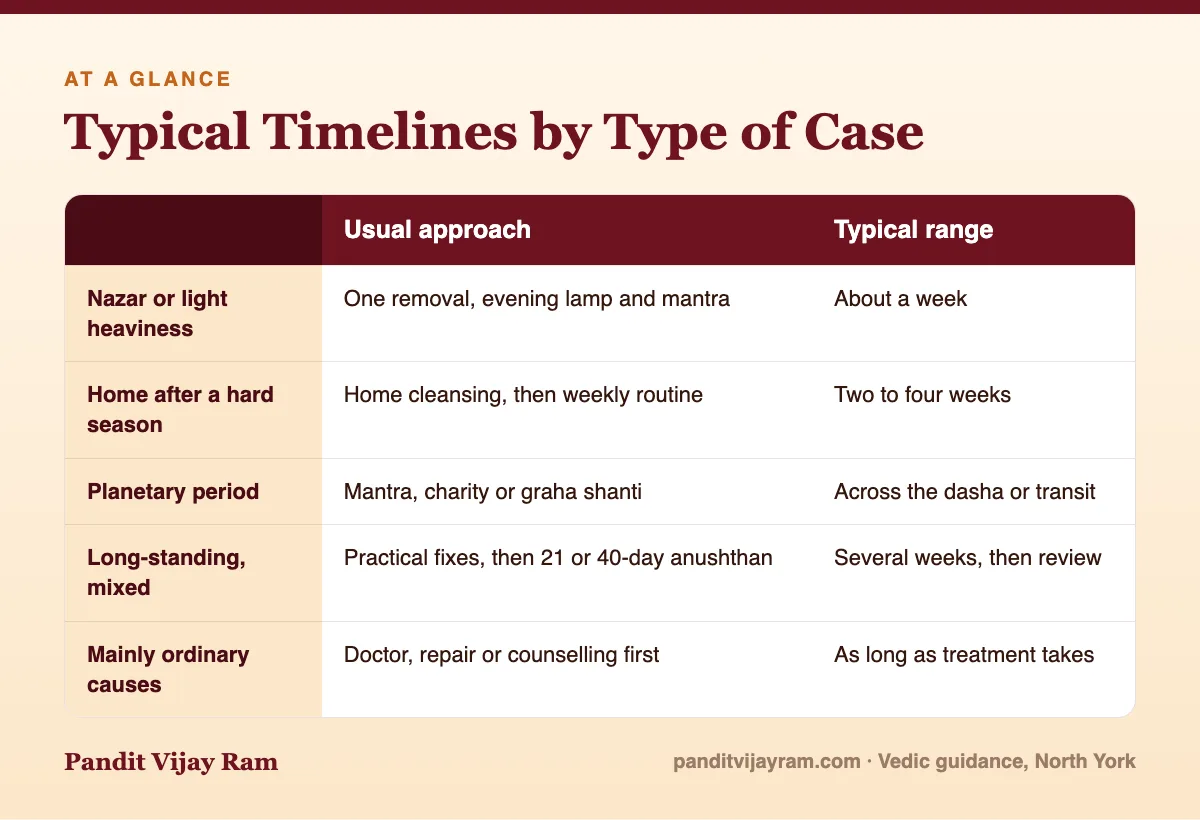
Nazar and light heaviness: one cleansing and about a week of practice. Home heaviness after a move or hard season: two to four weeks of routine. Planetary pressure: remedies across the length of the dasha or transit. Long-standing mixed cases: a 21 or 40-day anushthan, then review. These are typical ranges, never promises.
The ranges below reflect common patterns, not commitments. Every case is different.
- Nazar, the evil eye, or a heavy day after a crowd. One simple removal, such as salt or chilli rotation, plus a week of evening lamp and mantra. Many people feel lighter within a few days.
- A home that feels heavy after a move, an illness or a loss. One thorough home cleansing, followed by two to four weeks of a weekly routine such as salt water mopping and a Saturday or Tuesday lamp.
- A difficult planetary period. Remedies such as charity, mantra or graha shanti continue for much of the period itself, which can be months or longer. The aim is to support you through it, not to cancel it.
- Long-standing heaviness with several causes. Practical fixes first, then a 21 or 40-day anushthan with daily mantra, followed by a review.
- Mostly ordinary causes. As long as treatment or repair takes. Mould remediation, a furnace repair, or treatment for depression each have their own timeline, and spiritual practice runs alongside.
A negative energy removal consultation places your situation in one of these groups, or explains why it falls between them.
Be wary if anyone gives you a firm end date at the first meeting before hearing your story, or keeps extending the plan without explaining why. Both suggest the timeline is being set by something other than your needs.
Why do spiritual remedies run for 21 or 40 days?
The 21-day and 40-day cycles come from anushthan practice, where a fixed number of mantra repetitions is spread across a set period. Twenty-one, three times seven, stands for completion. Forty days, close to the South Indian mandala of forty-one days, gives time for a discipline to settle into daily life.
An anushthan is a vowed practice with a defined count, a defined period and defined rules. For example, a mantra may traditionally call for a total of one hundred and twenty-five thousand repetitions, known as sava lakh jaap. Spreading that across twenty-one or forty days gives a daily target that a priest or a family can keep. The period is a container for the count, not a magic number.
Each length has its own meaning:
- Seven or eleven days. Short vows, common for simple protection or a specific worry.
- Twenty-one days. Three weeks; three and seven are both numbers of completion in Hindu practice.
- Forty or forty-one days. The mandala period known in South India, for example in the Sabarimala vrat. The Hanuman Chalisa, whose name means forty verses, is often recited daily for forty days.
Other traditions share a similar instinct. The Christian season of Lent, the forty-day chilla in Sufi practice and the forty-day rest after childbirth in many cultures all use the same span as a period of change.
There is also a practical reason. A few weeks of steady practice gives a routine time to become a habit, and gives a family enough time to notice whether anything is really shifting. Our guide to mantras for negative energy removal suggests starter counts. For a priest-led vow, see our puja and anushthan page.
What makes negative energy removal take longer or shorter?
The biggest factors are whether ordinary causes have been dealt with, how consistently the daily practice is kept, whether the whole household takes part, the planetary period running in the chart, and ongoing stress such as conflict or debt. A clear cause and steady practice usually shorten the process.
Here are the factors I watch most closely:
- Unresolved ordinary causes. If a damp basement or untreated depression is part of the picture, no ritual will hold until that is addressed.
- Consistency. A lamp lit every evening for three weeks does more than an expensive ritual followed by nothing.
- The household. When only one person keeps the routine and others mock or ignore it, progress tends to be slower. Family support matters.
- Ongoing triggers. Living with constant shouting, or staying in contact with someone who frightens you, keeps heaviness renewed.
- The chart. During a demanding dasha, things may ease only gradually, however sincere the practice.
- Expectations. Waiting for one dramatic sign can hide small, real improvements, such as better sleep or fewer arguments.
Things that do not speed it up include paying more, adding ritual after ritual, or doing several practitioners' remedies at once. That last one often creates confusion and anxiety.
Frequency also matters after removal is complete. Our article on how often to do spiritual cleansing explains a sensible maintenance rhythm, and why wanting more and more cleansings can be a warning sign rather than progress.
How do you know removal is progressing, and when should you reassess?
Keep a short weekly log of sleep, mood, arguments and any specific complaint. Gradual improvement over the planned cycle is a good sign. If nothing has changed by the review point, reassess the causes with your practitioner and doctor rather than simply extending rituals. Never stay in an open-ended plan.
A simple log helps everyone see clearly. Once a week, note:
- How many nights you slept well.
- How many arguments or tense evenings there were.
- Your general mood on a scale you choose.
- Any specific issue, such as nightmares or a room that felt heavy.
- Whether you kept the daily practice.
Small, steady changes are what to look for. Our article on the signs that spiritual cleansing worked describes the honest markers of settling.
A decision rule at the review point:
- Clear improvement: move to light maintenance.
- Some improvement: continue the home routine for another short cycle and review again.
- No change: go back to the assessment. Recheck health, home and stress, and ask whether the original reading missed something.
- Things are worse: see your family doctor promptly. If anyone feels unsafe or hopeless, call or text 9-8-8.
If you have paid large sums over many months with no clear plan or review, that is a sign to stop. You can report suspected fraud to the Canadian Anti-Fraud Centre. The cleansing and protection hub gathers gentle practices you can keep up yourself without ongoing cost.
The bottom line
How long negative energy removal takes depends on the cause, the consistency of practice and the planetary period, not on how much is paid. Simple nazar may settle in about a week, home heaviness in a few weeks, and deeper cases often follow a 21 or 40-day anushthan with review. Those cycles exist to hold a fixed count of mantra and a steady routine. Track progress honestly and reassess rather than extending plans without reason.
Key takeaways
- Timelines depend on the cause found in the assessment.
- Nazar and light heaviness often settle within about a week of practice.
- 21 and 40-day cycles hold a fixed count of mantra and build a steady routine.
- Consistency, family support and dealing with ordinary causes matter more than cost.
- Set a review point, and reassess if nothing has changed.