
Negative Energy Removal: How a Practitioner Assesses Your Case

When life feels heavy for months, it is tempting to want a ritual straight away. Someone tells you the house has bad energy, and you want it gone by the weekend. Yet good negative energy removal never starts with fire or lemons. It starts with questions. People who come to me in North York are sometimes surprised that the first meeting feels more like a careful conversation than a ceremony. This article walks you through that assessment step by step: the interview, the screen for ordinary causes, the kundli check, and the questions about your home. It explains why each step matters, what a practitioner is listening for, and what kinds of conclusions an honest assessment can reach. You will also find a short list of what to bring, so the time is well used. In more than forty years of practice, I have found that the assessment is often where the most useful help happens. Many people leave with a clear plan, and some leave knowing their next step is a doctor, an electrician or a difficult conversation rather than a ritual.
What happens before any negative energy removal ritual?
Before any ritual, a responsible practitioner carries out an assessment in four parts: listening to your account, screening for ordinary causes, reading the birth chart, and asking about the home. These steps decide whether a ritual is needed at all, which kind fits, and what you should do alongside it.
The assessment exists because the same complaint can have very different roots. Poor sleep, arguments at home, a run of lost jobs and a constant sense of dread could come from a health problem, a graha dosh, nazar, a home issue, a painful family situation, or a mix of these. A ritual chosen without understanding the cause wastes time and money, and can delay the help you actually need.
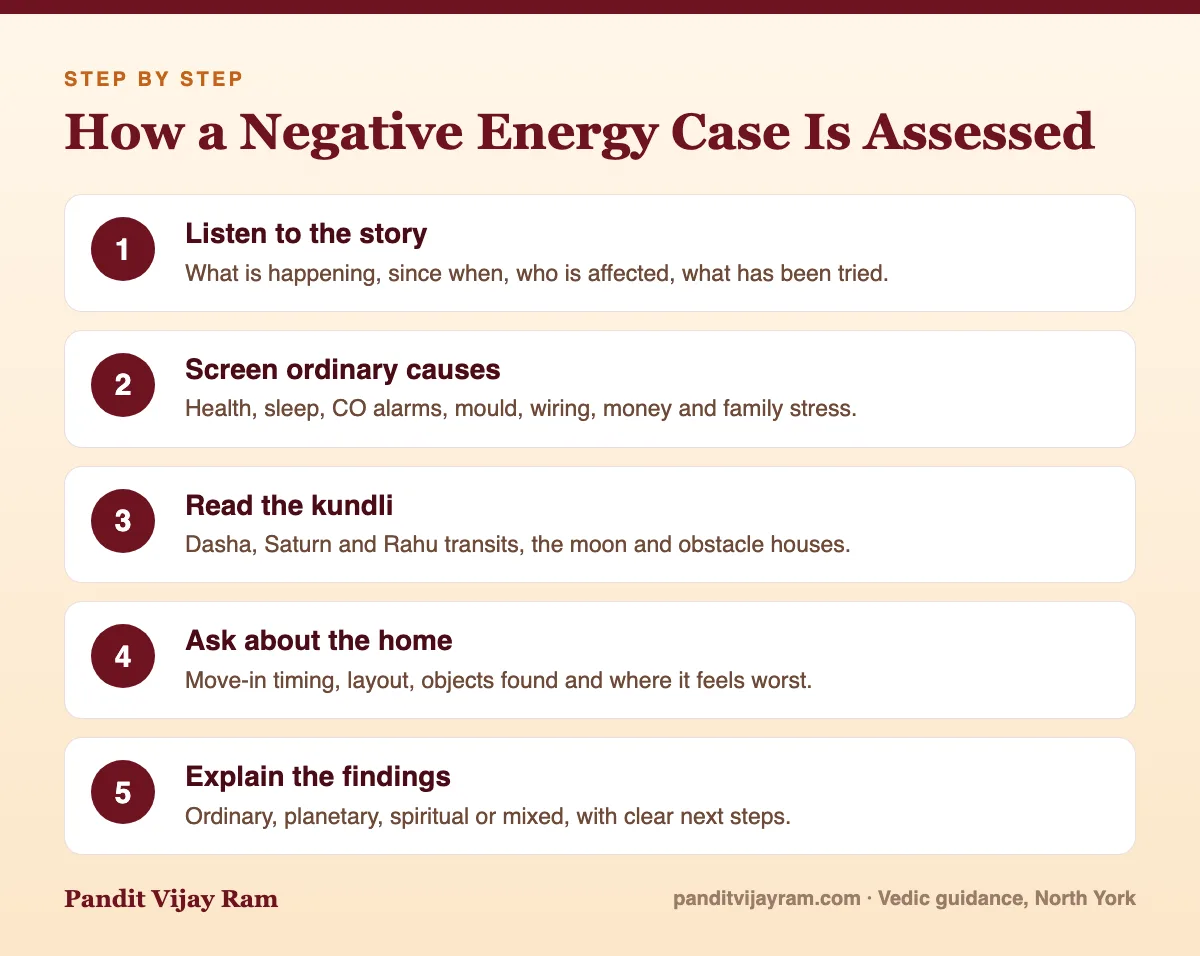
A typical first consultation follows this order:
- Your story, told in your own words without interruption.
- Ordinary causes, checked with simple practical questions.
- The kundli, using your birth date, time and place.
- The home, including when you moved in and where problems are felt most.
- A summary, where the practitioner explains what they see and what they suggest.
You should never feel rushed through this. If someone diagnoses a serious curse within two minutes of a phone call, before asking a single question about your health or home, treat that as a warning sign. Our list of negative energy removal scam warning signs covers other red flags.
When the concern is specifically black magic, the first meeting has some extra questions, which are described in our article on the first black magic removal consultation. This article covers the general assessment that applies to every negative energy case.

What questions are asked in a negative energy consultation?
Expect questions about what is happening, when it started, who in the household is affected, whether anything changed around that time, what you have already tried, and how you are sleeping, eating and coping. The practitioner is looking for patterns, timing and triggers, not for dramatic stories.
These are the questions I ask in some form at almost every first meeting:
- What exactly is happening? Specific examples help more than general feelings: arguments every evening, nightmares three nights a week, a business that lost two contracts.
- When did it begin? A clear starting point often links to a move, a death, a new job, a wedding, a planetary transit or a falling-out.
- Who is affected? One person, the whole family, or only people who spend time in a certain room.
- What changed around then? New medicine, a new relationship, a renovation, a gift brought into the house.
- What have you tried? Home remedies, other practitioners, doctors, counselling, and what happened after each.
- How are you coping? Sleep, appetite, work, mood, and whether you feel safe.
- What do you hope for? Peace at home, clarity about a decision, reassurance, or a specific remedy.
I also listen for things a person does not say directly. Fear of a particular relative, for instance, may point to a family conflict that needs a conversation more than a ritual.
It helps to answer honestly, even about things that feel embarrassing, such as debt, drinking or marriage strain. A practitioner cannot help with a picture that is only half visible, and a good one will not judge you.
Why are ordinary causes checked before spiritual ones?
Many experiences people call negative energy have physical or practical causes that are easy to test and treat. Checking health, the home and daily stress first prevents a real problem being missed, such as carbon monoxide, mould, a thyroid disorder or depression. Spiritual work then rests on firmer ground.
This screen is not a sign of doubt about the spiritual. It is part of the Vedic idea of viveka, clear discernment. A simple way to organise it is to match the complaint with ordinary causes to rule out:
- Headaches, dizziness, tiredness at home: carbon monoxide from a furnace or water heater, poor ventilation, dehydration. Check that CO alarms work.
- Musty smell, coughing, heaviness in one room: mould or damp, especially in basements.
- Humming, buzzing or flickering lights: wiring faults or appliances. Call an electrician.
- Scratching or tapping at night: mice, squirrels or pipes.
- Low mood, no motivation, poor sleep: depression, anxiety, grief, thyroid problems or anaemia. See your family doctor.
- Constant arguments: money stress, overwork, alcohol, or unresolved hurt.
- Bad dreams: late meals, screens in bed, stress, or medication side effects.
If any of these fits, it should be addressed first or alongside the spiritual work. Some cases turn out to be entirely ordinary. Others are mixed, where a real stress has been made heavier by a difficult planetary period.
If anyone in the home is feeling hopeless or thinking about self-harm, that comes before everything else. In Canada, call or text 9-8-8 at any time. Our article on whether your house might be cursed walks through the home checks in more detail.
What does a kundli check show about negative energy?
A kundli check looks at the running dasha, current transits of Saturn, Rahu and Ketu, the condition of the moon, and houses linked with obstacles, such as the sixth, eighth and twelfth. It can show whether a hard period has a planetary pattern, and how long that pattern is likely to last.
For the chart, the practitioner needs your date, time and place of birth. If the time is unknown, a prashna, a horary chart cast for the moment of your question, can be used instead.
The main points checked are:
- Dasha and antardasha. Which planetary period you are in. A Rahu or Saturn period, for example, can bring confusion or delay.
- Transits. Saturn near the natal moon, as in sade sati, or Rahu and Ketu crossing sensitive points.
- The moon. The moon rules the mind. A weak or afflicted moon can make a person more sensitive to stress and fear.
- Obstacle houses. The sixth house of enemies and disputes, the eighth of sudden events, and the twelfth of losses and hidden matters.
- Specific doshas. Pitru dosh, kaal sarp patterns or graha combinations that call for particular remedies.
A chart does not prove that someone has done black magic. What it can do is show whether you are in a demanding phase, which areas of life are under pressure, and when the pressure is likely to ease. That timing often brings real relief by itself.
A full chart reading can be booked on its own through our kundli and horoscope service. As part of an assessment, it is one piece of a larger picture.
What questions are asked about your home during the assessment?
Home questions cover when you moved in and how things were before, who lived there previously, which rooms feel worst, the layout and entrance direction, any objects found, plants or pets that seem unsettled, and recent renovations. Photos or a rough floor plan help with vastu observations.
A home can hold patterns that affect everyone in it. The practitioner will usually ask:
- Timing. Did problems begin after moving in, or after a renovation, a new tenant upstairs, or a death in the house?
- History. Anything you know about previous occupants, such as illness, conflict or a hurried move.
- Where it is felt. One room, one corner, or the whole house. Bedrooms and entrances are especially telling.
- Layout. The main door direction, the position of the kitchen, toilets and the mandir, and whether the centre of the home is cluttered.
- Objects. Anything unusual found in the house, garden or car, or gifts that arrived just before trouble started.
- Living things. Plants dying quickly, or pets behaving oddly in a certain spot. Pets are also sensitive to gas leaks and pests, so this ties back to the ordinary checks.
For condos and rentals, the questions adapt. You may not be able to change much, so suggestions focus on what you can control, such as clutter, light, sound and simple daily prayer.
If the home seems to be a central factor, a separate vastu consultation can look at it closely. The assessment is only meant to spot whether the home deserves that attention.
What can an assessment conclude, and what should you bring?
An honest assessment can conclude that the cause is ordinary, that a planetary period explains much of it, that nazar or another spiritual factor is likely, or that several causes are mixed. Bring your birth details, a dated list of what has happened, photos of the home, and your questions.
The outcome should be explained in plain language, with a clear reason for any remedy. Common conclusions include:
- Mainly ordinary. Next steps are a doctor, a home repair or counselling, with simple prayer for support.
- A demanding planetary period. Remedies such as mantra, charity or graha shanti, with an idea of when the period eases.
- Nazar or general heaviness. Home cleansing and a short protective routine.
- A suspected deliberate harm. A more structured plan, explained fully before you agree to anything.
- Mixed. Practical and spiritual steps together, in a sensible order.
You should leave knowing what is being suggested, why, roughly how long it might take, and what you can do yourself. Our article on how long negative energy removal takes explains realistic timelines. If the next step is a ritual, our negative energy removal service page describes what that involves.
What to bring:
- Date, time and place of birth for each person concerned.
- A short, dated list of what has happened.
- Photos or a rough sketch of the home, if relevant.
- Notes from doctors or other professionals, only if you are comfortable sharing.
- Your own questions, written down so you do not forget them.
You are always free to take time before deciding. The cleansing and protection hub has gentle practices to use meanwhile.
The bottom line
Responsible negative energy removal begins with assessment, not ritual. The interview, the ordinary-causes screen, the kundli check and the home questions together show what is really going on and what will help. Sometimes the answer is spiritual, sometimes practical, and often a mix. Bring your birth details, a dated list and your questions, and expect a clear explanation before any remedy is agreed.
Key takeaways
- A good practitioner listens and asks before suggesting any ritual.
- Health, home and stress causes are checked first, including CO, mould and depression.
- The kundli shows planetary periods and timing, not proof of black magic.
- Home questions cover timing, layout, objects and where problems are felt most.
- An honest assessment may conclude that no ritual is needed.