
How to Cleanse Your Home After Guests Leave Heavy Energy

After a big family dinner, a Diwali gathering or a weekend of relatives staying over, many people want to cleanse your home after guests have gone, and then feel guilty for wanting it. In South-Asian, Caribbean and Latino homes alike, hospitality is close to sacred, so the idea can seem unkind. Families in North York and across the GTA ask me about this often, usually in a whisper. There is nothing unkind about it. In forty-plus years of Vedic practice, I have come to see the after-guest reset as part of hosting well, the same way washing the good dishes is part of serving a meal. This guide explains why a house can feel heavy after visitors, how tradition views it without blaming anyone, a simple reset routine you can do in under thirty minutes, gentle nazar care for children who were fussed over, and the rare moments when a visit really does call for something more.
Why does my house feel heavy after guests leave?
Most of the heaviness after visitors is ordinary: hours of cooking and serving, late nights, rich food, noise and the effort of being on show. Tradition adds that many people's attention, praise and moods gather in a space and linger. Neither explanation means any guest wished you harm.
Hosting is work. You cleaned for two days, cooked for twenty people, kept tea flowing and managed one uncle's politics. When the door finally closes, your body drops its adrenaline and the house looks like a storm passed through. That flat, tired feeling is real, and it is mostly physical.
Tradition gives a second lens. In the Vedic view, every person carries a mood and a mental state, and a home absorbs some of what passes through it. A room where people argued, gossiped, grieved or simply talked loudly for hours holds a different feel than it did that morning. Praise is part of this too. When guests admire a new baby, a renovated kitchen or a child's exam results, the old belief in nazar says that concentrated attention, even loving attention, can unsettle what is admired.
Both lenses point to the same response: tidy up, let air in, rest, and offer a short prayer. You do not need to identify a culprit. You are simply returning the house to its everyday rhythm.
If the heaviness is less about a gathering and more about a particular person whose envy you feel, that is a separate question with its own guidance in negative energy from someone's jealousy.

Is it rude or unkind to cleanse the house after visitors?
No. The Sanskrit teaching Atithi Devo Bhava, the guest is like a god, frames hospitality as an offering, and cleansing afterwards completes that offering. Many families cleanse after weddings, pujas and festivals as routine. The intention is to restore the home, not to remove anyone or treat guests as a threat.
It helps to see the reset as the last course of hosting rather than a verdict on your guests. Temples do the same thing: after a crowded festival day, priests wash the floors, refresh the flowers and relight the lamps. Nobody imagines the devotees were unwelcome.
A few principles keep the practice kind:
- Do it after people leave. Waving salt or lemons while guests are still at the door sends a hurtful message, especially to elders.
- Don't narrate it. There is no need to tell family members you are cleansing after Aunty's visit. Quiet routine is enough.
- Bless rather than banish. Include a prayer for the wellbeing of everyone who came. That turns the ritual outward and keeps resentment out of it.
- Keep it proportionate. A two-hour dinner needs ten minutes, not a havan.
Other cultures have similar customs. Many Latino families sweep and mop with fragranced water after gatherings, and Caribbean households often open every window to let the house breathe. Each tradition treats it as housekeeping for the spirit.
The cleansing and protection hub has more on why homes are cleansed regularly, not just after trouble.
What is a quick way to reset the house after a party?
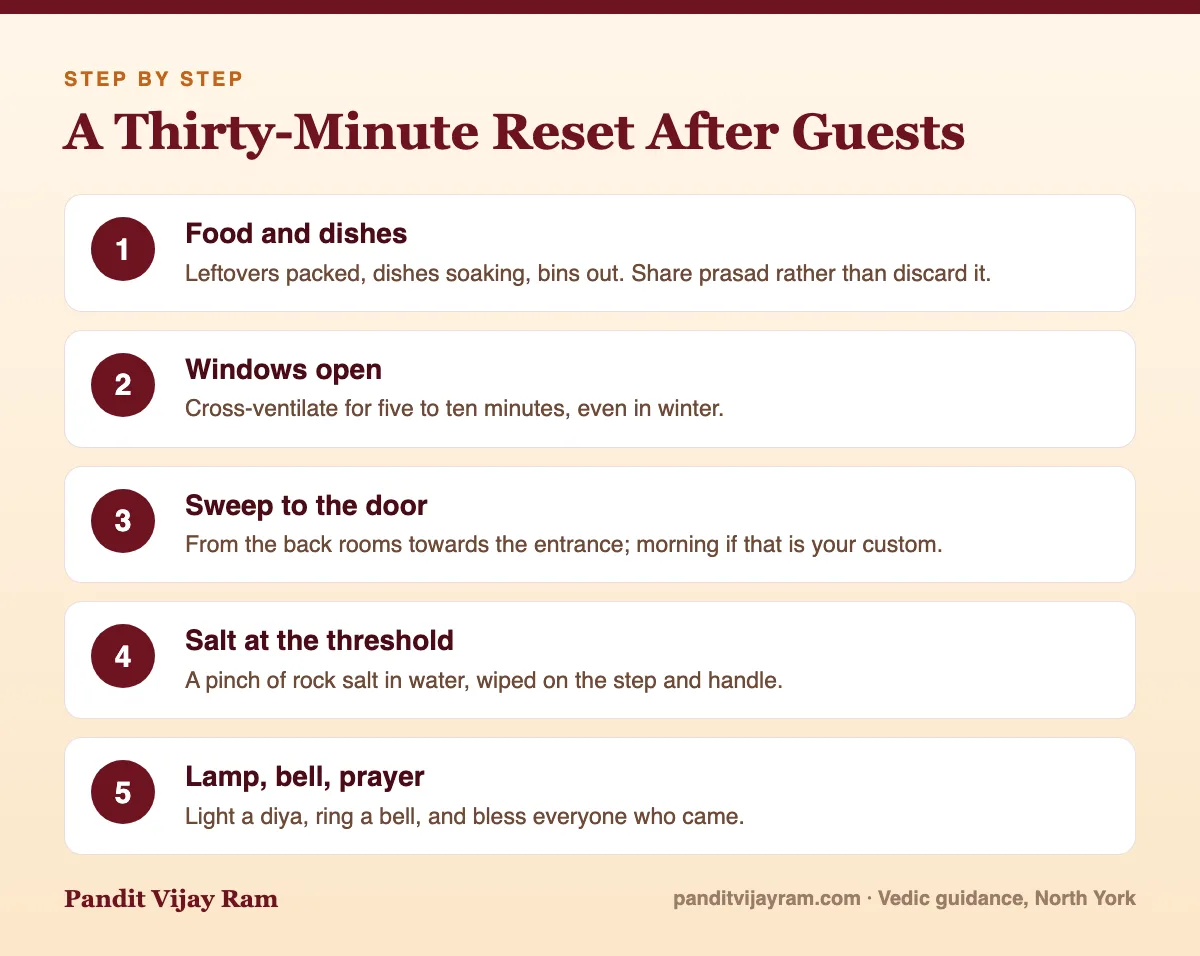
Clear food and dishes first, open windows for ten minutes, then sweep from the back of the house towards the main door. Wipe the threshold with a little salt water, light a diya at the altar, ring a bell through the main rooms and say a short prayer for everyone who visited.
This is the routine I suggest to families. It takes twenty to thirty minutes and needs nothing you don't already own.
- Food and dishes. Pack leftovers, wash or soak dishes and take out the garbage and green bin. Leftover prasad should be shared or eaten, not thrown away.
- Fresh air. Open windows on opposite sides for ten minutes. In winter, five minutes still helps.
- Sweep towards the door. Start at the farthest room and sweep or vacuum towards the main entrance. Some families avoid sweeping after dusk out of respect for Lakshmi; if that is your custom, leave it for the morning.
- Salt at the threshold. Add a pinch of rock salt to a cup of water and wipe the inside step and door handle. The main door threshold guide covers the doorway in more depth.
- Lamp and bell. Light a ghee diya at the home altar and ring a bell once in each main room.
- A short prayer. Thank the guests in your heart and ask that peace stays in the home. A single Gayatri mantra or a few lines of the Hanuman Chalisa is plenty.
After a very large event, such as a wedding at home, a weekly salt water mopping on the following Thursday or Sunday gives a deeper reset.
How do I remove nazar from my child after relatives visit?
The most common household method is to circle a pinch of salt or a few dried red chillies and mustard seeds around the child seven times, then discard them outside or in running water. A small black kala tika behind the ear is also traditional. If the child seems unwell, see a doctor first.
Babies and young children get the most attention at any gathering. They are passed around, kissed, photographed and praised. If a little one becomes cranky, clingy or sleeps badly afterwards, grandparents often say nazar lag gayi.
Start with what is most likely. A child who missed a nap, ate unusual food, was overstimulated by noise or met twenty new faces will be unsettled for a day or two. Colds and stomach bugs also spread easily at winter gatherings. If there is fever, vomiting, a rash, trouble breathing or anything that worries you, call your family doctor or Health811 before any home ritual.
Once the child is well, a gentle nazar practice is harmless and comforting for many families:
- Hold a pinch of salt, or a few dried red chillies with mustard seeds, in your closed hand.
- Circle it around the sleeping or seated child seven times, clockwise, with a quiet prayer.
- Discard it outside, away from the doorway, or flush it. Never put chillies on a hot stove indoors, as the fumes can hurt a small child.
- A tiny dot of kajal behind the ear or on the sole is the classic kala tika. Keep kajal away from the eyes.
The detailed method is in the older guide on removing nazar at home, and newborn customs are covered in care for babies and new mothers.
When does a visit call for more than a home reset?
If heaviness lasts well beyond a few days, if the same problems follow every visit by one person, or if a guest caused real harm such as theft, threats or abuse, a reset is not the answer. Practical boundaries, police or counselling come first, and a reading can follow if spiritual concerns remain.
Most gatherings need nothing more than the routine above. Occasionally, though, something else is going on, and it is worth being honest about it.
- Harm, not energy. If something went missing, a child was treated inappropriately, or someone made threats, that is a safety and legal matter. Speak to the police or a trusted professional.
- A repeating pattern. If every visit from one relative is followed by arguments at home for weeks, look first at what is said during those visits. Old family tensions often surface as a heavy atmosphere. Family counselling can help.
- Lingering low mood. If someone in the house feels flat for weeks after the holidays, that may be exhaustion, grief or depression. A family doctor is the right first stop.
- A persistent spiritual concern. If ordinary causes are addressed and the house or a child still seems affected, a consultation through the evil eye and nazar removal service can look at the chart and the home together.
None of this requires suspicion of your guests. Keep the door open, keep the routine gentle, and save the bigger steps for when the evidence asks for them.
The bottom line
It is perfectly respectful to cleanse your home after guests, because the reset completes hospitality rather than questioning it. Start with dishes, fresh air and sweeping towards the door, then add salt at the threshold, a lamp and a short prayer. Care for children with gentle nazar customs only after making sure they are physically well. Save bigger steps for real harm or a lasting pattern.
Key takeaways
- Tiredness after hosting is mostly physical, and that is normal.
- Cleansing after visitors completes hospitality and needs no suspicion.
- Dishes, air, sweeping, salt, lamp and prayer make a thirty-minute reset.
- Check a child's health first, then use a gentle nazar practice if you wish.
- Real harm from a guest is a matter for boundaries or police, not rituals.