
Love and Marriage After Forty: Remarriage and Companionship

People who come to me about marriage after 40 often start with an apology. A widowed father feels guilty for wanting company. A divorced mother worries what the community will say. A professional who never married wonders if it is too late. In North York and across the GTA, I meet many adults in their forties, fifties and beyond who want love but feel the subject is somehow not for them. It is. This guide looks at later marriage as a life stage of its own. It covers why people marry later, how to talk with adult children and elders, the money and legal questions to settle early, how to meet someone safely, and what a kundli can and cannot add. In more than forty years as a Vedic astrologer, I have seen later marriages bring great steadiness. The couples who do best are honest about what they want, and practical about the life they are joining.
Is it too late to get married after 40?
No. Many people marry for the first or second time in their forties, fifties and later. Later partnerships often benefit from self-knowledge, financial stability and clearer priorities. The challenges are different rather than greater: established routines, family obligations and practical arrangements need more open discussion than they would at twenty-five.
People reach later marriage by different roads, and each road shapes what they need.
- Never married. Study, career, caring for parents or simply not meeting the right person. Family pressure may have been heavy for years.
- Divorced. Often carrying lessons, and sometimes wounds, from the first marriage. Children and co-parenting may be part of the picture.
- Widowed. Grief and love can sit side by side. Wanting a companion does not betray the person who died.
- Separated by circumstance. Immigration, distance or family events that delayed or ended earlier plans.
What tends to be easier later on is knowing yourself. You know how you handle conflict, what you need from a home and which compromises you can live with.
What can be harder is flexibility. Two people with settled habits, homes and social lives must decide whose routines bend. That conversation is worth having early and plainly.
A practical point for women hoping for children: speak with a family doctor or fertility clinic early about options and timing. That is a medical question, and an astrologer should never answer it for you.
If you are looking for a partner and wonder how to judge fit beyond horoscopes, our guide to compatibility beyond the kundli gives a practical checklist.

How do I tell my adult children or family that I want to remarry?
Tell them yourself, early, before they hear it elsewhere. Explain what the relationship means to you, acknowledge their feelings, especially if they lost a parent, and reassure them about what will not change. Give them time to meet your partner gradually. Their approval matters, but the decision belongs to you as an adult.
Adult children often react to a parent's new partner with more emotion than anyone expects. Common worries include loyalty to a late or divorced parent, inheritance, the family home and fear of being replaced.
A sequence that tends to go smoothly:
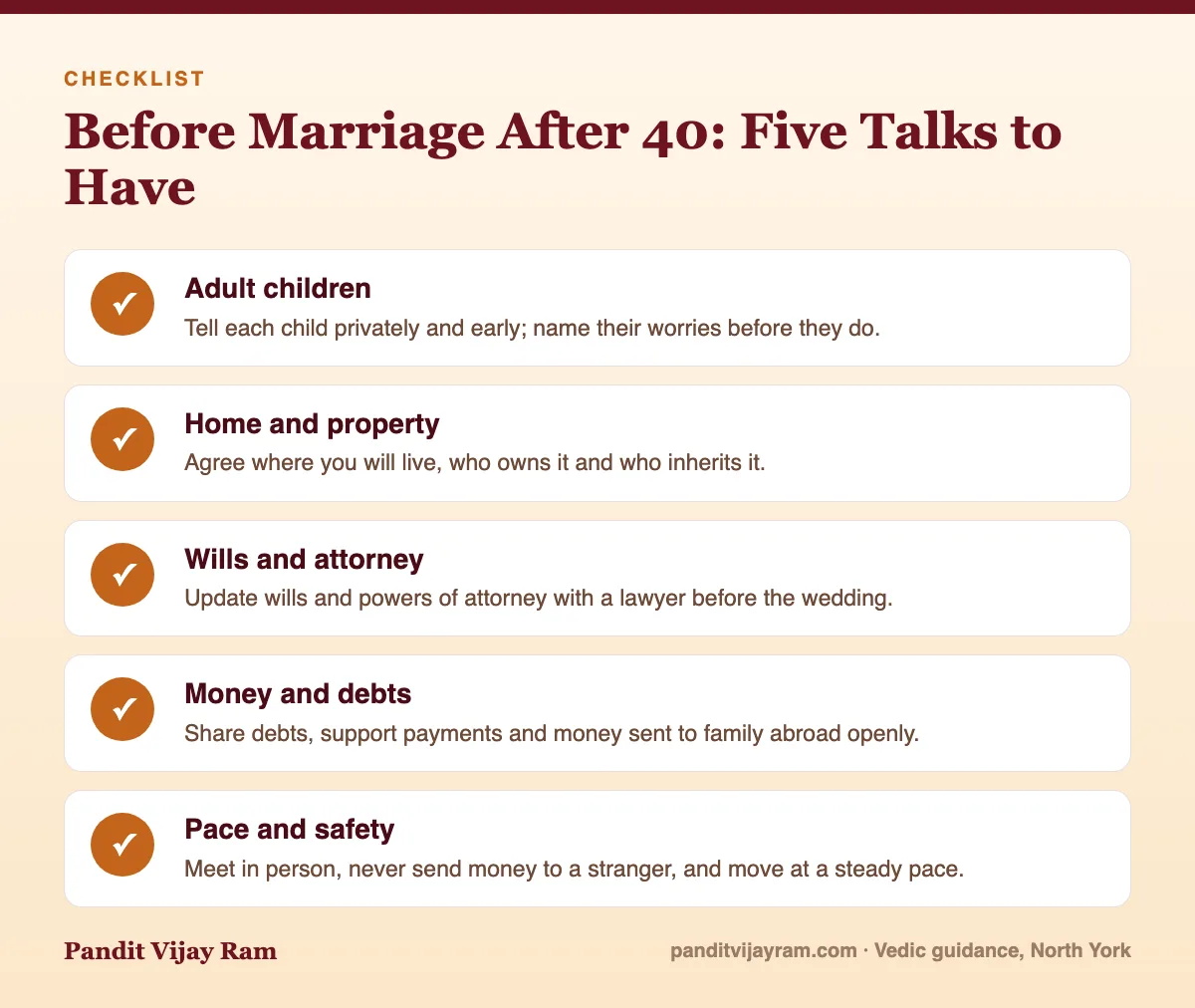
- Speak to each child privately first. Group announcements can feel like a decision already made.
- Name their concern before they do. 'I know you miss your mother. This does not change that.'
- Separate love from money. Say that you will make clear legal arrangements, and then do so.
- Introduce slowly. A relaxed meal before any big family function.
- Allow mixed feelings. Acceptance can take months.
Elders and the wider community may also have opinions, especially about a widowed woman remarrying. Some traditions once discouraged it strongly. Many families today see companionship in later life as entirely natural. You do not need everyone's blessing to live honestly.
Where a past marriage ended with abuse, keep your safety in mind while sharing details, and do not let anyone pressure you into reconnecting with a former spouse.
Wedding arrangements for later couples are often simpler. If you plan a civil or religious ceremony, our guide to the marriage licence in the GTA covers the paperwork side.
What money and legal questions should older couples settle before marriage?
Discuss homes, savings, debts, pensions, wills and what happens to each person's assets for their own children. In Ontario, married couples and common-law partners are treated differently under family law. A domestic contract, such as a marriage contract or cohabitation agreement, drawn up with independent lawyers, can protect both partners and reduce family conflict.
Romance in later life sits on top of decades of financial history. Being clear about it is an act of care, not suspicion.
Questions to discuss openly:
- Where will you live? Whose home, or a new one? Who owns it, and who inherits it?
- Debts and obligations. Loans, support payments to a former spouse, money sent to family abroad.
- Pensions and benefits. A new marriage or common-law relationship can change some government and workplace benefits. Check with Service Canada and your plan administrator.
- Wills and powers of attorney. Marriage can affect an existing will, and rules differ between provinces and have changed over time. Update documents with a lawyer.
- Care in illness. Who will make decisions if one of you becomes unwell?
In Ontario, the Family Law Act allows couples to sign domestic contracts. Each partner should have a separate lawyer so that the agreement is fair and holds up later.
If cost is a worry, our guide to legal aid and family law help in the GTA explains community clinics and other routes. None of this is legal advice; a lawyer will answer for your own situation.
How can people over 40 meet a partner safely?
Introductions through trusted friends, community and faith groups, hobbies and reputable matrimonial or dating services all work. Meet in public first, tell someone where you are, and move at a steady pace. Be alert to romance scams, which often target widowed and divorced adults: never send money to someone you have not met in person.
Later life offers more ways to meet people than many expect, from temple and gurdwara volunteering to walking groups, classes and community events. Online platforms are now common for people in their fifties and sixties too.
A few safety rules make the process calmer:
- Video call early. It confirms the person is who they say.
- First meetings in public, with a friend or relative aware of your plans.
- Watch the pace. Rapid declarations of love, pressure to commit or secrecy are warning signs. Our guide to love bombing explains the pattern.
- Money is a hard line. Requests for help with a medical bill, visa, customs fee or investment, from someone you have never met, are the classic sign of a romance scam.
- Keep your own counsel. Talk major decisions through with someone you trust before acting.
If you have been asked for money or have already sent some, report it to the Canadian Anti-Fraud Centre and your bank. Embarrassment is understandable, but scammers rely on silence.
Family-arranged introductions remain popular in later life, and they work best when both people are free to say no without offence.
What does astrology say about marriage later in life?
A kundli can describe how a person tends to approach partnership and which periods have historically been read as favourable for commitment. Late marriage is traditionally linked to Saturn's influence on the 7th house or Venus, but such placements describe tendencies, not destiny. A chart can never decide whether a specific person is right for you.
Classical astrologers often associate delayed marriage with Saturn aspecting or occupying the 7th house, or with Saturn's influence on Venus or the 7th lord. Many people who married later do have such placements. Many people with the same placements married young. This is why I treat them as descriptions of temperament, such as caution, seriousness or responsibility, rather than as causes.
For a remarriage, astrologers may look at the 9th house, 11th house and the navamsa in addition to the 7th. Those rules, and their limits, are explained in our article on second marriage astrology, so I will not repeat them here.
Where a reading helps most at this stage:
- Understanding your own patterns from past relationships.
- Comparing two charts for temperament and emotional rhythm, if both partners want this.
- Choosing a calm, auspicious time for a ceremony, if that matters to your family.
Where it does not help is replacing your own judgment. At forty or seventy, you know far more about a person after six months of honest time together than any chart can show.
Vijay Ram ji's love and marriage guidance is open to people at every life stage, including widowed and divorced adults.
The bottom line
Marriage after 40 is a real and often steady choice, whether it is a first marriage, a remarriage or companionship after loss. Talking early and honestly with adult children, and settling homes, wills and finances with independent lawyers, protects everyone involved. Meet people with sensible safety habits and never send money to someone you have not met. Astrology can describe tendencies, but the decision rests on what you learn from honest time together.
Key takeaways
- It is not too late to marry after forty.
- Tell adult children privately and early, before announcements.
- Settle homes, wills and pensions with independent legal advice.
- Romance scams often target widowed and divorced adults.
- Saturn placements describe temperament, not a fixed fate.