
Second Marriage Astrology: Timing and Remedies After Divorce or Loss

Starting again after a marriage ends is a brave thing. Some people arrive at this point after a long divorce, others after the death of a husband or wife they expected to grow old with. Both carry grief, and both often carry the quiet question of whether it is right, or even possible, to love again. Many people in North York and across the GTA ask me about second marriage astrology for exactly this reason. They want to know if the chart supports another marriage, when it might come, and whether anything from the first marriage needs to be settled first. This guide explains which houses and planets tradition reads for remarriage, how timing is judged, and what the chart cannot tell you. It also covers readiness after loss, the practical side of blended families, and prayer that supports a new beginning. After four decades of sitting with people at this crossroads, I believe the chart is a lamp, not a judge. It can show the road. You still decide when you are ready to walk it.
Which house shows second marriage in Vedic astrology?
Tradition reads the seventh house for the first spouse and the ninth house, which is third from the seventh, for a second spouse. Some schools look to the eleventh house for a further marriage. The second house, eighth from the seventh, is read for the ending of the first union. Venus and Jupiter are studied throughout.
Vedic astrology uses derived houses, counting from one house to another. Because the seventh house describes marriage, the houses counted from it describe what follows. The third from any house is its successor, so the third from the seventh, the ninth house, is the house of the next partner.
- Seventh house and its lord. The nature of marriage in general and of the first spouse.
- Ninth house and its lord. The second spouse, and the dharma and support a later marriage can bring.
- Second house. As the eighth from the seventh, it is read for the close of the first marriage and for family life rebuilt afterward.
- Venus. Love, partnership and the capacity for affection, read for everyone.
- Jupiter. Grace, wisdom and blessing in marriage, given particular weight in a woman's chart by tradition.
- The navamsha (D9). The divisional chart of marriage, essential for any confident view.
No single house decides the matter. A strong ninth lord in a supportive sign, aspected by Jupiter, is encouraging. A weak or afflicted ninth does not deny remarriage; it suggests a theme to understand and care for.
For a full natal reading that includes these derived houses, the kundli and horoscope service explains what I prepare. If the first marriage ended recently and you are unsure whether reconciliation is possible, our guide to love after divorce or separation looks at that question first.

What is second marriage yoga in a kundli?
Second marriage yoga refers to chart combinations traditionally linked with more than one marriage, such as a dual sign on the seventh house, the seventh lord in a dual sign, Venus or the seventh lord joined by several planets, or strong links between the seventh and ninth lords. These are tendencies, not certainties.
Classical astrologers grouped the twelve signs into movable, fixed and dual. The dual signs, Gemini, Virgo, Sagittarius and Pisces, carry a sense of twoness. When one of them occupies the seventh house, or holds the seventh lord or Venus, tradition sees the possibility of two significant partnerships.
Other combinations often cited include:
- Two or more planets in the seventh house, especially with Mars, Saturn or Rahu involved.
- The seventh lord and ninth lord in mutual aspect or exchange.
- Venus placed in a dual sign with another strong benefic.
- A weakened seventh lord alongside a strong, well-supported ninth lord.
I want to be careful here. Charts with these yogas belong to many people who stay in one long marriage. And many people who remarry have none of these combinations. A yoga describes a possibility the chart is open to, not an event it orders.
That matters, because people sometimes see these combinations and feel blamed for a divorce or a death, as if the chart proved it was their fault. It proves nothing of the kind. A marriage ends through two people's choices, through illness, accident and circumstance. The chart may echo those events; it did not cause them.
Where a reading suggests a divorce tendency, our post on divorce yoga in a kundli explains why such labels need very careful handling.
When will I get married again according to astrology?
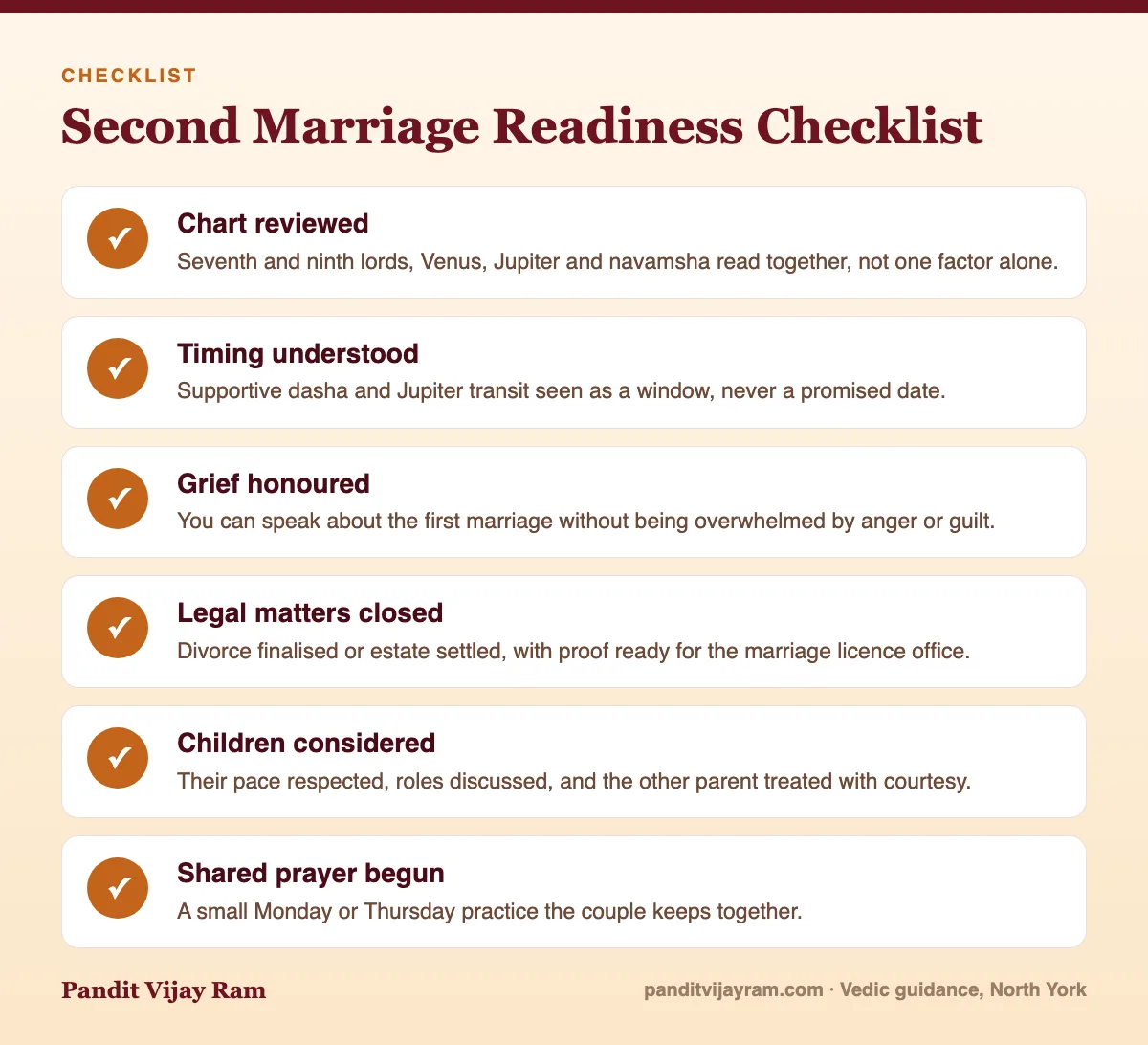
Astrologers judge remarriage timing mainly through dasha periods of the seventh, ninth or second lords, of Venus, or of planets placed in those houses, combined with Jupiter's transit over or aspecting the seventh or ninth house. Timing suggests windows of opportunity. Your own readiness decides whether to walk through them.
Vimshottari dasha is the main timing system I use. Each planet rules a period of years, and within it each planet rules a sub-period. When a planet connected to marriage runs its period, questions of partnership tend to come forward.
- Identify the marriage significators in your chart: the seventh and ninth lords, Venus, planets in those houses, and the navamsha seventh lord.
- Map the current and next dashas to see which of these planets become active and when.
- Add transits. Jupiter crossing or aspecting the seventh or ninth house, or the natal Venus, is traditionally a supportive trigger. Saturn's transit is read for seriousness and commitment.
- Check the Moon. The mind needs to be ready. A heavy Saturn transit over the natal Moon often coincides with grief or caution rather than new beginnings.
- Hold the window lightly. A favourable period is an opening, not an appointment.
I do not give future dates in an article, and I would be wary of anyone who promises a wedding by a certain month. Once a relationship is real and the couple is ready, a proper wedding muhurat calculated for Canada is a separate and useful step.
One practical note: before setting any date, make sure the earlier marriage has legally ended. The marriage licence office will ask for proof, and a family lawyer can confirm where a divorce stands.
How do I know if I am ready to remarry after divorce or the death of a spouse?
Readiness usually shows as being able to speak about the first marriage without overwhelming anger or guilt, wanting a partner rather than a rescue, having children's needs considered, and finances and legal matters settled. Grief has no fixed timetable. A counsellor or grief group can help you see where you are honestly.
When someone asks me about remarriage, I often ask about the first marriage before I look at the chart. How it ended shapes what someone carries into the next one.
After a divorce, people sometimes rush to remarry to prove something, to escape loneliness, or because family pressure makes single life feel shameful. Others hold back for years because trust was broken. Neither is wrong, but each benefits from reflection. A few questions are worth answering honestly:
- Can I describe what went wrong without making myself or my former spouse the only villain?
- Do I want this new person, or do I want the pain to stop?
- Have I changed the habits I contributed to the first marriage's difficulties?
After the death of a spouse, the feelings are different. Many widows and widowers feel guilty for even thinking of love again. Families sometimes add to that guilt, especially for widows. Historically, Hindu society placed heavy stigma on widow remarriage, and reformers fought hard to change both the law and attitudes. A widow or widower who chooses to remarry is not dishonouring the one who died.
A grief counsellor or bereavement group can help when sorrow still dominates daily life. If grief turns into hopelessness, please see your family doctor, and in a crisis call or text 988.
Spiritually, a gentle release practice can mark an ending with respect. Our guide to clearing ties to a past relationship describes one such prayer.
What remedies help a second marriage and a blended family?
Traditional remedies for remarriage include Thursday Jupiter prayer, Friday Venus worship, Shiva-Parvati or Gauri-Shankar prayer for harmony, and strengthening the ninth lord where it is weak. For blended families, the practical remedies matter as much: patience with children, clear roles, agreed finances and respect for the children's other parent.
Spiritual support for a second marriage is less about fixing a chart and more about blessing a new household. I usually suggest a small, regular practice that the couple can share.
- Thursday Jupiter prayer. A yellow flower, a lamp and the Guru mantra or Vishnu Sahasranama for wisdom and grace in marriage.
- Friday Venus prayer. Lakshmi worship or a Shukra mantra for affection and comfort in the home.
- Shiva-Parvati prayer. Monday worship as a couple, asking for steadiness between two people who have both known loss.
- Ninth-lord support. Where the ninth lord is weak, its own weekday prayer or charity, decided in a reading rather than guessed.
Wedding customs for a second marriage vary by community. Ask your family priest what your tradition expects. A second marriage deserves the same blessings as a first.
Blended families need practical care too. Children often feel their loyalty is being tested. Let the step-parent relationship grow slowly, and leave discipline to the birth parent at first. Agree on money, wills and living arrangements before the wedding. Where there is a former spouse, keep co-parenting arrangements calm and predictable.
The love marriage guidance page describes how I support couples preparing to marry, including those marrying for the second time.
The bottom line
Second marriage astrology reads the ninth house, the seventh lord, Venus, Jupiter and the navamsha, then uses dashas and transits to suggest windows rather than fixed dates. Yogas for remarriage describe possibilities and never assign blame for a marriage that ended. Readiness, grief, children and legal matters deserve as much attention as the chart. With honest preparation and a modest shared prayer, a second marriage can begin on steady ground.
Key takeaways
- The ninth house, third from the seventh, is the traditional house of the second spouse.
- Dual signs on the seventh house suggest openness to two partnerships, not a certainty.
- Dashas and Jupiter's transit indicate windows, never guaranteed dates.
- Grief and readiness deserve time; a counsellor can help.
- Blended families need patience, clear roles and agreed finances.