
Can a Curse Make You Sick? Separating Tradition From Medicine

When someone falls ill soon after a quarrel, a threat or a strange object on the doorstep, the mind connects the two. Relatives start asking whether it is a curse. The person who is sick begins to wonder too, and the worry itself becomes part of the illness. Asking can a curse make you sick is a fair question, and it deserves an answer that respects both faith and medicine. I meet many people in North York who arrive already frightened, sometimes after skipping a doctor's appointment because they were told the problem was spiritual. This guide explains what medicine knows about fear and the body, including the nocebo effect, and how Vedic and other traditions have described illness linked to ill-will. It sets out which symptoms need urgent medical help, why treatment must never be stopped, and where prayer fits in a sensible plan. In more than forty years of practice, my first question to anyone who feels cursed and unwell has always been the same: have you seen your doctor yet?
Can someone's curse cause a real physical illness?
There is no medical evidence that spoken words or rituals by another person create infections, tumours or organ disease. What is well documented is that believing you have been cursed can trigger stress responses strong enough to cause real symptoms. Illness that arrives after a curse almost always has a medical cause worth finding.
Timing fools all of us. If a fever starts two days after an aunt said something cruel, the two events feel linked. But fevers, migraines, stomach trouble and back pain are common, and something unpleasant has nearly always happened in the days before any of them.
Doctors see three common patterns in people who believe they are cursed:
- An ordinary illness, newly interpreted. A thyroid problem, anaemia, infection or diabetes is present and would be there with or without the curse. Fear simply changes how it is understood.
- Stress symptoms. Constant worry raises stress hormones, disturbs sleep and appetite, tightens muscles and upsets digestion. These symptoms are real, not imagined.
- Anxiety or depression. Panic attacks feel like heart trouble. Low mood drains energy. Both are treatable and often missed when everyone is focused on a curse.
None of this dismisses the spiritual worry. It puts it in the right order. A blood test or a scan that finds an ordinary cause is good news, because ordinary causes have treatments.
If sadness, hopelessness or exhaustion are part of what you feel, the guide to telling negative energy apart from depression walks through the warning signs and where to get help.

What is the nocebo effect and how does it relate to curses?
The nocebo effect is the shadow side of the placebo effect: expecting harm leads the body to produce real symptoms. In studies, people warned about side effects report more of them, even from inactive pills. A frightening belief about a curse can act the same way, turning fear into pain, nausea, dizziness and fatigue.
Researchers have studied this for decades. When patients are told a harmless treatment may cause headaches, a share of them develop headaches. When people expect to feel worse, their bodies often oblige, through the same stress pathways that make an exam or a job interview upset the stomach.
Anthropologists and physicians have long recorded cases from many cultures where a person who believed they were cursed became severely ill. The physiologist Walter Cannon called the most extreme reports voodoo death. The term is dated, and it wrongly singled out one religion, but the point behind it holds: belief, fear and social isolation can overwhelm a body.
Understanding the nocebo effect helps in three practical ways:
- It explains why symptoms are real. You are not making it up, and you are not weak.
- It shows why fear-selling harms. A practitioner who adds terror to a curse story can make someone sicker.
- It shows why reassurance helps. Calm explanation, medical clarity and steady prayer reduce the stress that feeds the symptoms.
The related belief that praise can make someone ill is explored in feeling unwell after praise, which looks at nazar through the same lens.
How do Vedic and other traditions explain illness from ill-will?
Vedic tradition names several causes of suffering: the body's own imbalance, the influence of grahas, past karma and, more rarely, harm intended by others. The Atharvaveda contains hymns for healing and for protection against hostile rites. Ayurveda separates diseases of the body from those of the mind and treats both practically.
Classical Hindu thought has always held more than one explanation at once. A fever could be treated with herbs by a vaidya while the family also prayed and gave charity. Nobody saw a conflict between the two.
Some key ideas:
- Adhi and vyadhi. Later texts distinguish adhi, distress of the mind, from vyadhi, disease of the body, and note that one can lead to the other.
- Graha influence. Astrology links health themes to the 6th and 8th houses and to periods of difficult planets. A reading may point to a stressful phase. It is not a diagnosis.
- Hostile rites. The Atharvaveda includes protective hymns against krtya, harmful ritual. Their response is protective prayer, not revenge.
Other faiths take a similar path. Islamic teaching recommends ruqyah, recitation of Qur'anic verses, alongside medical treatment, and many scholars stress that seeking treatment from doctors is itself encouraged. Caribbean and Latino healing traditions, too, often send a person to the clinic as well as to the healer.
Across these traditions, the healer's role was to support the sick person, never to forbid medicine. Our health and wellbeing guidance works in exactly that supporting role.
Which symptoms need a doctor or emergency care first?
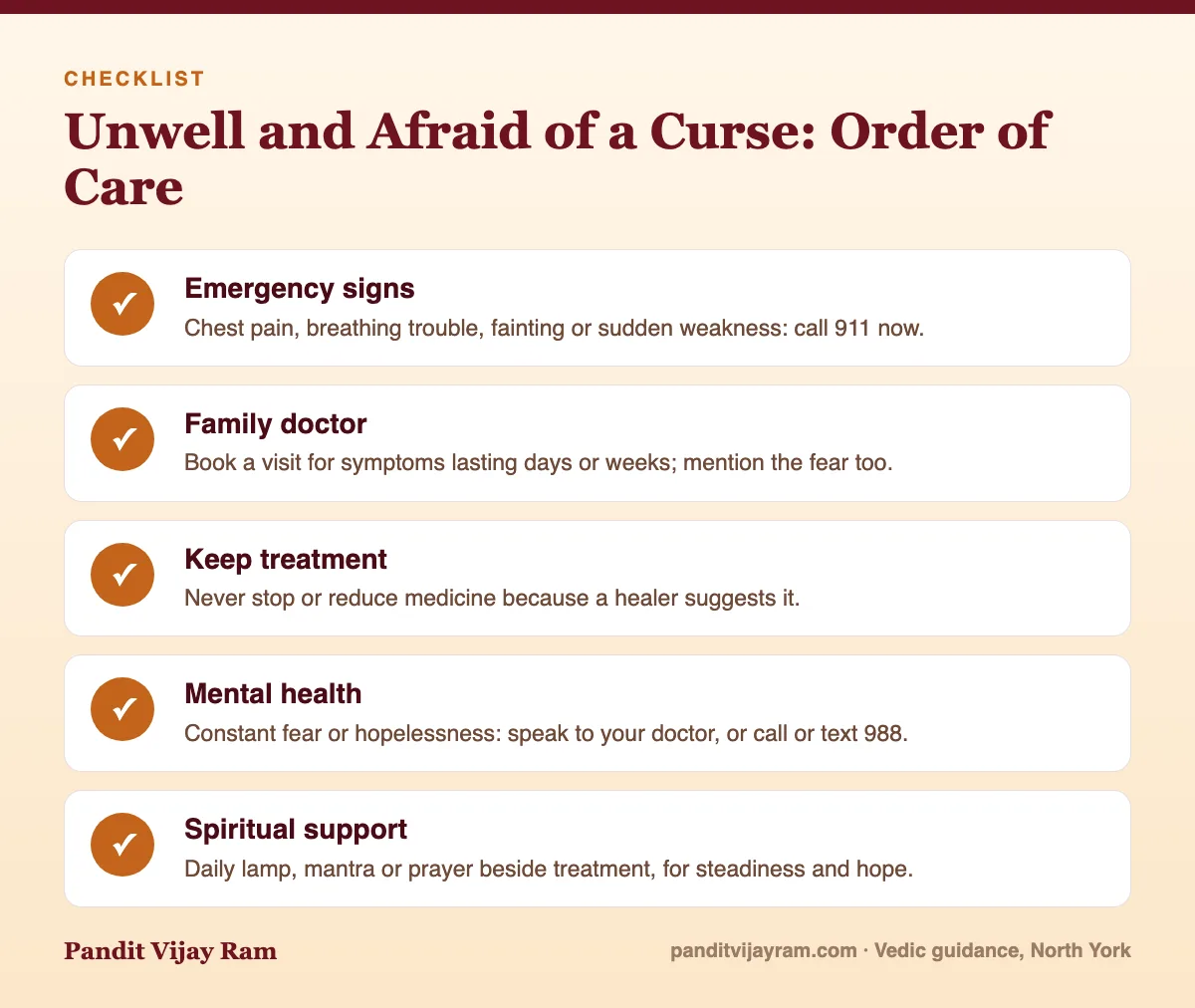
Call 911 for chest pain, trouble breathing, fainting, a sudden severe headache, one-sided weakness, seizures or heavy bleeding. Book your family doctor for weight loss, ongoing fatigue, fevers, new pain, sleep loss or mood changes lasting two weeks or more. For thoughts of suicide, call or text 988 any time.
A simple decision rule helps families who are torn between a temple and a clinic.
- Emergency signs: go now. Chest pain or pressure, breathing difficulty, confusion, fainting, sudden weakness or numbness on one side, a seizure, high fever in a baby, or bleeding that will not stop. Call 911 or go to the nearest emergency department.
- Ongoing symptoms: book an appointment this week. Unexplained weight loss, fatigue that does not lift with rest, repeated vomiting, persistent pain, rashes, or new trouble sleeping. Ontario residents without a family doctor can call Health811 for advice from a nurse.
- Mental-health symptoms: speak to someone. Panic, constant fear of being cursed, hopelessness or intrusive thoughts. Your family doctor can refer you, and the 9-8-8 Suicide Crisis Helpline answers by call or text.
- Only then: spiritual support. Prayer, mantra and protective practice can run alongside treatment from the first day.
Bring the full picture to your doctor, including the fear of a curse. Good doctors in the GTA see patients from many cultures and will not laugh at you. Saying it aloud often lowers the anxiety by itself.
Should I stop medicine if a healer says the illness is spiritual?
No. Never stop or reduce prescribed medicine, skip dialysis, delay chemotherapy or cancel surgery because someone says your illness comes from a curse. An honest spiritual practitioner will tell you to keep every treatment. Anyone who asks you to choose between medicine and their ritual is putting your life at risk.
This is the single most important point on this page. People have been harmed by stopping insulin, blood-pressure tablets, antidepressants or seizure medicine on the advice of someone who promised a spiritual answer. The harm can be sudden and serious.
Watch for these warning signs in any healer, of any tradition:
- Telling you doctors cannot help with your condition.
- Saying medicine will block the ritual or make the curse stronger.
- Promising that symptoms will disappear by a certain day.
- Asking for large or escalating payments as the illness continues.
- Discouraging you from telling family or your doctor.
These are red flags for exploitation, and the Canadian Anti-Fraud Centre takes reports about them. The guide to warning signs of removal scams lists more.
A sound plan looks like this: medical treatment as prescribed, honest conversations with family, and a short daily prayer for strength. For those who want protective support, our curse removal guidance always works with your treatment, not against it. The evil eye and curses hub gathers the other guides in this series.
The bottom line
So, can a curse make you sick? Fear of a curse can produce real symptoms through the nocebo effect, but disease itself needs a medical cause and a medical answer. Vedic and other traditions always placed prayer beside treatment, never in its place. See your doctor first, keep every prescribed treatment, and use spiritual practice for steadiness while you recover.
Key takeaways
- No evidence shows that a curse creates disease, but fear can create real symptoms.
- The nocebo effect means expecting harm can make the body feel harm.
- Emergency signs need 911; ongoing symptoms need a family doctor.
- Never stop or reduce medicine on a healer's advice.
- Prayer and protection work best alongside medical care.