
Life Path Number: What Numerology Calculates and What It Can't
Numbers have a quiet appeal. They feel exact, and a figure drawn from your own birthday seems personal in a way a horoscope column does not. That is why so many people search for their life path number after a friend mentions theirs. When clients in North York ask me about it, I am happy to show them the arithmetic and the traditional meanings, and I am equally clear about the limits. In more than forty years of Vedic practice I have used numbers as one gentle lens alongside the kundli, never as a verdict. This guide shows exactly how a life path number is calculated, why two common methods can give slightly different answers, how the Pythagorean and Chaldean systems differ and where the Indian bhagyank and mulank fit, what each number from one to nine is traditionally said to mean, and what numerology honestly cannot do. It is written for curious readers who want the method without the mystique. Numerology is a matter of personal interest and faith, and it never replaces professional advice about health, money, law or relationships.
What is a life path number in numerology?
A life path number is the core figure in Western numerology, calculated from the full date of birth. It is reduced to a single digit from one to nine, though many numerologists keep 11, 22 and 33 as master numbers. It is read as a broad theme of character and direction rather than a forecast of events.
Numerology rests on an old idea that numbers carry qualities, not just quantities. Versions of that idea appear in Greek, Hebrew, Chinese and Indian thought. The modern systems people use online, however, were organised quite recently, drawing loosely on those older traditions.
Several numbers are calculated in a typical reading:
- Life path number: from the whole birth date. The headline figure.
- Birth day number: from the day of the month alone.
- Expression or destiny number: from the letters of your full birth name.
- Soul urge number: from the vowels of your name.
Terms vary confusingly. Some writers call the life path the destiny number; others reserve destiny for the name total. Indian numerology uses mulank for the birth day number and bhagyank for the full-date total, which corresponds closely to the Western life path.
If you would rather skip the arithmetic, our free numerology calculators will do it for you. It is still worth knowing how the figure is produced, because that helps you judge how much weight to give it.

How do you calculate your life path number?
Write out your full birth date as digits, add them, and keep adding the digits of the result until you reach a single number. Many numerologists first reduce the day, month and year separately and stop at 11, 22 or 33. Both methods give the same root digit, but they can differ on master numbers.
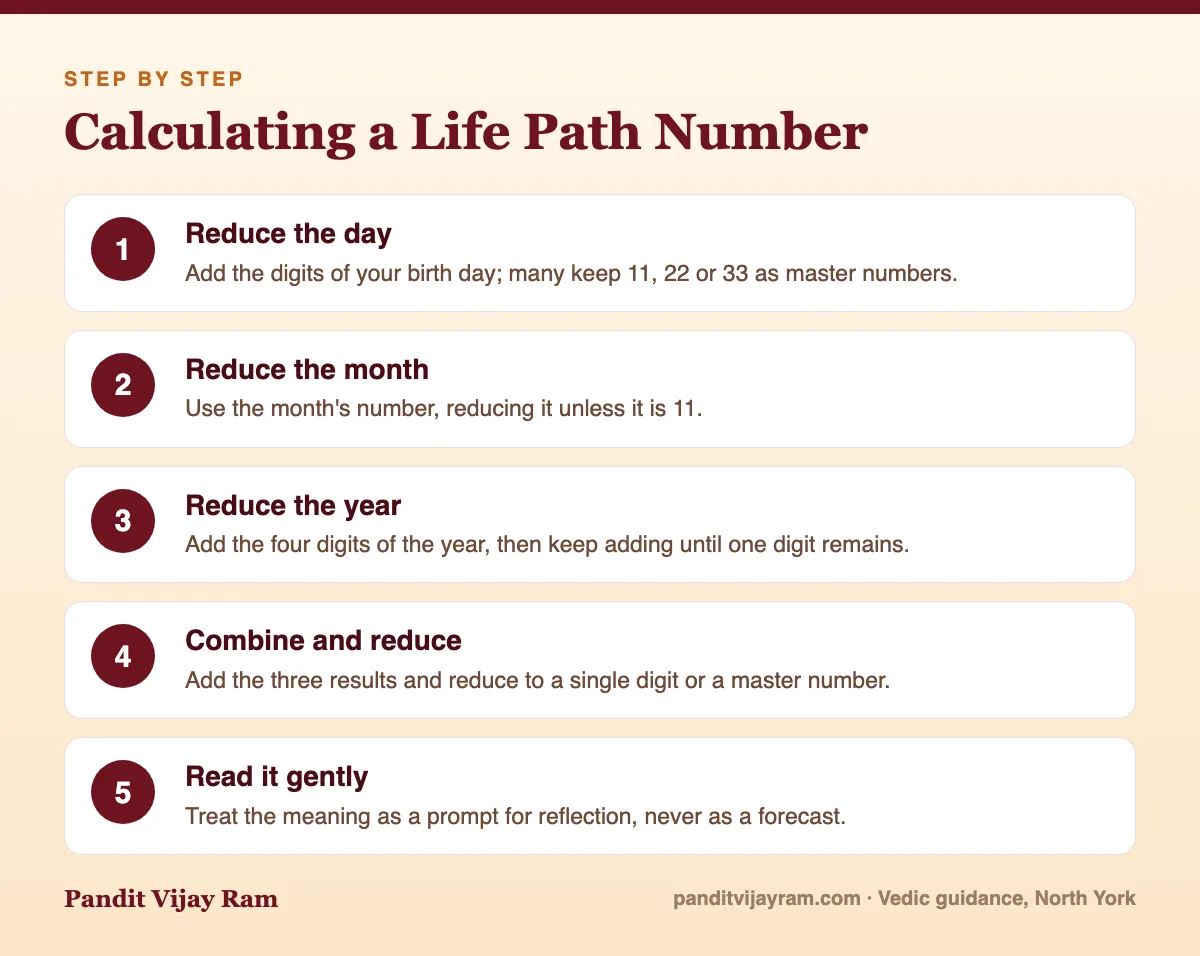
Here is the reduce-by-parts method, step by step:
- Day: reduce the day of the month. The 29th becomes 2 + 9 = 11, kept as a master number by many.
- Month: use its number. November is 11, also kept; September is 9.
- Year: add its four digits, then reduce. A year whose digits total 21 becomes 3.
- Combine: add the three results and reduce again, stopping at 11, 22 or 33 if you follow that custom.
The other common method simply adds every digit of the date at once and reduces the total.
Why the difference matters: take someone born on the 5th of June in a year whose digits add up to 18. By parts, the day is 5, the month 6 and the year 9, so the total is 20, which reduces to 2. Adding everything at once gives 5 + 6 + 18 = 29, which reduces to 11 before reaching 2. One numerologist will call this person a 2; another will call them an 11/2.
Neither is an error. They are different conventions. Indian practice usually reduces straight to a single digit and does not use master numbers. For the related calculation of a lucky number and colour by weekday, see that separate guide.
What is the difference between Pythagorean and Chaldean numerology?
Pythagorean and Chaldean numerology differ mainly in how they turn letters into numbers. Pythagorean assigns one to nine in alphabetical order; Chaldean assigns one to eight by sound and leaves nine unassigned. For a birth-date life path number, both systems give the same result, because no letters are involved.
The names suggest ancient origins, and that deserves an honest note. Pythagoras did teach that number underlies reality, but the alphabet table now called Pythagorean was arranged long after him, in Western esoteric writing. The Chaldean label points to ancient Babylon, yet the system as used today was popularised by modern writers, and its link to Babylon is doubtful.
In practice:
- Pythagorean: A is 1, B is 2 and so on to I as 9, then J starts again at 1. Simple and widely used online.
- Chaldean: letters are grouped by sound into values one to eight. Nine is treated as sacred and is not given to any letter, though it can appear in totals.
- Indian, or Ank Jyotish: commonly uses the Chaldean letter values and links each digit to one of the nine grahas.
So when a name is involved, the two systems often disagree. That is why our guides on name numerology and spelling changes and business name numerology discuss the choice of system in detail.
Classical Jyotish texts are astrological, not numerological. Indian numerology is a later practice that sits beside the kundli rather than inside it.
What do life path numbers 1 to 9 mean?
In common Western readings, 1 is independence, 2 cooperation, 3 expression, 4 structure, 5 change, 6 care, 7 reflection, 8 ambition and 9 compassion. Indian numerology pairs each with a planet: Sun, Moon, Jupiter, Rahu, Mercury, Venus, Ketu, Saturn and Mars. These are broad themes, not fixed personality types.
Here are the traditional associations, with the planet used in Indian practice:
- 1, Sun: leadership, initiative, self-reliance.
- 2, Moon: sensitivity, partnership, diplomacy.
- 3, Jupiter: creativity, teaching, optimism.
- 4, Rahu: hard work, method, an unconventional streak.
- 5, Mercury: curiosity, travel, adaptability.
- 6, Venus: family, beauty, responsibility.
- 7, Ketu: study, spirituality, solitude.
- 8, Saturn: persistence, authority, long effort.
- 9, Mars: courage, service, idealism.
Western numerologists add 11 for intuition, 22 for building on a large scale and 33 for teaching through service.
Notice how flattering and wide these descriptions are. Almost anyone can recognise part of themselves in several of them. Psychologists call this the Barnum or Forer effect: general statements feel personally accurate. That does not make the meanings worthless as prompts for reflection, but it is a reason not to treat them as a diagnosis of who you are.
Some sellers attach gemstones to these numbers. In my practice, gemstones are chosen from the kundli, not from a birth total. Our guide to choosing a gemstone explains why.
What can't numerology tell you?
Numerology cannot predict specific events, diagnose health, decide a marriage, guarantee a job or tell you whether a business will succeed. There is no scientific evidence that a birth-date total shapes character or fate. Its honest use is reflection: a prompt to think about strengths, habits and choices you already face.
About one person in nine shares any given life path digit. That alone shows how broad the number must be. It cannot tell your story apart from millions of others born in different families, countries and circumstances.
Limits I always share:
- No event forecasts. A number cannot tell you when you will marry, move or be promoted.
- No compatibility verdict. Two numbers that "clash" say nothing reliable about two real people.
- No medical meaning. If you feel unwell or low, see your family doctor.
- No financial signal. Lucky numbers do not improve odds in lotteries or markets.
- No reason for fear. No number is unlucky in a way that should alarm you.
The wider question of evidence is discussed in our honest article is astrology accurate, and the same reasoning applies here.
Where numbers can help is gentle reflection. If your number is 4, you might ask whether you are building steady habits. If it is 6, whether you give care and also receive it. In consultations I combine that with the birth chart, which carries far more individual detail. Our gemstone and numerology consultation explains how the two fit together without either becoming a verdict.
The bottom line
A life path number is a simple total of your birth date, reduced to one digit or kept as a master number depending on the convention you follow. Pythagorean and Chaldean systems agree on the life path and differ on names, while Indian numerology links the same digits to the nine planets. Use your life path number as a prompt for reflection, never as a forecast or a reason for fear.
Key takeaways
- The life path number is the reduced sum of your full birth date.
- Reducing by parts or all at once can disagree on master numbers only.
- Pythagorean and Chaldean systems differ on letters, not birth dates.
- Indian numerology calls the total bhagyank and pairs digits with planets.
- Numbers offer reflection, not predictions, diagnoses or verdicts.