
Lucky Numbers and Lucky Colours: What Vedic Tradition Actually Says
Lucky colour charts appear on calendars, phone apps and shop counters, and many people quietly wonder whether any of it is real. Your lucky number might be printed on one website and contradicted on the next. If you want to know what Vedic tradition actually says, the answer is more modest and more interesting than the charts suggest. Families in North York ask me about this most often before weddings, interviews and festivals, when they want to dress or plan with some meaning. This guide traces the weekday colours back to the nine planets and the verses that describe them, explains how a lucky number is calculated, and sorts the traditional pieces from the commercial ones. You will also find a simple way to use colour as a devotional reminder rather than a source of anxiety. In more than forty years of practice I have watched these customs comfort people when they are held lightly, and worry them when they are sold as rules. Tradition gives you a gentle language of colour and number, not a set of locks and keys.
What are the lucky colours for each day of the week in Vedic tradition?
Each weekday in the Indian calendar is ruled by a graha, and that planet's colour becomes the day's devotional colour. Sunday is red or saffron for Surya, Monday white for Chandra, Tuesday red for Mangal, Wednesday green for Budh, Thursday yellow for Guru, Friday white for Shukra and Saturday black or deep blue for Shani.
The planetary week is shared by many cultures, and the Sanskrit day names make the link plain: Ravivar, Somvar, Mangalvar, Budhvar, Guruvar, Shukravar and Shanivar. The colours come from how each graha is pictured in devotional verses, especially the widely recited Navagraha Stotra.
- Sunday, Surya – red like the hibiscus, japa kusuma; saffron and copper tones.
- Monday, Chandra – white like curd, conch shell and frost; silver and cream.
- Tuesday, Mangal – red, with the brightness of lightning; coral and deep orange.
- Wednesday, Budh – the dark green of a priyangu bud.
- Thursday, Guru – gold and yellow, the colour of turmeric and chana dal offerings.
- Friday, Shukra – white like snow, jasmine and lotus stalk; many people now add soft pastels.
- Saturday, Shani – the dark blue of collyrium, nilanjana; black and navy.
Rahu and Ketu have no weekday of their own. Rahu is described as smoky and dark, and Ketu is often linked with mixed or earthy shades. Regional customs vary, and some families avoid black at auspicious events even on a Saturday. Colours of the home follow a related but separate logic of directions, which the guide to vastu colours for each room explains.

How do you find your lucky number in Indian numerology?
Most Indian numerologists start with the moolank, the day of the month you were born reduced to one digit, so the 23rd gives 5. The bhagyank adds every digit of the full birth date. Each digit is tied to a graha, and the planet's friendships decide which other numbers count as favourable.
The mapping most practitioners use runs from 1 for Surya to 9 for Mangal, with 2 for Chandra, 3 for Guru, 4 for Rahu, 5 for Budh, 6 for Shukra, 7 for Ketu and 8 for Shani. Someone born on the 3rd, 12th, 21st or 30th has moolank 3, a Jupiter number.
Because the planets have traditional friendships, a numerologist might call 1, 2 and 9 friendly to a Jupiter number and treat 5 and 6 more cautiously. Different books give slightly different friendship lists, so do not be alarmed if two sources disagree.
An astrologer working from the Vedic chart may take another route entirely. Instead of the birth date, they look at the lagna lord, the Moon sign lord or a strong benefic graha in your kundli, and suggest that planet's number and colour. This often gives a different answer from the moolank, which is one reason charts and numerology websites contradict each other.
You can work out your own moolank and bhagyank with the numerology calculators. The guide to the life path number goes further into the birth-date total, and the article on name numerology and spelling changes covers the letter side.
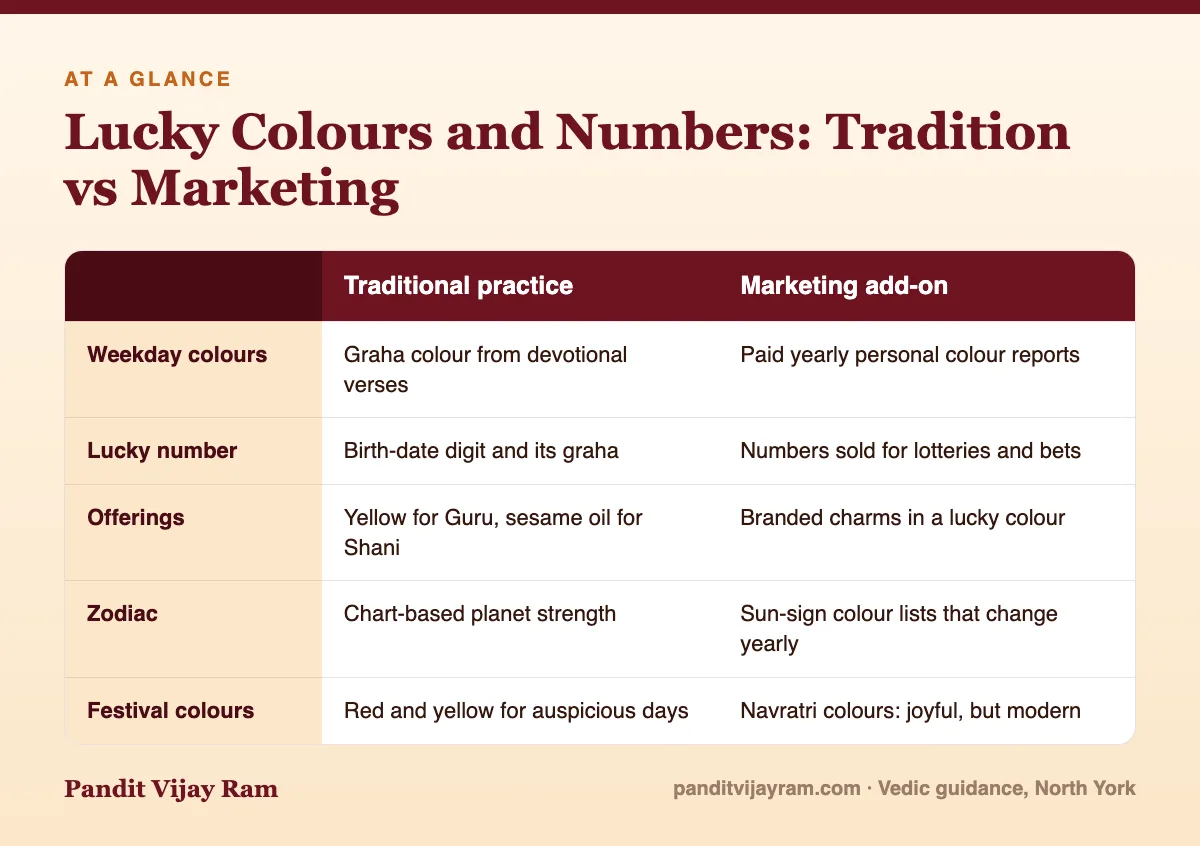
Which lucky colour and number customs are traditional and which are marketing?
Weekday planet worship, offerings in a graha's colour and fasting on a planet's day are long-standing devotional customs. Zodiac lucky-colour lists, paid personal colour plans, lottery numbers and branded lucky charms are recent and commercial. Navratri's nine daily colours are popular and joyful, but also a fairly modern custom rather than scripture.
A useful test is to ask where the advice lives. If it appears in prayers, vrat kathas or temple practice, it is probably traditional. If it appears mainly in product listings, it is probably marketing.
Rooted in practice:
- Offering yellow flowers or turmeric to Guru on Thursdays, and wearing yellow for a Brihaspati vrat.
- Sindoor and red cloth for Hanuman on Tuesdays and Saturdays in many North Indian families.
- Black sesame and mustard oil for Shani on Saturdays.
- White clothing and milk offerings for Shiva and Chandra on Mondays.
Largely commercial:
- Twelve-sign colour charts that change every year.
- "Lucky" car colours, phone numbers and wallet colours sold as wealth tools.
- Paid yearly colour reports that repeat the weekday list in new packaging.
- Lucky numbers offered for lotteries or betting.
The Navratri colour of the day sits in between. It is widely said to have spread through Maharashtra's newspapers and is loved for the community feeling it creates. Enjoy it as a festive custom without believing that the wrong colour spoils your prayer. Gemstones are another area where devotional colour and sales pressure meet; the guide to gemstone substitutes covers gentler options.
Do you have to wear your lucky colour every day?
No. Wearing a planet's colour is an optional reminder of devotion, not a requirement. Work uniforms, weather, mourning customs and personal taste all come first. A small touch such as a handkerchief, a thread or a flower on the home altar carries the same intention without changing your whole wardrobe.
I sometimes meet people who feel guilty because they wore blue on a Thursday. Please set that guilt down. Classical astrology does not say a garment decides your day. The colour is a way of keeping a planet, and the qualities it stands for, in your mind.
Here are some lighter ways to follow the custom:
- Place a flower of the day's colour at your mandir instead of changing clothes.
- Keep a coloured thread or a cloth in your bag for that graha's day.
- Choose the food offering by colour: yellow sweets on Thursday, white rice kheer on Monday.
- Use the colour for a short mantra session rather than all day.
There are also times to ignore the chart completely. Mourning customs in many Hindu families call for white whatever the weekday. Workplaces in Canada may have dress codes. Winter in the GTA dictates boots and dark coats regardless of the planet. None of that cancels your devotion.
If you are curious which graha matters most in your own chart, a gemstone and numerology consultation can suggest one colour and one number that fit your kundli, rather than seven rules to juggle.
Can a lucky number help you win the lottery or a bet?
No. Lottery draws and casino games are random, and no planet, chart or numerology method can predict them. Vedic astrology does not offer winning numbers, and anyone selling them is selling a hope. If betting has started to cause money worries or secrecy at home, ConnexOntario offers free, confidential help.
This is one of the firmest lines I hold. People sometimes ask for a lucky number to play, especially during hard financial months. I understand the wish. But a random draw has no memory and no relationship to your birth date, and offering numbers for it would be dishonest.
Some warning signs that luck-seeking has become a problem:
- Buying more tickets after a loss to "win it back".
- Hiding spending from a spouse or family.
- Borrowing to play, or delaying rent and bills.
- Feeling restless or irritable when you cannot play.
If any of these sound familiar, ConnexOntario provides free, confidential support for gambling concerns across the province, and your family doctor can also help. A non-profit credit counselling service can help you look at debts calmly.
Astrology can still play a quieter role in money matters. A chart can show periods when patience, saving or careful decisions suit you, which is very different from predicting a jackpot. The article explaining why we give no stock market or lottery tips sets out this boundary in more detail.
How can you use weekday colours as a simple daily practice?
Choose one small act for each day: a flower, a lamp or a food offering in the graha's colour, followed by that planet's short mantra. Keep it brief and steady. The value lies in a few calm minutes of attention each morning, not in matching your clothes perfectly to a chart.
A gentle weekly rhythm might look like this:
- Sunday: offer water to the rising sun in a copper lota and recite Om Suryaya Namah.
- Monday: white flowers or a little milk at the Shiva lingam or home altar.
- Tuesday: a red flower for Hanuman and a reading of the Hanuman Chalisa.
- Wednesday: a green leaf or durva grass for Ganesha, honoured on this day in many families.
- Thursday: yellow flowers or turmeric rice for Guru, and a moment of gratitude for teachers.
- Friday: white or pastel flowers for Lakshmi.
- Saturday: a sesame-oil lamp for Shani, lit safely and never left unattended.
Practise only what fits your life. A student might choose one day a week. A busy parent might simply say the planet's name while making tea. If you light lamps in a condo, keep them away from curtains and smoke alarms working, and consider an LED diya where building rules are strict.
Over time this practice becomes a calendar of attention. That steadiness, rather than any colour itself, is what most people tell me they value.
The bottom line
Vedic weekday colours come from devotional verses that picture each graha, and the lucky number usually comes from your birth-date digit and its planet. Zodiac charts, lottery numbers and paid colour plans are later marketing, not tradition. Colour works best as a small daily reminder of devotion, never as a rule that brings guilt. Hold your lucky number and colours lightly, and let steady practice do the deeper work.
Key takeaways
- Each weekday is ruled by a graha, and its colour comes from devotional verses.
- Your moolank is your birth day reduced to one digit and linked to a planet.
- Zodiac colour charts and lucky lottery numbers are commercial, not Vedic.
- Wearing the day's colour is optional; a flower or lamp carries the same intention.
- No astrology method can predict random draws or gambling results.