
Gemstones for Love Life: Diamond, Opal and White Sapphire
Jewellery counters and astrology websites both like to say that the right stone can transform a love life. People bring me photographs of opal rings and diamond pendants and ask, quite sensibly, whether any gemstone for love will actually help. Many are clients in North York and across the GTA, and a few have already spent a great deal on a stone chosen by birth month. This guide explains how Vedic astrology links diamond, opal and white sapphire with Venus, how a reader decides whether strengthening Venus suits your chart at all, how a stone is worn and tested, and what to check before you buy. In more than forty years of practice I have recommended a Venus stone far less often than people expect. For many ascendants Venus rules difficult houses, and a stronger Venus is not what the chart needs. Where it does suit, a stone is a small support for confidence and warmth. It is never a promise of romance, marriage or reunion, and I will say so plainly throughout.
Is there a gemstone for love in Vedic astrology?
Vedic astrology does not have a stone that produces love. It links each gem with a planet, and Venus, the significator of romance and the spouse, is linked with diamond. Wearing a Venus stone is meant to strengthen that planet's good results for your ascendant. Whether that improves your relationships depends on the whole chart and on you.
The classical scheme is the navaratna, nine gems for nine grahas. Diamond belongs to Venus, ruby to the Sun, pearl to the Moon, red coral to Mars, emerald to Mercury, yellow sapphire to Jupiter, blue sapphire to Saturn, hessonite to Rahu and cat's eye to Ketu.
Two ideas follow from this, and both matter for love questions:
- A stone strengthens, it does not purify. If Venus rules houses that cause trouble for your ascendant, a stronger Venus can amplify that trouble.
- Love is not only Venus. The 7th house and its lord, the Moon and the navamsa all shape relationships. A Venus stone is irrelevant if the real issue lies elsewhere.
This is why a gemstone recommendation should follow a reading, not replace one. The guide to choosing the right gemstone explains the general method, and the article on Mars and Venus in the kundli shows how Venus is read for romance specifically.
If your question is really about one person, a stone is the wrong tool. A love problem reading looks at the situation honestly, including what is and is not within your control.

Diamond, opal or white sapphire: what is the difference?
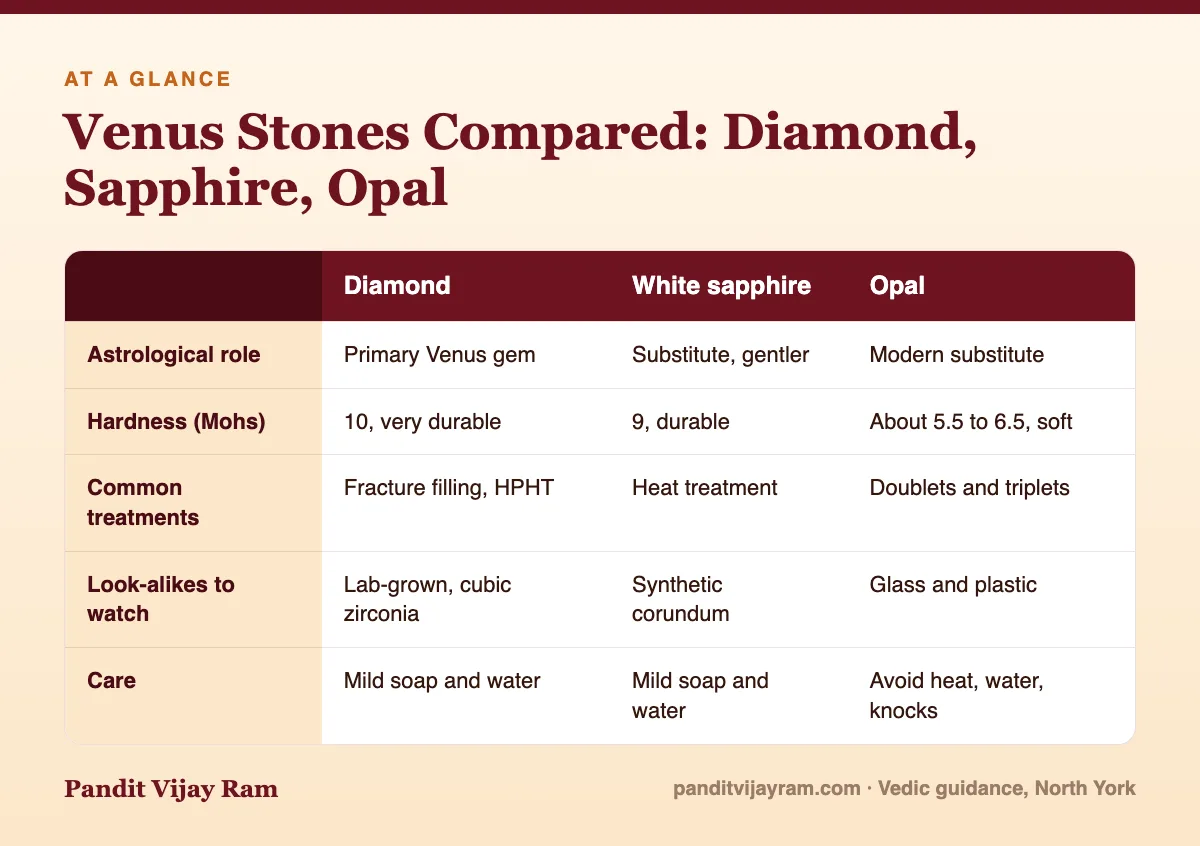
Diamond is the primary Venus gem, the hardest natural material and usually the most expensive. White sapphire is colourless corundum, very hard and a common substitute. Opal is a softer, water-bearing silica gem popular for Venus in modern practice, though not part of the classical navaratna. Natural white zircon is another traditional substitute.
The stones differ physically as well as astrologically, which affects how you wear and care for them:
- Diamond (heera): pure carbon, hardness 10 on the Mohs scale. Durable for daily wear. Treatments include fracture filling and HPHT colour change, and lab-grown diamonds are now common; many traditional astrologers prefer a natural, untreated stone, though views differ.
- White sapphire: colourless corundum, hardness 9, the same mineral as blue and yellow sapphire. Usually heat-treated. Synthetic corundum is cheap and widely sold, so documentation matters.
- Opal: amorphous silica containing some water, hardness around 5.5 to 6.5. It can scratch, crack with sudden heat or dryness, and is often sold as doublets or triplets glued to a backing.
- White zircon: a natural mineral, not the same thing as cubic zirconia, which is a synthetic diamond simulant.
In astrological practice, substitutes are generally treated as gentler than the primary gem. That can be an advantage for someone wanting a mild trial. The uparatna guide compares substitutes for every planet, including non-gem alternatives.
Which ascendants can wear a diamond or Venus stone?
Venus stones are most often considered for Taurus and Libra ascendants, where Venus is the lagna lord, and for Capricorn and Aquarius, where Venus is a yogakaraka. Gemini and Virgo are frequently included. For Aries, Scorpio, Sagittarius and Pisces, Venus rules more difficult houses, so most readers are cautious. Schools differ on the rest.
A Venus stone is judged by the houses Venus rules for your rising sign. This is a simplified table; your full chart may change the advice.
- Taurus (1st, 6th) and Libra (1st, 8th): Venus is the ascendant lord, usually supportive.
- Capricorn (5th, 10th) and Aquarius (4th, 9th): Venus is a yogakaraka, often the strongest case for a Venus stone.
- Gemini (5th, 12th) and Virgo (2nd, 9th): generally favourable, with a trine lordship.
- Cancer (4th, 11th) and Leo (3rd, 10th): mixed; depends heavily on placement.
- Aries (2nd, 7th): both maraka houses, so most readers hesitate despite the link to marriage.
- Scorpio (7th, 12th), Sagittarius (6th, 11th), Pisces (3rd, 8th): usually not advised.
Placement adds another layer. Some astrologers will not strengthen a Venus sitting in the 6th, 8th or 12th house even for a friendly ascendant; others will, if Venus is the lagna lord. Combustion, debilitation in Virgo and the navamsa position all enter the judgement. Because of these disagreements, I would never advise a Venus stone from the rising sign alone, and certainly not from the birth month. A full gemstone consultation sets out the reasoning.
How should a Venus gemstone be worn and tested?
Traditionally a Venus stone is set in silver, white gold or platinum, worn on the middle or ring finger of the working hand, and put on on a Friday morning in the bright fortnight after a short Shukra mantra. Many readers suggest a trial of several weeks first, watching sleep, mood, spending and relationships before deciding.
Customs differ on the finger. Many North Indian readers use the middle finger for Venus; others prefer the ring finger or, less often, the little finger. Follow the advice of the person who read your chart and stay consistent.
A sensible way to trial a stone:
- Begin with a substitute or a loose stone. Some people keep it in a pocket or tie it in white cloth on the arm for a few weeks.
- Keep a short journal. Note sleep, energy, spending, arguments and general mood once a day.
- Watch for overindulgence. A stronger Venus can show up as more spending or seeking comfort, not only warmth.
- Review honestly. If life feels steadier, the stone can be set. If you feel more restless or quarrelsome, remove it and discuss.
There is no fixed rule for carat weight, despite confident claims online. Bigger is not necessarily better, and a clean, untreated smaller stone is generally preferred to a large treated one.
Opal needs extra care: remove it before washing hands, swimming or exercise, and keep it away from heat. Diamonds and sapphires tolerate daily wear but still benefit from gentle cleaning with mild soap and water.
What can a Venus gemstone not do for your love life?
A Venus gemstone cannot make a specific person love you, bring back an ex, guarantee marriage or fix a relationship problem that needs conversation or counselling. Gemstones carry no proven health effects either. At best, a well-chosen stone is a reminder of Venus's qualities, such as warmth, grace and enjoyment, for someone whose chart supports it.
I say this directly because the jewellery trade often does not. Love depends on two people's choices, timing, family circumstances and plain compatibility. No mineral changes another person's free will, and trying to use one that way only adds to disappointment.
Before buying, protect yourself:
- Ask for written disclosure of any treatment, and for a report from an independent gem laboratory on costly stones.
- Know the difference between natural, treated, synthetic and simulant stones; a white sapphire and a diamond can look alike to the untrained eye.
- Check the return policy in writing before you pay.
- Walk away from anyone who uses fear, insists the stone is urgent, or claims it will bring a particular person back.
The guide on fake gemstones and buying safely covers these checks in detail.
Many people are better served by practice than by jewellery. A Friday lamp before Lakshmi, the Shukra mantra, gentler speech, charity of white food and taking real care of yourself all strengthen Venus in the traditional sense, cost little and carry no risk. If a stone still seems right after a reading, it can be added later.
The bottom line
A gemstone for love in Vedic astrology means a Venus stone, with diamond as the classical gem and white sapphire, zircon or opal as substitutes. Whether any of them suits you depends on the houses Venus rules for your ascendant, its placement and the full chart, and schools differ on borderline cases. A careful trial, written disclosure and a fair return policy protect you. No stone can make someone love you or bring a partner back, and simple Venus practices are often the better first step.
Key takeaways
- Diamond is the classical Venus gem; white sapphire, white zircon and opal are substitutes.
- Venus stones mainly suit Taurus, Libra, Capricorn and Aquarius ascendants, with caveats.
- A stone strengthens Venus's results, including difficult ones, so a reading must come first.
- Opal is soft and water-bearing and needs gentle care.
- No gemstone can make a person love you or bring an ex back.