
Dating Secretly Because of Family: Risks and a Way Forward

You have two phones' worth of habits: one for home, one for the person you love. You say you are at the library, at a friend's place or working late. Dating secretly is common among young South-Asian, Caribbean and Middle-Eastern adults in Canada, and it is rarely about rebellion. It is usually about love meeting a family that may not be ready to accept it, because of faith, caste, culture, age or simply the expectation of an arranged match. Young people from North York, Brampton and Mississauga have told me how exhausting the double life becomes. This guide is written without judgment of you or your family. It explains why secret relationships happen, the real risks they carry, how to stay safe while you are not ready to tell anyone, how to recognise when you are ready, and how to plan the conversation with your parents. It also covers what to do if you fear threats or honour-based pressure. In more than forty years of guiding families, I have seen many parents eventually accept a relationship they first opposed, but only when the conversation was handled with patience and safety in mind.
Why do so many people end up dating secretly from their family?
People usually hide a relationship because they expect disapproval: a partner from another religion, caste, community or country, a family plan for an arranged marriage, worries about reputation, or parents who believe dating itself is wrong. Many also want time to be sure of the relationship before inviting family opinions into it.
Secrecy is often a sign of love for family rather than disrespect. Many young adults want both their partner and their parents, and fear that being open now will force a choice they are not ready to make.
Common reasons I hear:
- Faith or community differences. A Hindu dating a Muslim, a Sikh dating a Christian, or a partner from a different caste or region. The guides to inter-caste marriage and parental approval and interfaith relationships explore those situations.
- Arranged-marriage expectations. Parents may already be looking at rishtas, or have promised a match informally.
- Reputation. Fear of what relatives and the community will say, especially for daughters.
- Age and studies. Parents who want children to finish education before any relationship.
- Uncertainty. Not wanting to announce something that may not last.
Short-term privacy while you get to know someone is normal and reasonable. The difficulty comes when months become years, or when secrecy starts to put your wellbeing or safety at risk.

What are the risks of a secret relationship?
The main risks are constant stress and guilt, isolation because no one can support you when things go wrong, a partner who exploits the secrecy, discovery through social media or gossip at the worst moment, and, in some families, threats or pressure once the relationship is found out. Awareness of these risks helps you plan.
Secrecy affects more than the relationship itself. Consider each of these honestly:
- Emotional strain. Lying daily wears people down. Anxiety, poor sleep and guilt are common.
- No support network. If the relationship becomes unhealthy or ends, you may feel you cannot turn to anyone. The guide to heartbreak in South-Asian families speaks to those who went through a breakup alone.
- A partner who uses the secret. Someone who threatens to tell your parents, demands money or intimate images, or controls you through fear of exposure is being abusive. The signs are listed in signs of a controlling partner.
- Image-based threats. Threatening to share intimate photos is a crime in Canada. Do not pay or comply; save evidence and contact police.
- Unplanned discovery. A tagged photo, a relative seeing you at a mall, or a phone left unlocked can reveal everything at once, without the calm conversation you hoped for.
- Family reaction. Most parents respond with anger or hurt that softens over time. A few respond with threats, confinement or pressure to marry someone else quickly.
Knowing these risks is not a reason to panic. It is a reason to protect yourself while you decide what to do.
How can you stay safe while dating secretly?
Tell at least one trusted adult, such as a sibling, cousin or close friend, who knows your partner's name and where you go. Meet in public places early on, avoid sharing intimate images, keep your own money and passwords, and notice whether your partner respects your boundaries about the secret.
Privacy and safety can go together. A simple safety plan:
- One trusted person. Someone outside the relationship who knows who you are with and can help if something goes wrong.
- Public places first. Especially with someone you met online. Romance scams and fake profiles target young people in the diaspora; the guide on dating as a newcomer in the GTA explains common warning signs.
- Protect your images. Do not share anything you would not want seen widely, however much you trust your partner today.
- Keep your independence. Your own bank account, your own passwords and your own plans for school or work.
- Watch how your partner treats the secret. A caring partner accepts that you need time. One who pressures you to tell everyone immediately, or never at all, deserves a closer look.
- Keep important documents safe. Know where your passport and identification are, particularly if you worry about a sudden trip abroad.
If you feel low or overwhelmed by the double life, speak with your family doctor or a campus counsellor. In a crisis, call or text 988 at any hour.
When is the right time to tell your parents about your relationship?
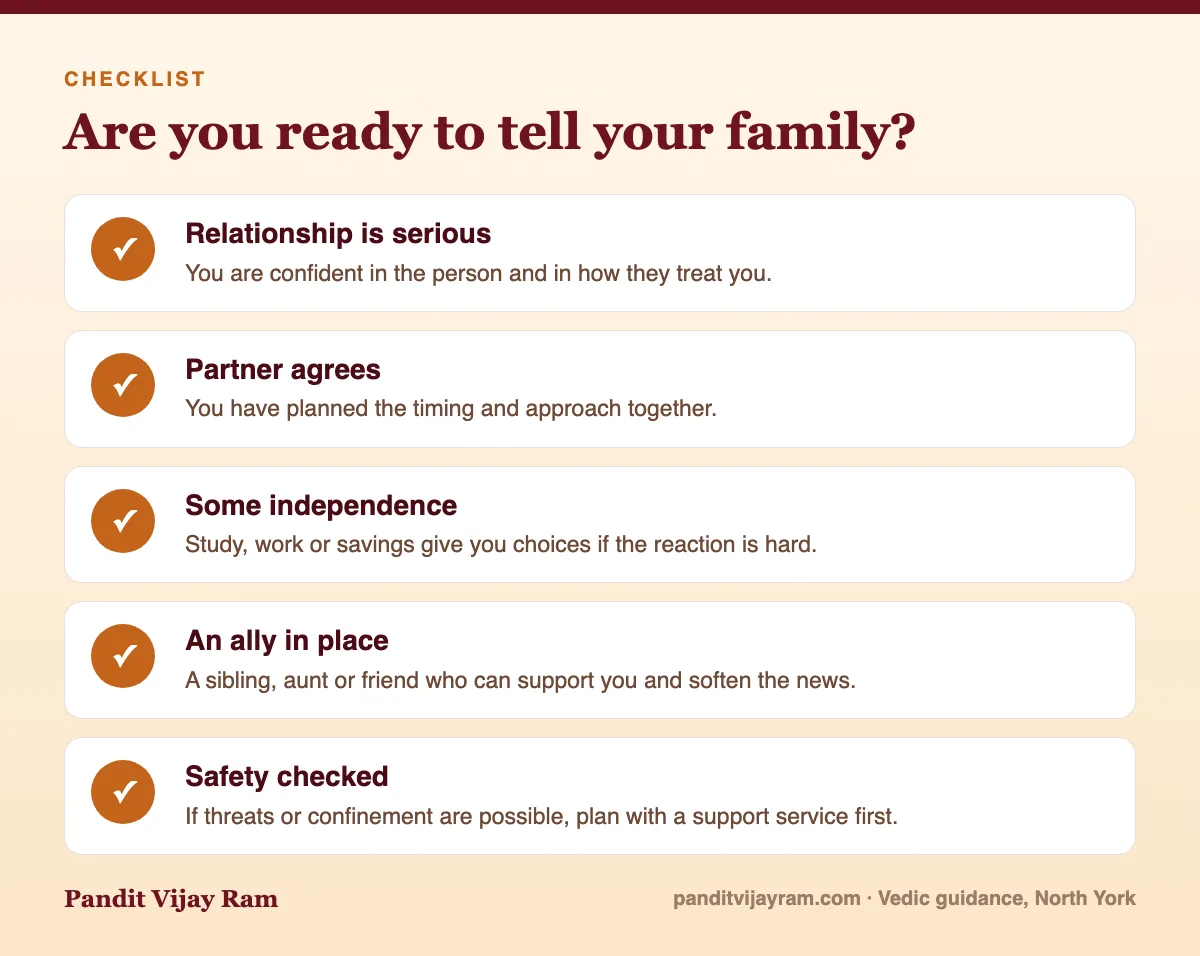
You are usually ready when the relationship is serious and stable, you are confident your partner respects your family, you have some independence through study, work or savings, and you have a support person ready. If you expect violence or confinement, plan for safety before telling anyone, ideally with a support service.
There is rarely a perfect moment, but there are better and worse ones. A simple decision guide:
- Is the relationship serious? If you are not yet sure about the person, there may be no need to tell family yet.
- Has your partner agreed? Telling family affects them too. Plan it together.
- Do you have some independence? Being in school, working or having savings gives you more choice if the reaction is difficult.
- Is there an ally? A sibling, aunt, uncle or family friend who can soften the first reaction.
- Is it safe? If your family has threatened or harmed anyone over relationships before, treat telling them as a safety matter.
- Is the timing calm? Avoid weddings, funerals, exams or the middle of a family crisis.
For many people, the right order is to tell a trusted sibling first, then one parent who tends to be calmer, and only later the wider family.
Astrology cannot choose a safe date to confess, but some families feel more open if they know a kundli has been seen. A love problem reading can help you reflect on the relationship and your family's concerns, without replacing your own judgment.
How do you tell your family, and what if they react with threats?
Choose a calm, private moment, start with your love and respect for them, share a little about your partner's character, acknowledge their worries and give them time. If anyone threatens you, confines you, takes your documents or pressures you into marriage, contact police or a support service immediately. Your safety comes first.
A first conversation is not a final decision. It plants a seed. A gentle approach:
- Start with respect: "I love you, and I want to be honest with you about something important."
- Share who your partner is as a person: their education, values, kindness and how they treat you.
- Acknowledge their concerns without arguing: "I know you worry about what this means for our family."
- Ask for time, not instant approval. Suggest a later meeting rather than demanding one now.
- Step away if voices rise. You can return to the conversation another day.
The longer guide to convincing parents for a love marriage covers the following weeks, including involving elders.
Some families react with more than anger. Honour-based pressure can include threats, monitoring, confinement, being taken abroad or being pushed into a quick marriage. Forced marriage is a crime in Canada, and you have the right to refuse any marriage. If you are in danger, call 911. The guide to domestic-violence help in the GTA lists confidential services, including some with experience of honour-based situations. Canadians abroad who are being forced to marry can seek help from Canadian consular services.
I will never help anyone pressure a son or daughter into giving up a partner, nor help a couple trick parents. Honest, safe conversation is the only path I support.
The bottom line
Dating secretly is a common response to family disapproval, but long-term secrecy brings stress, isolation and real safety risks. Protect yourself with a trusted confidant, careful online habits and your own independence. When the relationship is serious and you have support, tell your family calmly and in stages, and treat any threats or pressure to marry as a safety matter that needs police or a support service.
Key takeaways
- Secret relationships usually come from love for family, not disrespect.
- Secrecy brings stress, isolation and openings for a controlling partner.
- Tell one trusted person and keep your own money, passwords and documents.
- Tell family when the relationship is serious, you have support and it is safe.
- Threats, confinement or forced marriage call for police or a support service.