
Business Partnership Disputes: Chart Timing and Peaceful Resolution

A partnership often starts with friendship, family ties or shared hope, which is exactly why a dispute between partners hurts so much. Money is at stake, but so are years of trust, and sometimes relationships between two families. Owners in North York and across the GTA bring business partnership problems to me in many forms: a partner who stopped pulling their weight, a disagreement about expansion, a suspicion about the accounts. My first advice is always the same. Protect the business and yourself with proper documents and independent legal advice, and look for a neutral mediator before positions harden. This guide explains those first steps, how mediation works, and what the 7th house and related factors are said to show about partners in a kundli. It also looks honestly at partnership kundli matching, which is quite different from marriage matching. In more than forty years of practice, I have found that partners who agree to speak through a mediator early usually part, or continue, with far less bitterness. Prayer has a place too, as a way to keep anger from making decisions for you.
What causes business partnership problems?
Most partnership disputes come from unequal effort, disagreements about money or drawings, different visions for growth, family members becoming involved, unclear roles and the absence of a written agreement. Stress outside the business, such as health or marriage problems, often adds to them. Naming the real issue is the first step toward resolving it.
When I listen to two partners describe the same dispute, each usually feels the other has broken an unspoken promise. The promise was rarely written down. Common pressure points include:
- Effort imbalance. One partner works long hours in the shop while the other has another job or steps back.
- Money and drawings. Disagreements about salaries, personal expenses through the business or reinvesting profits.
- Direction. One wants to expand or borrow; the other wants to stay small and safe.
- Roles. Nobody agreed who decides on hiring, pricing or suppliers.
- Family involvement. Spouses, parents or children start working in the business or giving opinions.
- Transparency. One partner controls the books, and the other feels shut out.
- Life changes. Illness, divorce or a move changes what a partner can give.
Many of these are communication problems before they become legal ones. Writing down, separately, what each partner believes the original deal was can reveal where the misunderstanding started.
A struggling business makes every disagreement sharper. If sales are falling at the same time, our guide to auditing a business that is not doing well can help both partners look at the same numbers rather than argue from impressions.

What should partners do first when a dispute begins?
Stay calm and protect the business. Read any partnership or shareholder agreement, keep records of decisions and finances, avoid moving money or locking anyone out, and each get independent legal advice. Ask your accountant for an up-to-date picture of the accounts. Then propose a meeting with a neutral mediator before anything escalates.
The first weeks of a dispute often decide whether it ends in a fair settlement or a long court fight. This order of steps protects everyone:
- Pause big decisions. Agree in writing not to take on new debt, sell assets or hire and fire without both partners' consent while you talk.
- Find the documents. Partnership agreements, shareholder agreements, incorporation papers, loans you signed personally and bank mandates.
- Get the numbers. Ask the business's accountant for current statements both partners can see.
- Take independent legal advice. Each partner should have their own lawyer. One lawyer cannot represent both sides of a dispute.
- Keep a log. Dates, emails and decisions. Stay factual and polite in writing.
- Propose mediation. A neutral third party can often settle what partners cannot.
A simple rule: if you discover missing money, threats or locked accounts, speak to your lawyer immediately and, where there is a threat, the police. Do not try to settle these through confrontation.
I do not give legal advice, and nothing here should be read as such. Lawyers can explain your rights under the agreement and the law that applies in Ontario. If the dispute is moving toward court, our article on court case astrology explains why a lawyer comes first and how prayer can support calm.
No agreement?
Without a written agreement, provincial partnership or corporate law may decide many questions. A lawyer can explain what applies.
How does mediation help resolve a partnership dispute?
Mediation is a voluntary, confidential process in which a neutral mediator helps partners talk through their dispute and reach their own agreement. The mediator does not decide who is right. It is usually faster and less costly than court, and it often preserves enough goodwill for partners to keep working together or separate fairly.
Mediation is one form of alternative dispute resolution. Others include negotiation through lawyers and arbitration, where an arbitrator makes a binding decision. Mediation is different because the partners keep control of the outcome.
A typical process looks like this:
- Both partners agree on a mediator, often a lawyer or accredited professional with business experience.
- Each shares a short summary of the issues and what they want.
- In joint and separate sessions, the mediator helps clarify interests, not just positions. "I want my investment back" might really mean "I need security for my family."
- Options are explored: a buyout, new roles, a revised profit split, or an orderly wind-up.
- Any agreement is written down, and each partner's lawyer reviews it before signing.
Mediation works best when both sides come willing to listen. If one partner refuses entirely, a lawyer can explain the next options.
Families of partners deserve care too. When siblings or cousins own a business together, disputes can split the wider family. Our guide to family property disputes discusses keeping relationships intact while legal questions are settled.
Before a mediation session, many people find it helps to sit quietly, light a lamp and set an intention to speak honestly and listen without interrupting. That is a small spiritual practice with very practical benefits.
What does the 7th house show about business partners?
In Vedic astrology, the 7th house governs all formal partnerships, including business partners, contracts and dealings with the public. Astrologers read its sign, its lord and planets placed there, along with Mercury for trade and the 6th house for disputes. A tense dasha may describe friction, but the chart never says who is at fault.
The 7th house is best known as the house of marriage, but classical texts give it a wider meaning: the other person in any one-to-one bond. That includes business partners, clients and contracts. Our guide to the twelve houses explains how each house carries several themes.
For partner dispute astrology, I usually look at:
- The 7th lord. Its strength and placement describe how partnerships tend to unfold. A 7th lord in the 6th, 8th or 12th is often read as partnerships needing extra care.
- Planets in the 7th. Mars may bring energy and argument, Saturn caution and delay, Jupiter good faith, Rahu unusual or unequal arrangements.
- Mercury. The karaka of trade, contracts and negotiation.
- The 6th house. Disputes, competition and litigation.
- The 11th house. Gains, networks and friendships that support business.
- Current dasha. A period of the 6th lord, or of a planet afflicting the 7th, may coincide with friction.
These readings describe tendencies in your own chart. They cannot reveal another person's intentions or prove dishonesty. Used well, they help you recognise your own patterns, such as avoiding conflict until it explodes, and choose a calmer way forward.
Can partnership kundli matching help choose a business partner?
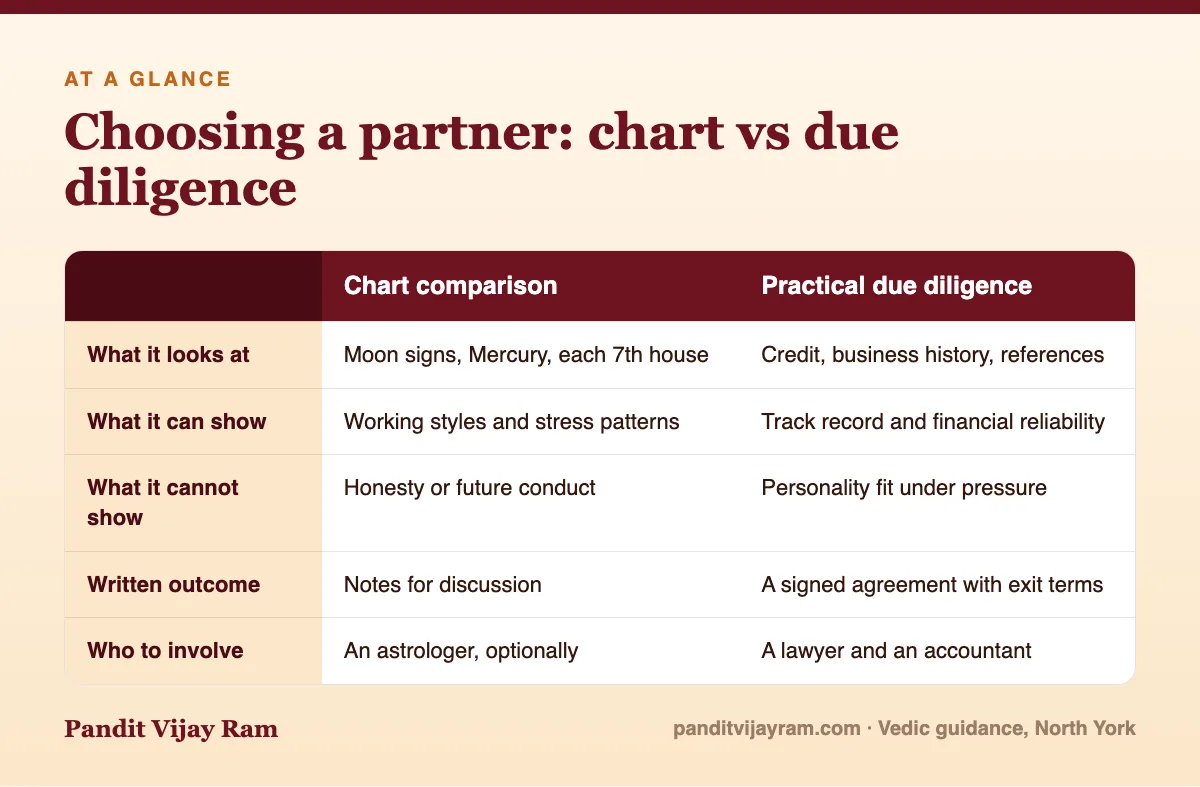
Some astrologers compare two charts before a partnership, looking at Moon signs, lagnas, Mercury and each person's 7th house. This is not the same as marriage guna milan. It can start a useful conversation about working styles, but due diligence, a written agreement and clear roles matter far more than any chart comparison.
Families sometimes ask for partnership kundli matching in the same way they would for a marriage. The Ashtakoota guna milan system, with its 36 points, was designed for marriage and does not transfer neatly to business. When I compare two charts for a partnership, I look at a few practical themes instead:
- How each person's Moon sign handles stress and change.
- Whether Mercury is strong in both charts, suggesting comfort with negotiation.
- How each lagna lord relates to the other's chart.
- Each person's own 7th house, describing how they behave in partnerships generally.
Whatever the charts suggest, practical steps come first. Check each other's credit and business history, meet each other's families, agree roles and a profit split, and sign a partnership or shareholder agreement with exit terms before any money changes hands. A lawyer should draft it.
For peaceful resolution once a dispute has started, gentle practices help. A Ganesh prayer before meetings, the Shanti mantra "Om Sahana Vavatu", and avoiding angry messages late at night all support calm. If you want a personal reading of timing and temperament, the business and career consultation can look at your chart, and the relationship compatibility service can compare two charts with care.
The bottom line
Business partnership problems are best handled early, with documents in hand, independent legal advice for each partner and a neutral mediator. Mediation keeps control with the partners and often saves both the business and the relationship. The 7th house, Mercury and the 6th house describe how partnerships and disputes tend to feel in a chart, but they never assign blame. Use chart comparison and prayer as support, and let a lawyer, an accountant and a written agreement carry the weight.
Key takeaways
- Read your partnership or shareholder agreement and get independent legal advice first.
- Pause big decisions and avoid moving money while a dispute is being discussed.
- A mediator helps partners reach their own agreement without deciding who is right.
- The 7th house governs business partners as well as marriage in Vedic astrology.
- Marriage guna milan does not transfer to business; due diligence matters more.