
Children Seeing Things: Imaginary Friends or Spirits?

Your four-year-old chats happily to someone in the corner. Your seven-year-old insists a lady stands by the bedroom door at night. When a child sees ghosts or describes an invisible friend, parents often feel a jolt of fear, especially if grandparents start talking about spirits. Families in North York, Richmond Hill and Etobicoke bring me this worry regularly, and my first answer is nearly always reassuring. Children's minds work differently from ours, and much of what looks mysterious is healthy growth. In this guide you will learn what child development tells us about imaginary companions and night fears, the signs that mean you should book a paediatrician, how to talk with your child so they feel safe rather than scared, and a gentle bedtime prayer routine that comforts without creating fear. In more than forty years of practice I have seen how quickly a child settles when the adults around them stay calm, and how easily well-meant spiritual drama can teach a child to be afraid of their own room.
Is it normal for a child to have an imaginary friend?
Yes. Imaginary friends are very common, especially between about three and seven years old, and some older children keep them too. They are linked to creativity, language and social practice, not to illness. A child usually knows the friend is pretend, even when they talk about it with total conviction.
Imaginary companions take many forms: a named friend, an invisible animal, a talking toy or a character who sits at dinner. Children use them to rehearse conversations, process feelings, cope with change and enjoy their own stories.
What healthy imaginary play usually looks like
- The child is cheerful or neutral about the friend, not terrified.
- The friend appears during play, quiet time or bedtime routines.
- The child still plays with real children and enjoys daily activities.
- The friend changes or fades as the child grows, often without anyone noticing.
Imaginary friends often appear after a big change: a new sibling, a move, starting school, or a parent working away. They can also show up after the death of a grandparent, sometimes with the grandparent's name. That is a child's way of keeping someone close, much as adults do with photographs and memories.
Join in lightly if invited, ask friendly questions and avoid mocking or banning the friend. Children tell parents more when they feel safe. If the friend says frightening or hurtful things, or the child seems controlled by it, mention it to your paediatrician.
Many South Asian elders believe young children are more open to the unseen. I respect that belief, and I still encourage parents to treat a happy imaginary friend as play first.

Why is my child suddenly scared at night and seeing things?
Night fears are very common between about three and six, as imagination grows faster than the ability to separate fantasy from reality. Children may see shapes in shadows, wake from nightmares, or have night terrors in which they scream without truly waking. Tiredness, stress, illness and scary media all make these episodes more frequent.
Three different things often get grouped together as seeing ghosts:
- Nightmares. Bad dreams in the second half of the night. The child wakes, remembers the dream and wants comfort.
- Night terrors. Usually earlier in the night. The child may sit up screaming, stare or seem not to recognise you, then has no memory in the morning. They are distressing to watch but are generally harmless and outgrown.
- Shadows and shapes. A coat on a door or headlights on the ceiling become a figure to a sleepy child.
Common triggers
- late bedtimes, missed naps or overtiredness;
- fever and illness, which can cause brief confused or frightened states;
- stress such as a new school, a new baby or parents arguing;
- videos, games or stories that are too scary for their age, including adult conversations about ghosts.
What helps
- Keep a consistent bedtime and calming routine.
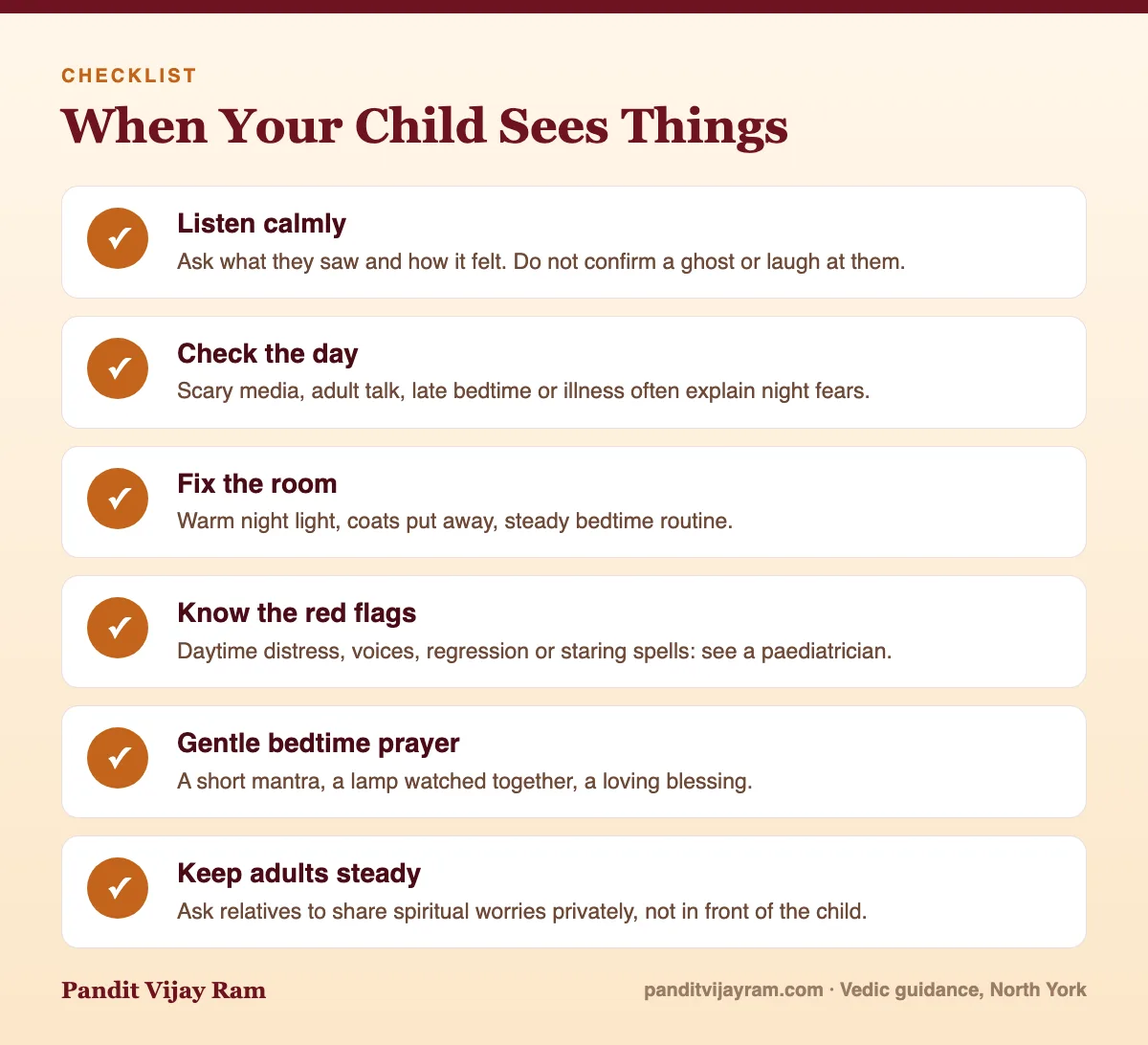
- Use a warm night light and tidy away items that cast odd shadows.
- Check what your child watched or heard during the day.
- During a night terror, keep them safe and stay close, but do not try to wake them.
Many families with babies also use gentle protective customs explained in negative energy, babies and new mothers.
When should I take my child to a paediatrician about seeing things?
See your paediatrician or family doctor if sightings happen in daylight and distress your child, if they hear voices telling them to do things, if behaviour, speech or toileting regress, or if sleep is badly disrupted. Also seek care for loud snoring, staring spells, or seeing things during a fever that does not settle.
Most children who talk about ghosts are healthy. These signs, though, deserve a professional opinion. Writing them down before the appointment helps.
Book an appointment if your child:
- is frightened by what they see during the day, not only at bedtime;
- hears voices that are unkind or tell them to do things;
- loses skills they had, such as speech or toilet training;
- has staring spells, blank moments or unusual jerking movements;
- snores loudly, gasps or stops breathing in sleep;
- has frequent night terrors or sleepwalking that puts them at risk;
- has become withdrawn, anxious or angry after a loss, a move or a frightening event;
- struggles to see or hear clearly, which can make shapes and sounds confusing.
Seek urgent care or call 911 if a child is very drowsy, confused with a high fever, has a seizure, or has injured themselves.
A paediatrician may check vision and hearing, ask about sleep, and refer to a child psychologist if anxiety or trauma seems involved. Asking for help is not a judgement on your parenting or your faith. In my consultations I always ask whether the child has seen a doctor before we talk about any spiritual step, and the family guidance page reflects that order.
How do I talk to my child about ghosts without scaring them?
Stay calm, listen and ask open questions such as what it looked like and how it made them feel. Avoid confirming that a ghost or spirit is present, and avoid laughing at them. Reassure them that they are safe, that you are nearby, and that home is protected by your love and, if you pray, by God.
Children take their emotional cue from adults. If a parent gasps, calls a grandparent in a panic or starts a ritual in the child's room, the child learns that something terrible is there. If the parent stays steady, the child relaxes.
Helpful phrases
- Tell me about it. What did you see?
- How did you feel when that happened?
- Sometimes our eyes and dreams play tricks at night. You are safe here.
- Shall we turn on your night light and say our prayer together?
Things to avoid
- saying a ghost, bhoot or jinn is in the room;
- discussing spirits, black magic or curses in front of the child;
- moving them out of their room permanently, which can confirm the fear;
- shaming them for being scared or for having an imaginary friend.
Agree on a family story about safety. For some families that is God's protection; for others it is a favourite toy on guard or a special blanket. Keep it positive and simple.
Grandparents and relatives may have strong spiritual views. Thank them, and ask them to share their concerns with you privately rather than with the child. Children who are already prone to night fears pick up adult worry very quickly. Related advice on dark shapes is in shadow figures at night.
What is a gentle bedtime prayer to protect children?
Keep it short, warm and the same each night. Many Hindu families recite Om Gam Ganapataye Namah or a few lines of the Hanuman Chalisa, light a lamp briefly at the prayer place, and touch a little holy water to the child's forehead. Present it as a loving goodnight ritual, never as protection against monsters.
A bedtime prayer for a child should feel like a hug in words. It works best when the child looks forward to it.
A simple routine
- Wash up. Hands, feet and face, then pyjamas.
- Light a lamp together. Let the child watch a diya at the family shrine for a minute, then an adult puts it out. Never leave a flame near a sleeping child.
- Say a short prayer. Three repetitions of Om Gam Ganapataye Namah, or the opening doha of the Hanuman Chalisa, or a simple thank-you to God for the day.
- A blessing. A drop of Ganga jal or a touch of the parent's hand on the head.
- Lights low, story or song, sleep.
Families who follow nazar customs may use a black dot of kajal behind the ear or a black thread on the wrist, explained in kala tika against nazar. Keep threads loose and remove anything a young child could choke on.
Sikh, Muslim and Christian families can use their own short bedtime prayers in the same spirit. If fear continues after medical checks and steady routines, a calm consultation can look at the family's wider situation. The negative energy guidance page explains how that starts, and more articles are in the magic and entities hub.
The bottom line
When a child sees ghosts or talks to an invisible friend, development is the first and most likely explanation. Imaginary companions, nightmares, night terrors and shadow shapes are common and usually fade with time and steady routines. A paediatrician should hear about daytime distress, voices, regression, staring spells or poor sleep. At home, stay calm, never frighten the child with talk of spirits, and offer a short, loving bedtime prayer.
Key takeaways
- Imaginary friends are common and usually a healthy sign of imagination.
- Night fears and night terrors peak in early childhood and are often outgrown.
- Daytime distress, voices, regression or staring spells need a paediatrician.
- Never tell a child a ghost is present; stay calm and reassuring.
- A short, warm bedtime prayer comforts without creating fear.