
Best Time to Propose: Muhurat and Common Sense

Proposals have become events. There are rooftop dinners, flash mobs, drone photographers and long debates online about the perfect date. Couples in North York and across the GTA also ask me a more traditional question: is there an auspicious day for it? Both questions matter, but neither comes first. The best time to propose is when the answer is already quietly known, because you have talked about marriage, families, money and the future together. This guide keeps things light and practical. It covers how to tell if you are both ready, how to choose a setting your partner will genuinely love, how to handle families in South Asian households, and how to pick a simple muhurat if that would make the moment feel blessed. It also explains why a proposal should never be used to fix a shaky relationship. In more than forty years of guiding couples, I have found that the proposals remembered most fondly were rarely the grandest. They were the ones that felt completely like the two people involved.
How do you know when it is the right time to propose?
It is the right time when you have already discussed marriage seriously, agree on major questions such as children, money, faith and where to live, have seen each other handle stress and conflict, and both feel ready rather than pressured. A proposal should confirm a shared decision, not surprise your partner with the idea of marriage.
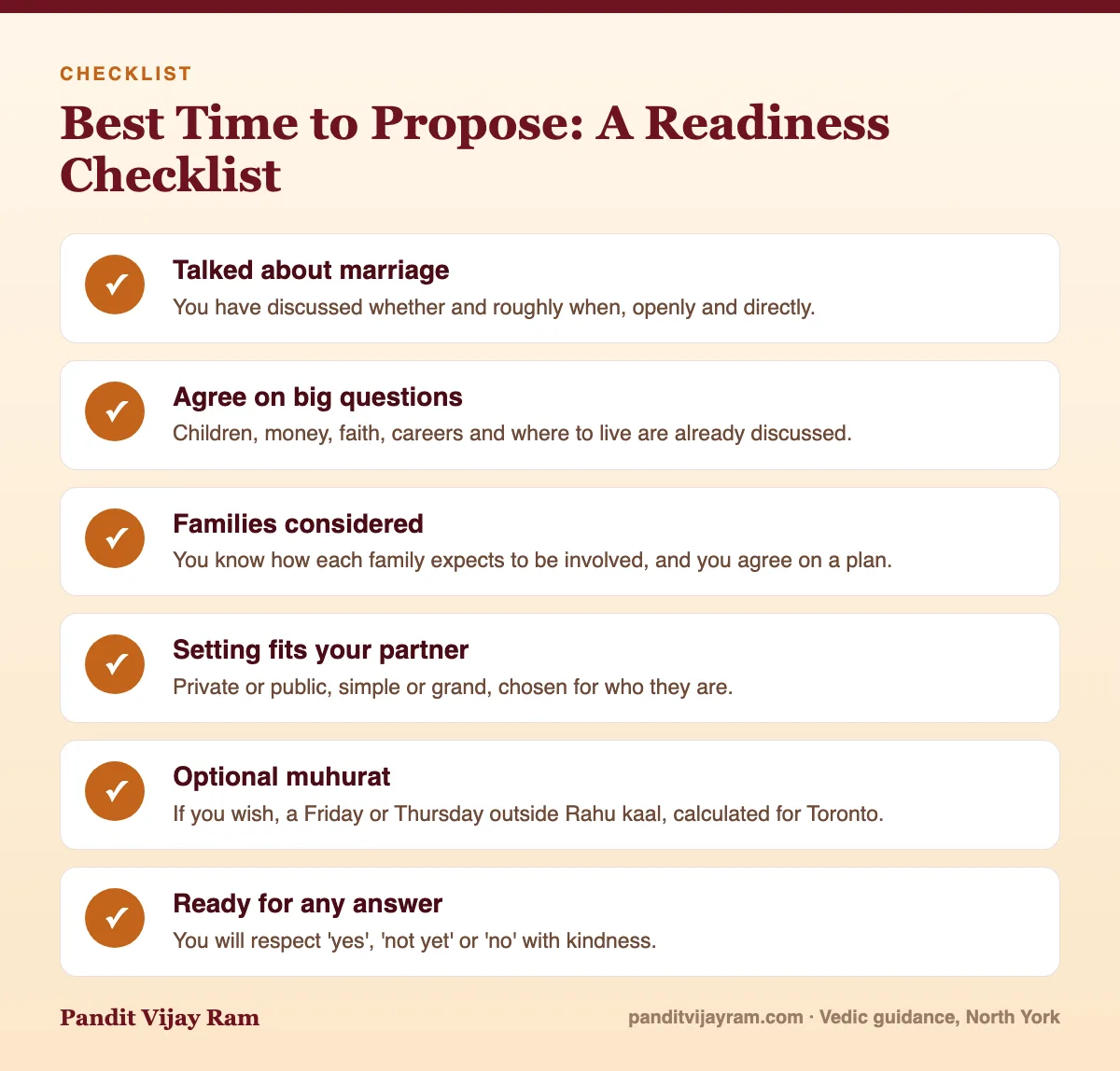
The surprise in a proposal should be the moment, not the question. A short readiness check helps.
- Have you talked about marriage directly? Not just hinted, but discussed whether and roughly when.
- Do you agree on the big things? Children, careers, religion, where to live, money and support for parents.
- Have you seen hard days together? Illness, family stress, a serious argument and how you repaired it.
- Are you both ready, not just one of you? Readiness that comes from outside pressure is not readiness.
- Is the relationship calm and safe? A proposal will not fix control, frequent fights or doubt.
If you answered no to any of these, wait and talk more. That is not failure; it is good preparation.
If your partner keeps postponing the conversation, our guide on a partner who is not ready for marriage helps you raise it honestly. Couples who want structured help with these topics can also consider premarital counselling before or after the proposal.
One rule needs no exceptions. A proposal is a question. Your partner has every right to say 'not yet' or 'no', and that answer must be respected without anger or pressure.

Is there an auspicious day or muhurat to propose?
Classical texts set muhurats for engagement and wedding ceremonies rather than for a private proposal, but many families like to choose a favourable day. Common choices are a Friday for Venus or a Thursday for Jupiter, a waxing Moon, an auspicious nakshatra and a time outside Rahu kaal. It is a gentle blessing, not a requirement.
If a muhurat would make the moment feel right for you, a simple approach works well.
- Weekday. Friday is linked with Venus, the planet of love and harmony. Thursday is linked with Jupiter, read as blessing and wisdom. Monday, for the Moon, suits emotional occasions.
- Lunar phase. Many families prefer the bright half of the lunar month, shukla paksha, when the Moon is growing.
- Tithi. The rikta tithis, the fourth, ninth and fourteenth lunar days, and amavasya are usually avoided for new beginnings.
- Nakshatra. Rohini, Hasta, Swati, Anuradha and Revati are among those often favoured for marriage-related events, though lists differ between traditions.
- Time of day. Avoid Rahu kaal, a daily period of about an hour and a half. Some families also check the choghadiya, which divides day and night into eight parts each.
All of these must be calculated for Toronto time, not copied from an Indian calendar. Check a current Toronto panchang, or ask an astrologer.
A formal roka, sagai or engagement ceremony is different. Families often want a proper muhurat for those, as they do for the wedding itself. Our guide to the wedding muhurat in Canada explains why local calculation matters.
Should you propose on Valentine's Day, a birthday or a holiday?
Special days are popular because they feel romantic and easy to remember, but they come with drawbacks: crowded restaurants, high prices, and a proposal that may overshadow a birthday or festival. Choose a day by your partner's taste. Some love a shared celebration; others prefer an ordinary day made special only by the question.
Here is a simple way to weigh the options.
- Valentine's Day. Romantic and expected, which can spoil the surprise. Restaurants are busy and some partners find it a little clichéd.
- A birthday. Personal, but some people prefer their birthday to stay theirs alone. Ask a close friend how your partner feels.
- Festivals such as Diwali or Vaisakhi. Joyful and full of family, which suits couples who want relatives present. It can also feel public and busy.
- An anniversary of your first meeting. Meaningful only to the two of you, which many people love.
- An ordinary day. Often the most relaxed. No crowds, no expectations.
Toronto weather deserves a mention too. An outdoor proposal by the lake in deep winter needs a backup plan, and a summer park may be crowded. If you choose a public place, check the venue's rules for photographers or set-ups ahead of time.
Above all, think about who your partner is. A shy person may dread a crowd watching. A sociable one may love a gathering of friends waiting nearby. The best setting is the one that feels like them.
Should you ask parents before proposing in South Asian families?
In many South Asian families, parents expect to be involved, and some couples speak to both families before any proposal. Others propose privately first and then involve parents together. Discuss it with your partner in advance, respect their wishes about their own family, and never use a public proposal to force a family's acceptance.
Family involvement varies widely between households, communities and generations. Some families arrange a formal meeting, sometimes followed by a roka or sagai, where elders agree the match. Some modern couples propose privately and announce the news together. Many do something in between.
A few practical points:
- Talk with your partner first about how each family usually handles these moments.
- Let each person lead with their own parents. Your partner knows their family's sensitivities best.
- Avoid surprises that trap people. A public proposal in front of disapproving relatives can create lasting hurt on all sides.
- Consider kundli matching early if either family values it, so it does not become a shock after the ring. Our guide to kundli matching for a love marriage explains its role as insight rather than veto.
Where a family strongly opposes the match, read our guide to convincing parents for a love marriage. If anyone faces threats or coercion over the relationship, safety comes first and the police can help.
Asking blessing from elders can be a lovely gesture, but the decision to marry belongs to the two adults.
How do you plan a proposal your partner will remember?
Plan around your partner's personality, keep it personal rather than expensive, prepare a few honest words, sort out the ring size and logistics quietly, and have a backup for weather. Decide in advance whether you want photos or privacy. Most of all, stay present in the moment; the memory is made by sincerity, not by the scale.
A short planning list for a calm proposal:
- Pick the setting that suits your partner: home, a favourite walk, a quiet restaurant or a family gathering.
- Choose a meaningful detail. A song, a place, a small token from your first meeting.
- Prepare a few sentences. Say why you love them and what you hope for together. Simple, true words matter more than a speech.
- Sort out the ring quietly. Borrow a ring they wear for sizing, or plan to choose it together. Some families prefer to exchange rings at a formal engagement instead.
- Plan the weather and timing. Have an indoor option.
- Decide on photos. A hidden photographer can be lovely, or intrusive. Know your partner.
- Leave room for their answer. Pause and listen.
If you would like a muhurat or a simple prayer before the day, you might light a diya at home on a Friday morning and ask for harmony for both of you. That is a private blessing, not a condition for success.
For couples who want guidance on compatibility, family conversations or timing before taking this step, Vijay Ram ji's love marriage guidance page explains how consultations work.
The bottom line
The best time to propose is when you have already talked about marriage and agree on the big questions, so the proposal confirms a shared choice. Choose a day and setting that suit your partner's personality, and handle family involvement together in a way that respects both households. A muhurat, calculated for Toronto time, can add a sense of blessing but remains entirely optional. Sincerity and readiness matter far more than any date or display.
Key takeaways
- Propose after you have openly discussed marriage together.
- Choose the setting by your partner's personality, not trends.
- A muhurat is optional and must be calculated for Toronto time.
- Agree how and when to involve both families.
- Respect any answer, including 'not yet'.