
Aghoris and Tantric Sadhus: Facts, Fears and Respect
Television documentaries and viral videos have turned the Aghori into one of the most sensational figures in Hindu life: ash-covered, living by cremation grounds, said to eat what no one else will touch. Many people in North York and across the diaspora have seen such clips and now feel either fascination or fear. Others meet online adverts from an "Aghori baba" offering to remove or send black magic. This article separates fact from spectacle. You will learn where the Aghor tradition comes from, its link with the older Kapalikas, what Aghori practice aims at, which stories are exaggerated or unfair, and why using the Aghori image to sell fear is a misuse of a real ascetic path. I am a Vedic practitioner and householder, not an Aghori, so I write as a respectful outsider. In more than forty years I have learned that renunciates of every kind deserve respect for their discipline, even when their path looks strange to us. None of them need to frighten anyone.
Who are the Aghoris?
Aghoris are Hindu ascetics devoted to Shiva, especially in his fierce form as Bhairava, who follow the Aghor path of radical non-discrimination. The Sanskrit aghora means not terrible, and is also a name of Shiva. Aghoris seek liberation by seeing the divine in everything, including what society calls impure.
The word aghora appears in old Shaiva hymns as one of Shiva's five faces, and in the Shvetashvatara Upanishad Shiva's auspicious form is called aghora. The Aghor tradition takes that name as its ideal: to become free of fear, disgust and judgement by recognising Shiva in every condition of life and death.
Aghoris are a small minority among Indian sadhus. Most live as wandering ascetics or in ashrams, often in or near Varanasi, which has long been their spiritual centre. Many revere Dattatreya, a figure combining Brahma, Vishnu and Shiva, as an early teacher of the path, and Baba Kinaram as a founding saint of the modern lineage. The ashram associated with Kinaram in Varanasi remains an important centre.
Common features of Aghori life include:
- renunciation of family, property and caste identity;
- meditation and ritual at the shmashana, the cremation ground;
- smearing the body with ash, a reminder of mortality;
- use of a skull bowl, or kapala, among some practitioners;
- devotion to Shiva and to the Goddess in fierce forms.
Fierce forms of the divine are a theme across Hindu devotion. The guide to Kali and protection explains why fierce does not mean evil.
How are Aghoris related to the Kapalikas and tantra?
Many historians see the Aghoris as heirs to the Kapalikas, medieval Shaiva ascetics known for carrying skull bowls and worshipping Bhairava. Both belong to the wider world of Shaiva tantra, especially its left-hand forms. The Aghor tradition as known today took clearer shape in later centuries, around figures such as Baba Kinaram.
The Kapalikas, "skull-bearers", appear in Sanskrit literature, inscriptions and the accounts of rival religious writers. They were described as wearing bone ornaments, carrying a skull as a begging bowl and following a vow modelled on Shiva's penance after he severed one of Brahma's heads. Much of what we know comes from critics and satirical plays, so historians treat the lurid details with caution.
Points scholars generally agree on:
- The Kapalikas were a real Shaiva ascetic order with tantric practices.
- They largely disappeared as an organised group, while some of their ideals continued.
- The Aghoris share their cremation-ground focus and fierce devotion.
- Direct, unbroken descent is hard to prove and is debated.
Aghoris also belong to the tantric family of traditions, especially the vamachara or left-hand path, which uses what convention forbids to dissolve attachment. That is a spiritual method, not sorcery. The site's explainer on why tantra is not black magic describes the wider field and its misuse online.
What do Aghoris actually practise?
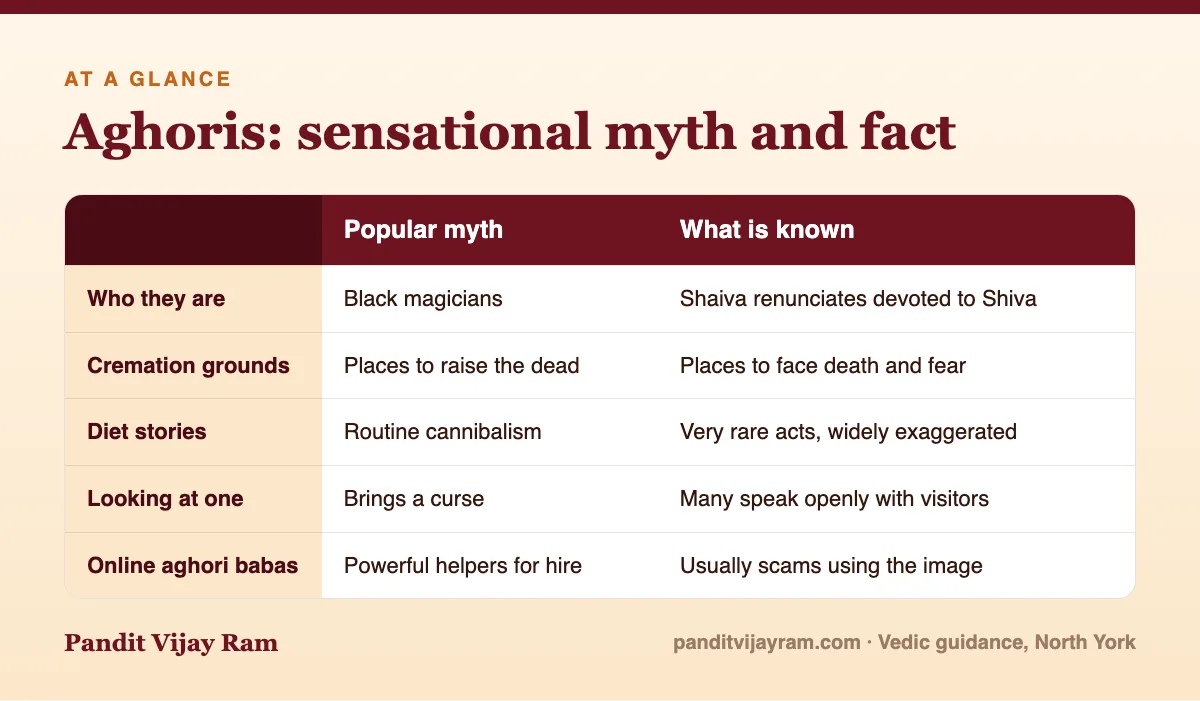
Aghori practice centres on meditation, mantra, ritual worship of Shiva and the Goddess, and deliberate contact with death and impurity to break fear and disgust. Cremation grounds are their temples. Some accounts describe consuming alcohol, meat or worse in ritual, but these acts are rare, symbolic in intent and often exaggerated by outsiders.
The aim is not shock. Aghor teaching holds that the feelings of fear, disgust and shame tie a person to ordinary ego, and that facing what society avoids most, especially death, can loosen those ties. The cremation ground is where every social rank ends in the same ash.
Elements reported by scholars and by Aghor teachers themselves include:
- Sadhana at night in the shmashana, with fire, mantra and meditation.
- Ash and the kapala as constant reminders of impermanence.
- Indifference to caste and purity rules, eating with anyone and accepting what is offered.
- Service to outcasts. Some modern Aghor teachers in Varanasi became known for founding ashrams that care for people with leprosy and others rejected by society.
That last point surprises many readers. A tradition famous for fearlessness before death has also produced teachers devoted to people whom others refused to touch. The same principle, seeing no one as impure, lies behind both.
Reports of cannibalism appear mainly in sensational media. Where scholars mention such acts, they describe them as very rare, involving remains from the cremation ground rather than killing, and not representative of Aghor practice as a whole.
Which Aghori myths are untrue or exaggerated?
Common myths claim that Aghoris kill people, curse anyone who looks at them, sell black magic, or can be hired online for vashikaran and revenge. None of these reflect the tradition. Aghoris are renunciates following a severe spiritual discipline, and genuine ones do not advertise services or make threats.
Here is a sober check on the most repeated claims:
- "Aghoris murder people for rituals." There is no basis for this as Aghor practice; violence is a crime anywhere, whoever commits it.
- "Looking at an Aghori brings a curse." A folk fear, not a teaching. Many Aghoris speak openly with visitors.
- "Aghoris are black magicians." Their path is renunciation and devotion to Shiva, not paid sorcery.
- "All sadhus at cremation grounds are Aghoris." Several ascetic orders visit cremation grounds; Aghoris are one small group.
- "An Aghori baba online can solve love or enemy problems." Adverts like this almost always come from people using the image to sell fear.
Documentaries made for foreign audiences often focus on the most shocking images and skip the philosophy. That leaves viewers with dread rather than understanding. If a rumour about an Aghori has left you uneasy, remember that fear is exactly what this path asks its followers to overcome. The guide to genuine and harmful practice in Hindu exorcism covers related warning signs.
Why is it wrong to use Aghoris to sell fear, and where can you get help?
Using the Aghori image to sell spells, removals or revenge misrepresents renunciates who have given up money and status, and exploits frightened people. Anyone advertising as an aghori for hire should be treated with caution. For spiritual worries, look first at ordinary causes and then seek a practitioner who works openly and refuses harm.
The pattern is familiar. An advert shows ash, skulls and fire, then lists services: get your ex back, destroy enemies, remove black magic in a day. Each step costs more. The client is told that stopping will bring disaster. This has nothing to do with Aghor teaching, which rejects worldly gain.
A short decision rule helps:
- If anyone uses frightening imagery to sell you a solution, pause.
- If they promise to harm or control another person, refuse.
- If fees rise with each new "obstacle", stop paying.
- If you have lost money, report it to the Canadian Anti-Fraud Centre.
Our checklist for choosing a spiritual specialist gives more questions to ask. When people come to me afraid of a curse, I look at health, stress and family conflict first, then offer Vedic prayer, mantra or puja for their own protection. The negative energy guidance page explains that approach, and related reading is gathered in the magic and entities hub.
The bottom line
An Aghori is a Shaiva renunciate whose path aims at freedom from fear and disgust, rooted in older traditions like the Kapalikas and in left-hand tantra. Most popular stories exaggerate rare practices and ignore the philosophy and service that also mark the tradition. Online adverts using the aghori image to sell spells exploit frightened people and should be avoided.
Key takeaways
- Aghoris are Shaiva ascetics devoted to Shiva in his fierce form.
- Historians link them with the medieval Kapalikas and Shaiva tantra.
- Cremation-ground practice aims to overcome fear, not to harm anyone.
- Sensational media exaggerates rare acts and skips Aghor philosophy.
- An aghori baba advertising spells for money is a warning sign.